Best Hiking Boots of 2026 — hiking gear
Hiking Boot Buying Guide

Best Hiking Boots of 2026

Six mid-height hiking boots from $105 to $190. Ranked on fit, support and price using published specs and what Amazon buyers report.

View Top PicksUpdated 2026-08-02 · Ranked from specs & buyer reviews
How to Choose

How to Choose a Hiking Boot

Boots almost never fail people on quality. They fail on shape. Every brand builds around a last, a foot-shaped mold, and those molds differ enough that a boot half the internet loves can rub you raw in three miles. Merrell and Salomon run fairly narrow through the midfoot. KEEN is famously roomy up front. Timberland and Columbia sit somewhere in between, and both sell wide widths. Figure out which of those matches your foot and the shortlist gets a lot shorter.

The second decision is whether you want a waterproof membrane at all. A membrane keeps out wet grass, puddles and light rain, and it also slows down how fast sweat leaves. On a hot dry trail that turns into a swampy sock by mile four, and if water does come over the collar the boot holds it. Mesh boots soak through instantly and then dry in an hour. Wet climates and shoulder season favor waterproof. Desert and high summer favor vented. Most people only need whichever one matches where they actually hike.

The ranking below comes from published specs, the design decisions each brand made, and what Amazon buyers report after living with these boots. I haven't walked every one of these up a mountain and I'm not going to pretend otherwise. Star ratings and review counts are the real figures off each listing on 2 August 2026. Footwear is priced per color and size, so the price shown is what that specific listing cost when I checked. Another colorway of the same boot can be twenty dollars either side. Every link goes to the men's listing; all five brands here sell a women's version of the same model.

Anatomy

What You're Actually Paying For

Boot spec sheets are full of trademarked names for fairly ordinary parts. This is what each one actually does, and which ones change how the boot feels on your foot. The items marked essential are worth checking on any boot you're considering.

Upper Material

Essential

Leather-and-mesh is the standard mix: leather panels where the boot takes abrasion, mesh where it needs to breathe. Full leather lasts longer and takes far longer to break in. All-textile uppers are lightest and wear through fastest.

Waterproof Membrane

Nice to Have

A thin film between lining and upper that blocks liquid water. Genuinely useful in wet country, a liability in dry heat. Optional rather than essential, and probably the biggest comfort decision on this list.

Midsole

Essential

The foam layer that does the cushioning. EVA is light and comfortable and packs out over a few hundred miles. Denser foams last longer and feel firmer. This is what wears out first on most boots, long before the outsole does.

Shank or Plate

Nice to Have

A stiffener under the arch, usually nylon. It stops the boot twisting and folding, which matters on rock and under a load. Day hikers on smooth trail can skip it. Anyone carrying weight over rough ground shouldn't.

Outsole & Lugs

Essential

The rubber and the tread pattern cut into it. Deeper, more spaced-out lugs handle mud; shallower, closer lugs grip dry rock. Around 4 to 5mm is the general-purpose depth most hiking boots land on.

Toe Cap

Essential

A rubber bumper over the front of the boot. It's there for the rock you didn't see, and it's also the part of the upper that wears through first on scree. Cheap boots often skip it or make it decorative.

Gusseted Tongue

Essential

The tongue is stitched to the boot along both sides so grit and water can't get in past it. Also called a bellows tongue. Easy to check by hand and a genuine difference on dusty trail.

Footbed

Essential

The removable insole. Stock footbeds are usually thin and generic. Pulling it out and replacing it is the cheapest way to change how a boot fits, and it's also how you make room for an orthotic.

Lacing Hardware

Essential

Eyelets low down, open hooks up top. The hooks let you lace the lower and upper sections at different tensions, which is what makes a heel lock possible. Rustproof hardware is worth having if you hike wet.

Hiking Socks

Essential

Not part of the boot, but part of the fit. Merino or synthetic, never cotton, and buy them before you size the boot because a thick sock can eat half a size of length.

Aftermarket Insoles

Nice to Have

Twenty to fifty dollars, and often the difference between a boot that nearly fits and one that does. Useful for taking up volume in a boot that's slightly too roomy over the instep.

Gaiters

Nice to Have

Fabric cuffs that bridge the gap between boot and pants. Low ones keep grit and seeds out on dusty trail; tall ones keep snow and mud out. Cheap and light, and worth having on an overgrown route.

Footwear Types

Which Type of Hiking Footwear Fits Your Trails

Hiking footwear splits into three broad categories, and the right one depends far more on your terrain and your pack weight than on how experienced you are.

Low-Cut Trail Shoe

$90 to $160Fast & dry

Sits below the ankle, weighs the least and needs no breaking in. Excellent on maintained trail with a day pack. Gives you the least protection once the ground turns loose and uneven or your pack gets heavy.

Mid Waterproof Hiker

$100 to $190Most day hikes

The category almost everyone should be shopping in, and where every pick in this guide sits. Collar above the ankle, moderate stiffness, usually a membrane. Handles day hikes, light overnights and mixed weather without being heavy enough to notice.

Backpacking Boot

$200 to $350Heavy loads

Stiffer midsole, a full shank, a taller and more supportive collar, often full leather. Built for multi-day loads and rough ground. Heavier, hotter, and it needs real break-in time. Overkill for an afternoon on a groomed trail.

Quick Picks

Top Three at a Glance

Short on time? Start with these top-rated hiking boots picks.

Best Overall
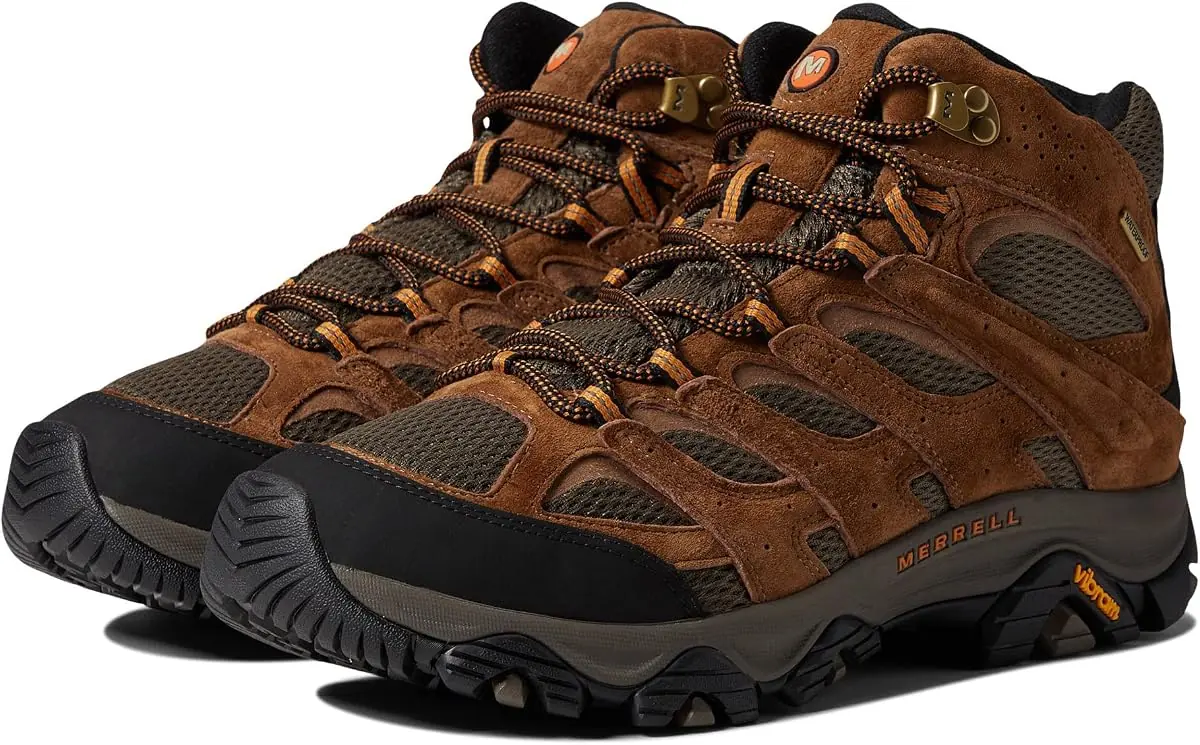
Merrell Men's Moab 3 Mid Waterproof Hiking Boots
4.5

Merrell Men's Moab 3 Mid Waterproof Hiking Boots

The safe answer, and the reason is unglamorous. It's comfortable straight out of the box, the parts are all a step above what the price suggests, and 5,134 Amazon buyers have settled on 4.5 stars. Buy this one if you want to stop researching and go hiking.

Check Price
Most Reviewed
Timberland Men's White Ledge Mid Waterproof Hiking Boots
4.5

Timberland Men's White Ledge Mid Waterproof Hiking Boots

67,815 ratings at 4.5 stars is an evidence base nothing else here comes close to, and it's a full waterproof leather boot for under $130. It's heavier and warmer than the technical picks, and for casual hiking and general outdoor wear that trade is usually worth it.

Check Price
Best Budget
Columbia Men's Newton Ridge Plus II Waterproof
4.4

Columbia Men's Newton Ridge Plus II Waterproof

The cheapest listing in this guide and still a proper boot: waterproof leather-and-mesh bootie construction, a real traction outsole, 4,893 ratings at 4.4 stars. If you hike a handful of times a year, spending more than this buys you refinement rather than capability.

Check Price
Comparison Table

Every Pick, Side by Side

Best Overall
Best For
A first proper hiking boot
Difficulty
Beginner
Price
$$$
Most Reviewed
Best For
Getting the most boot per dollar
Difficulty
Beginner
Price
$$$
Best Budget
Best For
Spending the least without buying junk
Difficulty
Beginner
Price
$$$
Best for Wide Feet
Best For
Wide feet and roomy toes
Difficulty
Beginner
Price
$$$
Best for Hot & Dry
Best For
Hot, dry trails
Difficulty
Beginner
Price
$$$
Best Lightweight
Best For
Moving fast over rough ground
Difficulty
Intermediate
Price
$$$
The Lineup

6 Best Hiking Boots, Compared

Detailed picks with verdicts, strengths, tradeoffs, and the situations where each one makes the most sense.

Best Overall
Merrell Men's Moab 3 Mid Waterproof Hiking Boots
4.5 (5,134 Amazon ratings)

Merrell Men's Moab 3 Mid Waterproof Hiking Boots

Quick verdict: The safe answer, and the reason is unglamorous. It's comfortable straight out of the box, the parts are all a step above what the price suggests, and 5,134 Amazon buyers have settled on 4.5 stars. Buy this one if you want to stop researching and go hiking.

Why It Stands Out

  • Pigskin leather and mesh upper with a waterproof membrane, so it handles wet trail without feeling like a work boot
  • Vibram TC5+ outsole, a genuinely good rubber at a mid-range price
  • Molded nylon arch shank and an EVA midsole, enough support for a loaded day pack
  • Kinetic Fit ADVANCED removable insole, so swapping in your own is straightforward

Pros

  • Needs essentially no breaking in, which is rare in a leather boot
  • Bellows tongue and a protective toe cap keep grit and rock out
  • The deepest pool of buyer feedback here apart from the Timberland

Cons

  • Runs narrow through the midfoot; wide feet should look at the KEEN instead
  • The membrane makes it warm in summer, which is what the vented version below is for

Best Situations

Day hikesWet trailsLight overnightsFirst-time buyers
Difficulty
Beginner
Price Range
$$$
Most Reviewed
Timberland Men's White Ledge Mid Waterproof Hiking Boots
4.5 (67,815 Amazon ratings)

Timberland Men's White Ledge Mid Waterproof Hiking Boots

Quick verdict: 67,815 ratings at 4.5 stars is an evidence base nothing else here comes close to, and it's a full waterproof leather boot for under $130. It's heavier and warmer than the technical picks, and for casual hiking and general outdoor wear that trade is usually worth it.

Why It Stands Out

  • Waterproof full-grain leather upper rather than the leather-and-mesh mix everything else uses
  • By far the largest review base in this guide at 67,815 Amazon ratings
  • Fully gusseted tongue and rustproof speed-lace hardware with hooks at the top
  • EVA footbed and midsole, and it's regularly listed in wide widths

Pros

  • Hard to beat on price for an all-leather waterproof boot
  • Rustproof hardware holds up to being wet repeatedly
  • Works as a general outdoor and yard boot as much as a hiking one

Cons

  • Heavier and warmer than the leather-and-mesh boots here
  • Full leather takes longer to break in than the Merrell or the Columbia

Best Situations

Casual hikingWet groundEveryday outdoor workTight budgets
Difficulty
Beginner
Price Range
$$$
Best Budget
Columbia Men's Newton Ridge Plus II Waterproof
4.4 (4,893 Amazon ratings)

Columbia Men's Newton Ridge Plus II Waterproof

Quick verdict: The cheapest listing in this guide and still a proper boot: waterproof leather-and-mesh bootie construction, a real traction outsole, 4,893 ratings at 4.4 stars. If you hike a handful of times a year, spending more than this buys you refinement rather than capability.

Why It Stands Out

  • Waterproof full-grain leather and mesh bootie construction, sealed rather than just treated
  • Omni-Grip traction rubber outsole with a tread pattern built for mixed ground
  • Lightweight midsole that keeps the whole boot noticeably lighter than the Timberland
  • The lowest price on this page, and cheaper again in some colorways

Pros

  • The best capability-per-dollar on the list
  • Lighter on the foot than the all-leather options
  • Widely stocked in wide widths

Cons

  • Midsole foam and outsole rubber won't last as long as the pricier picks
  • Less underfoot support than the Merrell or Salomon once the pack gets heavy

Best Situations

Occasional hikingDay trailsWet weatherValue buyers
Difficulty
Beginner
Price Range
$$$
Best for Wide Feet
KEEN Men's Targhee 4 Mid Height Waterproof Hiking Boots
4.4 (937 Amazon ratings)

KEEN Men's Targhee 4 Mid Height Waterproof Hiking Boots

Quick verdict: If other boots pinch across the forefoot, start here. KEEN's Original Fit gives noticeably more room for toes to spread than anything else in this guide, and the Targhee has been the brand's hiking mainstay for years. The catch is price and a review base still building at 937 ratings.

Why It Stands Out

  • KEEN Original Fit deliberately leaves generous room for toes to splay on descents
  • KEEN.DRY waterproof breathable membrane rather than a coating
  • KEEN.ALL-TERRAIN rubber outsole aimed at mud and wet rock specifically
  • Bruise plate underfoot and a high-abrasion rubber toe guard for rough ground

Pros

  • The most forgiving fit here for wide or high-volume feet
  • Direct-attach construction resists the sole separating over time
  • Removable Luftcell footbed with real arch support out of the box

Cons

  • Second most expensive listing in this guide
  • Bulkier and blunter through the toe than the Merrell or Salomon, so narrow feet will swim in it

Best Situations

Wide feetMuddy trailsRocky groundLong descents
Difficulty
Beginner
Price Range
$$$
Best for Hot & Dry
Merrell Men's Moab 3 Mid Hiking Boot
4.6 (3,181 Amazon ratings)

Merrell Men's Moab 3 Mid Hiking Boot

Quick verdict: The same boot as the top pick with the waterproof membrane taken out, cheaper, and better in heat. Buyers rate it a notch higher at 4.6 stars, which tracks with how much cooler a membrane-free boot runs. Buy it for a desert summer and buy something else for wet country.

Why It Stands Out

  • Identical platform to the waterproof Moab 3: same Vibram TC5+ outsole, shank and insole
  • No membrane, so it breathes far better and dries in about an hour when it does get wet
  • Cheaper than the waterproof version of the same boot
  • 4.6 stars from 3,181 Amazon ratings, tied for the highest score in this guide

Pros

  • Much cooler than any membrane boot on a hot climb
  • Dries quickly after a stream crossing instead of staying soaked
  • Same proven outsole and support as the top pick for less money

Cons

  • Soaks straight through in wet grass, rain or mud
  • Fine dust gets through the mesh more easily than through a membrane boot

Best Situations

Hot weatherDry climatesSummer hikingFast drying
Difficulty
Beginner
Price Range
$$$
Best Lightweight
Salomon X Ultra 5 Mid GTX
4.6 (44 Amazon ratings)

Salomon X Ultra 5 Mid GTX

Quick verdict: The most technical boot here and the priciest. A molded chassis in the outsole gives it lateral stability without the weight of a stiff shank, which is what makes it feel quick on broken ground. Independent 2026 roundups rate the X Ultra 5 highly, but on Amazon it's still only 44 ratings, so treat that score as early.

Why It Stands Out

  • Advanced Chassis, a molded insert embedded in the outsole, adds lateral support without extra bulk
  • Gore-Tex membrane, generally the better-breathing option among waterproof laminates
  • All Terrain Contagrip outsole aimed at mixed rock, dirt and wet surfaces
  • Largely textile upper, so it's lighter on the foot than the leather boots here

Pros

  • Feels the quickest and most agile of the six on technical ground
  • Strong lateral stability for a boot this light
  • Textile upper keeps it lighter underfoot than the leather boots here

Cons

  • Only 44 Amazon ratings, the thinnest evidence base on this page
  • The most expensive listing here, and a narrow fit that wide feet should avoid

Best Situations

Fast hikingTechnical terrainScramblingNarrow feet
Difficulty
Intermediate
Price Range
$$$
Buying Guide

What to Check Before You Buy

Fit beats brand every time

Three measurements matter and only one is the number on the box. Length wants about a thumb's width of space ahead of your longest toe, because your foot slides forward on every descent and a bruised toenail is what happens when it doesn't have room. Width is the one people ignore and then blame the boot for. Volume, the space over the top of your foot, is what decides whether the laces can hold your heel down. Try boots on at the end of the day when your feet have swollen, wearing the socks you actually hike in.

Waterproof membrane or breathable mesh

A membrane is a thin layer between the lining and the upper that blocks liquid water while letting some vapor through. It works well in cool wet conditions and it always breathes worse than plain mesh. It also does nothing about water that comes in over the top of the collar, and once it's in there the boot stays wet for a day or more. Vented boots soak through immediately and dry out on your feet. Match the boot to your climate rather than buying waterproof out of habit.

Support scales with what you're carrying

A soft flexible boot feels great on a groomed trail with a light pack and stops feeling great once you're carrying thirty pounds over loose rock. What stiffens a boot is the shank or plate under the arch and how dense the midsole foam is. Day hiking on maintained trail wants a boot you can flex by hand. Rough ground and a loaded pack want something that resists twisting, because that stiffness is what stops your ankle rolling when a rock moves.

Outsole rubber and lug depth

Deep, widely spaced lugs bite into mud and shed it instead of packing solid. Shallower, closer lugs give you more rubber touching dry rock, which is what you want on slabs and scree. Around 4 to 5mm is the useful middle for general hiking. Softer rubber grips wet rock better and wears out faster. Harder rubber lasts longer and gets slippery when it's damp. No compound wins everywhere, so pick for the surface you're on most weekends.

Dry Day Trails
Vented Mid

Warm, dusty, well-marked trail with a light pack. Skip the membrane and take the breathability. A stream crossing means wet feet for an hour, and that's a fair trade here.

Wet & Muddy
Waterproof

Spring runoff, rain, morning dew on overgrown trail. A membrane earns its keep here, and deeper lugs stop the mud packing into the tread.

Heavy Loads
Stiff Midsole

Overnight packs, talus and long descents. Look for a boot that resists twisting in your hands and has a real shank under the arch rather than just thicker foam.

Getting Started

Fitting and Breaking In a New Pair

Most boot problems are fit problems that were fixable at the trying-on stage. Work through these in order, at home, while the return window is still open.

  1. 1

    Try them on at the end of the day

    Feet swell over the course of a day and swell again over hours of walking. A boot fitted first thing in the morning is a boot that gets tight by mile six. Late afternoon or evening is closer to how your foot will be on trail.

  2. 2

    Wear the socks you'll actually hike in

    A thick merino sock can take up half a size of length and a good deal of volume. Fitting boots in thin cotton socks and then hiking in thick wool ones is one of the most common ways people end up with boots that are too small.

  3. 3

    Check length with the heel test

    Unlaced, slide your foot forward until your toes touch the front of the boot. You should be able to slip one finger down behind your heel. Less than that and your toes will hit the front on every descent.

  4. 4

    Lace with a heel lock

    Tighten the lower eyelets for a snug midfoot, then put an extra twist into the lace where it crosses the ankle flex point, a surgeon's knot, before running it up through the top hooks. That splits the tension into two zones and stops your heel lifting.

  5. 5

    Walk stairs and a slope at home

    Flat carpet tells you almost nothing. Walk down stairs to see whether your toes hit the front, and walk up to see whether your heel lifts. Do it for twenty minutes. Anything that rubs now will be a blister at mile eight.

  6. 6

    Build up on short walks first

    Wear them around the house and on a few local walks before the first real hike. Modern leather-and-mesh boots need very little of this, but it lets the footbed take your shape, and it's how you find out in time to send them back.

Plain English

Boot Terms, Translated

Last
The foot-shaped mold a boot is built around. It's why two boots in the same size fit completely differently, and it's the main reason the boot your friend swears by might do nothing for you.
Toe box
The space at the front of the boot. A roomy one lets your toes spread out on descents, which is what stops bruised toenails. KEEN has built much of its reputation on making theirs wide.
Shank
A stiffening insert under the arch, usually molded nylon. It resists twisting and stops the boot folding under load. More shank means more support and less trail feel.
Rand / toe cap
The rubber bumper wrapped over the toe and sometimes around the whole lower edge of the boot. It takes the hits from rock and stops the upper abrading through.
EVA midsole
The most common cushioning foam. Light and comfortable when new, and it gradually compresses over a few hundred miles. When a boot starts feeling flat and harsh, that's the EVA, not the outsole.
Waterproof membrane
A thin film laminated inside the upper that blocks liquid water but lets some vapor out. Gore-Tex is one brand of it; most manufacturers also make their own in-house version.
Surgeon's knot
An extra twist in the lace at the ankle flex point. It holds tension in the lower half of the boot so you can lace the top loosely, which is the standard fix for a lifting heel.
Bellows tongue
A tongue sewn to the boot along both edges so grit and water can't get in around it. Also called a gusseted tongue. Standard on proper hiking boots, missing on cheap ones.
Avoid These

Mistakes Worth Skipping

  • Buying your street shoe size. Hiking feet swell and slide forward on descents, and most people need about half a size more length than they expect.
  • Fitting boots in thin socks and then hiking in thick ones, which costs you the exact space you just checked for.
  • Buying waterproof out of habit. In hot dry country a membrane makes your feet sweatier without keeping anything useful out.
  • Treating pain as break-in. A hot spot on day one is a fit problem, and thirty more miles won't move the boot's shape.
  • Ignoring width because the length felt right. A boot that's too narrow will hurt across the forefoot no matter how well the rest of it fits.
  • Lacing the whole boot at one tension. Without a heel lock at the ankle, a well-fitting boot can still let your heel lift and blister.
  • Saving a brand-new pair for a big trip. A long day out is a bad time to find out where they rub.
Explore Individual Gear

Once you know which setup fits your situation, dig into the full guide library for in-depth picks and buying advice:

Full Catalog

Compare All 6 Hiking Boots

Want to browse beyond the ranked picks? Filter and sort the full hiking boots listing below.

Best Hiking Boots of 2026 — All Products

6 Products
FAQ

Frequently Asked Questions

Most people end up half a size larger than their street shoe, but treat that as a starting point rather than a rule. What you're checking for is roughly a thumb's width of space in front of your longest toe with the boot laced and your hiking socks on. Slide your foot forward until your toes touch the front, and you should be able to fit a finger behind your heel. Try boots on late in the day, because feet swell over a day of walking and a boot fitted first thing in the morning gets tight by the afternoon.

How We Choose Products

How These Picks Are Chosen

Reader-supported and free of paid placements. Every pick is ranked on published specs and Amazon buyer ratings, not on who pays us.

Spec Research

Each pick is compared on published specs, materials, design, and category fit across the major brands.

Practical Fit

Rankings factor in how well each product matches common hiking, backpacking, and trail running needs, not just popularity.

Amazon Buyer Ratings

Star ratings and review volume from verified Amazon buyers are factored in to reflect real-world satisfaction.

Value

A pick earns its spot by delivering useful performance for the money, whether budget or premium.

BOOTS SORTED.
WHAT'S NEXT?

Budget trekking poles are up now, and socks and water filters are queued up next. New guides go live as I finish them.

Browse All Guides
See Top Picks