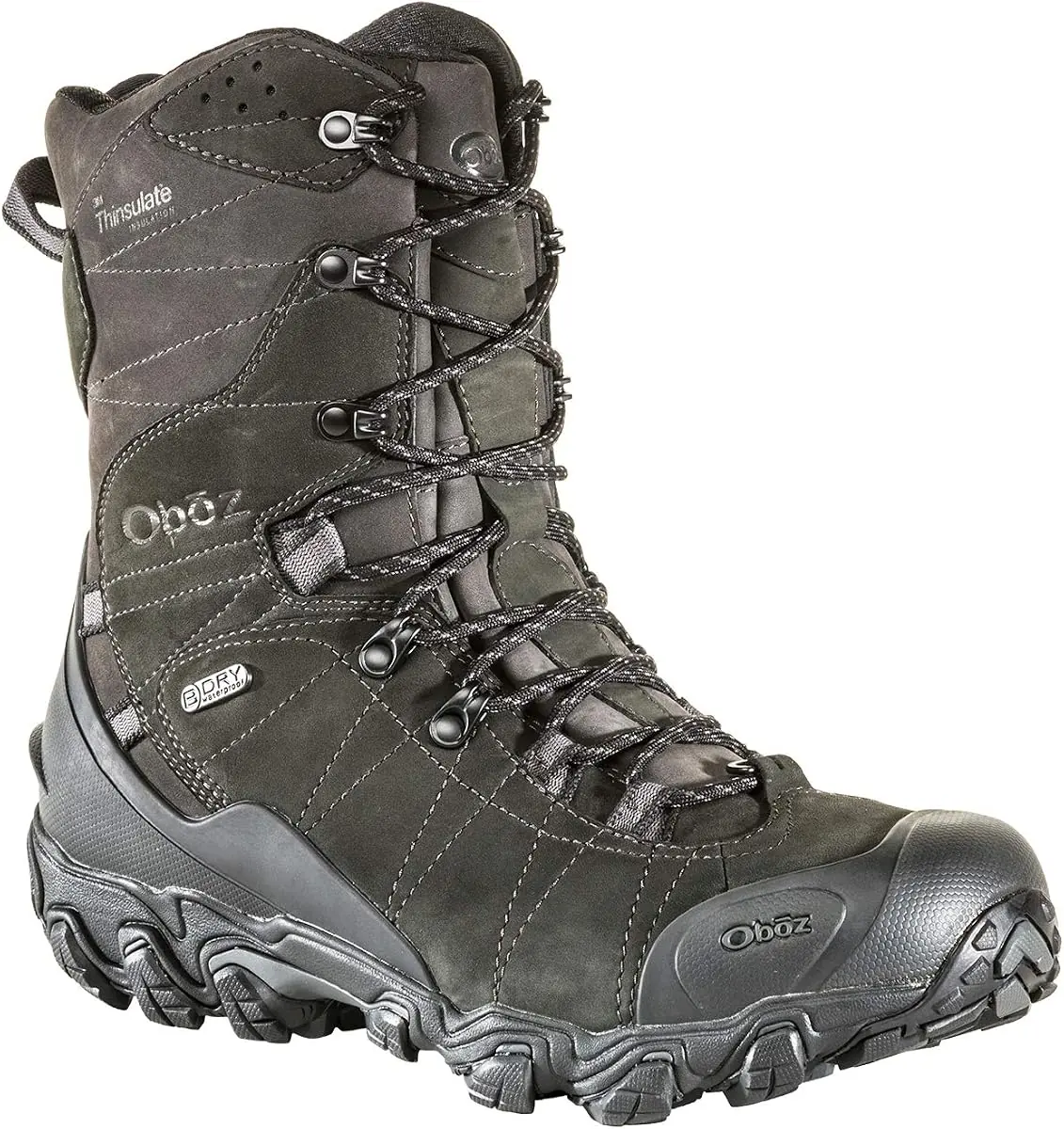
The mistake almost everybody makes buying their first winter boot is buying the warmest one. It looks like the safe call, and in a parking lot it is. Two miles up a climb it's the opposite. Your feet are sweating into an insulated boot that has nowhere to put the moisture, and wet feet in a cold boot get cold much faster than dry feet in a thinner one ever would. The warmest boot on this page is the wrong boot if you plan to work hard in it.
So this page ranks on a narrower question than warmth: how warm a boot is for the pace you hike at. Insulation matched to effort comes first, then waterproofing and how far up the leg the boot comes, then the rubber, because a sole that goes hard below freezing is a grip problem no lug pattern fixes. Fit over a thick sock breaks the ties.
The shorthand on insulation is that 200g suits a moving hiker in most conditions, and 400g suits somebody slower, colder, or out for longer in real cold.
A few notes before the list. My dad and I haven't worn any of these boots, not one pair, not for a day, and I'm not going to dress that up. The ranking comes from published specs, the makers' own material data, the testing other reviewers have put in print, and Amazon buyer reviews, all read on August 28, 2026.
Review count sets none of that order, and here it would invert the page: the boot with the deepest pile of ratings finishes eighth, and there's an FAQ at the bottom on why. LOWA's Renegade Evo Ice GTX belongs in this conversation on merit and costs around $250 direct, but it isn't here, because every Amazon listing for it resolves to a size-specific reseller entry well above that and there's nowhere sensible to send you.
Buy that one from a proper retailer if it appeals. And all eight links below go to men's listings.
Quick Picks
Top Three at a Glance
Short on time? Start with these top-rated winter hiking boots picks.
The most complete winter boot here. Tall shaft, 400g of Thinsulate, a waterproof membrane and an aggressive sole, and it's still shaped like something you walk distances in.
The best outsole here, on a boot light enough to hike in. Arctic Grip is Vibram's wet-ice rubber, and 200g of PrimaLoft keeps the boot usable while you're moving.
The cheapest way onto a cold-rated boot. KEEN quotes -25F, wraps it in a calf-high shaft with its own cold-weather rubber underneath, and it's sitting well below list price right now.
Quick verdict: The most complete winter boot here. Tall shaft, 400g of Thinsulate, a waterproof membrane and an aggressive sole, and it's still shaped like something you walk distances in.
Why It Stands Out
400g of Thinsulate, which is the right amount if you're slow, cold, or out all day, and too much if you're pushing a fast climb.
A tall shaft, so snow stays out over the collar in conditions where the mid-height boots here need a gaiter.
Oboz's B-DRY membrane, plus a rubber rand around the toe, which is the part that takes the beating in frozen ground.
Tied for the highest average rating here, on a review pool deep enough that the score isn't luck.
Oboz cuts a roomier boot than most, and that counts double in winter, because cold feet swell and a tight boot is a cold boot.
Pros
The most capable boot here in real winter conditions
Tall shaft, so no gaiter needed in moderate snow
Roomy enough for a thick sock without crushing the insulation
Tied for the highest average rating on this page
Cons
Too warm for hard uphill work in milder conditions
Heavy, and you feel it on every step of a long day
The tall shaft stiffens the ankle more than some hikers like
Best Situations
Winter day hikes in real coldSnowshoeing and slower-paced winter travelAnyone whose feet run cold, or who stops often
Quick verdict: The best outsole here, on a boot light enough to hike in. Arctic Grip is Vibram's wet-ice rubber, and 200g of PrimaLoft keeps the boot usable while you're moving.
Why It Stands Out
A Vibram Arctic Grip outsole, formulated for wet ice instead of just being deep-lugged. It's the clearest technical edge on this page.
200g of PrimaLoft, the right side of the insulation trade if you're working rather than standing.
A side zip, so you get in and out without unlacing. Sounds trivial until you're doing it with cold hands.
Danner's own waterproof construction, and a build quality that shows in a 4.6 average.
Pros
Vibram Arctic Grip is the most ice-capable sole here
Light enough for real mileage
The side zip earns its keep in the cold
Handsome enough to wear off the trail
Cons
The most expensive boot on this page
200g isn't enough for standing around in deep cold
A mid-height shaft, so deep snow needs a gaiter
The second-thinnest review pool here
Best Situations
Icy, freeze-thaw trails in the shoulder of winterHikers who want one boot for the trail and the townAnyone who values grip over outright warmth
Quick verdict: The cheapest way onto a cold-rated boot. KEEN quotes -25F, wraps it in a calf-high shaft with its own cold-weather rubber underneath, and it's sitting well below list price right now.
Why It Stands Out
Rated by KEEN to -25F, which is the only published sub-zero temperature claim on this page.
KEEN.FREEZE rubber with a published 5mm lug depth, mixed to stay pliable in the cold instead of being a general-purpose hiking compound.
A calf-high shaft and a KEEN.DRY waterproof breathable membrane, so snow stays out and sweat has somewhere to go.
An external stability shank, which is what keeps the sole from flexing out of a snowshoe binding over a long day.
The second-deepest review pool on this page, so the 4.4 average has been well tested.
Pros
Only boot here with a published sub-zero rating
Currently well under its list price
Tall shaft plus a cold-specific outsole compound
Large, well-established review pool
Cons
KEEN publishes no gram figure, so it's hard to compare head to head
KEEN's roomy toe box doesn't suit every foot
Heavier and warmer than an active hiker needs in mild conditions
Best Situations
Cold-weather day hiking on a budgetStanding around in the cold as much as walkingFirst proper winter boot for somebody stepping up from three-season
Quick verdict: The hiking specialist of the group. 200g in a mid-height boot built to move, which is the spec most people should buy and the one most people talk themselves out of.
Why It Stands Out
200g of insulation in a mid-height boot, which is the combination that keeps working when you're climbing with a pack on.
Oboz's B-DRY membrane, with the same insole and support platform the brand's three-season boots are known for.
Lighter and more precise underfoot than the tall boots here, so long days cost you less.
Discounted from its list price at the time of writing, which puts it in the same bracket as boots that do less.
Pros
The right insulation for an active hiker
Noticeably more agile than the tall boots here
Supportive platform for long distances
Currently below its list price
Cons
The thinnest review pool on this page
Mid-height, so deep snow needs a gaiter
Not enough insulation for standing around in deep cold
Best Situations
Long winter day hikes with a packMixed trails where you're moving most of the dayHikers who found their last winter boot too hot
Quick verdict: The most approachable boot here that still has real winter hardware under it. 200g of insulation, a waterproof build, and Vibram Arctic Grip on the sole for the frozen sections.
Why It Stands Out
A Vibram Arctic Grip outsole, the same wet-ice compound as the Danner, at a lower price.
200g of insulation, which keeps it usable on a climb instead of only when you're standing still.
A waterproof membrane and a rubber toe rand, on the last Merrell has a reputation for being wearable straight from the box.
A 4.6 average across 233 ratings, which is a solid case for consistency.
Pros
Ice-specific outsole compound at a mid-range price
Reputation for needing little break-in
Good balance of warmth and walkability
Enough reviews behind the score to trust it
Cons
Mid-height, so it needs a gaiter in deep snow
Less supportive than the Oboz boots under a heavy pack
200g is not a deep-cold specification
Best Situations
Winter day hiking on popular, partly icy trailsAnyone who wants comfort straight out of the boxShoulder-season conditions that swing above and below freezing
Quick verdict: A light, hiking-cut boot for milder winters. 200g and a waterproof membrane in a mid-height build, for people whose winter is more frozen mud than deep powder.
Why It Stands Out
200g of insulation in a light mid-height boot, which suits milder winters and shorter days.
Vasque's UltraDry waterproof membrane, which keeps out slush and wet snow.
The second-cheapest boot here, and still cut and built as a hiking boot instead of a snow boot.
Light enough that it doesn't punish you on a long, flat day.
Pros
Hiking-boot shape, not a snow-boot shape
Comfortable for distance in mild winter conditions
Priced below most of the field
Cons
The lowest average rating on this page
A thin review pool
Not enough boot for deep cold or steep, icy ground
Conventional outsole rubber, with no cold-specific compound
Best Situations
Milder winters and freeze-thaw conditionsShorter day hikes on packed trailsHikers who want winter protection without the weight
Quick verdict: The cheapest boot here and the most popular, and it's honest about what it is: a comfortable, warm, waterproof boot for flat, packed ground, and not a boot for a mountain.
Why It Stands Out
200g of insulation under a Cordura upper, which is plenty for a walk on packed snow in ordinary winter cold.
932 ratings, the deepest pool on this page, at an average tied for the best here. Together that says it's reliably the boot it claims to be.
A waterproof build and a fleece-lined collar, which make it a nicer place for your foot than most boots at this price.
The cheapest boot on this page, which makes it the easy answer when the alternative is not owning a winter boot at all.
Pros
The cheapest boot here
Deepest review pool and tied for the best rating
Warm and comfortable straight away
Light for an insulated boot
Cons
The least capable boot here on steep or uneven ground
Little support under a loaded pack
Conventional outsole rubber, so no cold-specific grip advantage
Mid-height, so deep snow gets in
Best Situations
Packed winter trails close to townDog walks, errands and snow clearingA first winter boot on a tight budget
How much insulation do winter hiking boots actually need?
Match the insulation to your pace, not to the forecast. For most people walking uphill with a pack, 200g is the right answer down to around 0F, and 400g only starts to make sense once you're moving slowly, standing around a lot, or out in deep cold. That number is the weight per square meter of the insulating sheet the boot is built from, not the weight of insulation inside the boot, so a 400g boot carries a heavier sheet and not twice the warmth.
Warmth doesn't scale with it either. 400g is warmer than 200g, but nowhere near double, while the weight and bulk penalty lands immediately and you feel it on every step for the whole day. The reason overbuying hurts is sweat. A hiking foot puts out a surprising amount of moisture, and a waterproof boot is bad at letting it out by design. Overheat inside 400g on a climb and the insulation dampens, loses most of its loft, and then works against you the moment you stop at a windy summit.
That's the classic way people end up with cold feet in the warmest boots they own. Under-insulate a little and a thicker sock or a faster pace fixes it. Over-insulate and there's nothing you can do about it out on the trail. One more wrinkle: makers describe warmth two different ways and both show up here. Most publish grams, which lets you compare like for like.
KEEN publishes a temperature rating instead, quoting -25F for the Revel IV High Polar, which is a claim about the whole boot and doesn't convert into a gram figure. Neither number accounts for you, and foot circulation varies enormously between people, so treat both as a starting point and not a promise.
Does a winter hiking boot need a waterproof membrane, and how tall should it be?
Yes to the membrane, and taller than you think. Snow is water waiting to happen. It melts against a warm boot all day, so a winter boot without a waterproof-breathable membrane wets through from the outside in even when it never rains. Every boot on this page has one, and the trade names are all doing the same job with different plumbing behind them, whether that's Gore-Tex, Oboz's B-DRY, KEEN.DRY, Columbia's Omni-Tech or Vasque's UltraDry.
What separates them in practice is less the membrane than the seams and the rand, and a rubber rand wrapped around the toe is the part that holds up when you kick steps into crusted snow. Height is the half people skip. A mid-height boot that's perfect in three seasons lets snow straight in over the collar the moment you step into anything above ankle depth, and once snow is inside the boot the membrane is beside the point.
Past about six inches of soft snow you want a taller shaft, a gaiter, or both. Gaiters are the cheaper and more flexible answer: they seal the gap between cuff and pant, they come off when the snow runs out, and they work with boots you already own. A tall boot does the same job with nothing extra to carry, and it stiffens the ankle, which some people like on sidehill traverses and others find restrictive.
Three of the boots here have tall shafts and the other five are mid-height. One thing a membrane can't do is dry out. Once a boot is wet inside, from sweat or from snow over the top, it'll still be wet in the morning unless you pull the liner and footbed out overnight. Plan for that on any trip longer than a day.
What makes a winter outsole different from a normal hiking outsole?
The rubber compound, more than the tread pattern. Ordinary hiking rubber is mixed to grip in the temperature range people mostly hike in, and it stiffens as it gets colder. A hard sole can't deform into the surface it's standing on, so it skates on exactly the cold, polished ground you bought it for. Winter-specific compounds stay pliable well below freezing, which is why the same lug pattern in a winter rubber grips where a three-season version of it doesn't.
It's worth knowing which boots here are doing something about that and which are just deep-lugged. Danner and Merrell both run Vibram's Arctic Grip, which is mixed for wet ice, and KEEN uses its own KEEN.FREEZE rubber for the same reason and publishes a 5mm lug depth alongside it. The other five run conventional winter-oriented rubber with aggressive lugs.
Beyond the compound, look for deep, widely spaced lugs that shed packed snow instead of balling up with it, and for siping, the fine slits cut across the lug faces that add a lot of biting edges on hard snow. Then the honest limit. None of this grips smooth ice. Rubber on hard ice is a losing proposition for every boot ever made, Arctic Grip included, and Arctic Grip helps most on wet ice, which is not the same problem as a frozen waterfall.
If you're choosing between a better outsole and a set of microspikes, buy the microspikes. Last thing: if you expect to use snowshoes or step-in crampons, check the sole stiffness. A shank is what stops a boot flexing out of a binding, and a soft boot in a snowshoe binding works loose.
How should winter hiking boots fit over a thick sock?
With enough room that your toes are never pressed against anything, because in winter a snug fit is a cold fit. This is the one place winter sizing really differs from three-season sizing, and getting it wrong is the most common reason an expensive boot leaves somebody cold. Warmth comes from still air held around the foot, and from blood reaching your toes. A boot laced tight over a thick sock does two bad things at once.
It squashes the loft out of the insulation, and it restricts circulation to the part of your foot furthest from your heart. Both effects push the same way, so the tighter boot ends up colder than the roomier one with the same insulation in it.
In practice that means going up about half a size from your three-season boot, and trying boots on with the sock you'll actually hike in. Width deserves the same attention, because cold feet swell and a boot that's fine at the trailhead can be tight by mid-afternoon. Oboz has a reputation for accommodating wider feet, which is part of why the Bridger opens this page.
Two sock notes to finish. One good thick wool sock beats two thin ones, since the second layer mostly just takes up the room the insulation needed. And a damp sock is a cold sock, so carry a dry spare on any full day out.
If you hike hard in the cold
200g insulation
Stay at 200g and spend the money on the sole and the fit instead. The Oboz Bangtail and the Merrell Coldpack 3 are both built to walk in, and both hold enough insulation for a moving hiker well below freezing without cooking your feet on the climb. Most people reading this page should be shopping here.
If you stop a lot, or your feet run cold
400g insulation
Go up to 400g, or to a boot with a published sub-zero rating, and take the weight hit. The Oboz Bridger is the most capable version of that here, with a tall shaft and a deep-cold build. The KEEN Revel IV High Polar is the cheaper way to the same job, rated by KEEN to -25F and currently well under its list price. Either one is more boot than a fast hiker needs.
If it is mostly packed trails near town
$90-$140
You don't need an alpine boot for a groomed river path in January. The Columbia Firecamp is the cheapest boot here, carries the deepest review pool on the page, and does exactly this job. Step up to the Vasque Coldspark if your walks get longer or rougher. Neither one belongs on a steep, icy, off-trail day.
Full Catalog
Compare All 8 Winter Hiking Boots
Want to browse beyond the ranked picks? Filter and sort the full winter hiking boots listing below.
A winter hiking boot is a hiking boot with insulation added. A snow boot is a warm, waterproof boot that isn't really designed to walk far in. The differences are structural. A hiking boot has a supportive midsole and some torsional stiffness, so it stays stable when the ground underneath is uneven and frozen into ruts, and it has a lacing system that locks your heel down, which is what stops blisters over distance.
Its cuff is usually lower and more flexible so your ankle can roll through a stride. A snow boot, or a pac boot, tends toward a soft or removable liner, a much warmer build, a simpler closure, and a sole that's fine on a driveway and vague on a sidehill. The categories overlap, and a couple of the boots here sit right in the middle.
The North Face Chilkat V is sold as a snow boot, and it does that job well, but it's heavier and less precise to hike a long day in than the Oboz or the Merrell. The Columbia Firecamp is at the other end, light and comfortable and not much boot for steep ground. The practical test is what you plan to do. If the answer involves distance, elevation, or ground that isn't flat, buy the hiking boot.
If it involves shoveling a driveway, walking a dog and a flat mile on packed snow, a snow boot is warmer for the money and you'll be happier in it.
For most people hiking, 200g. Both numbers grade the insulation itself and not the finished boot, so 400g is warmer than 200g without being anywhere near twice as warm, and the penalty arrives immediately: more bulk, more weight on your feet all day, and much less ability to shed the moisture your foot produces on a climb. Insulation should match your pace.
If you're moving steadily uphill with a pack, your own body is doing most of the heating, and 200g down to around 0F is comfortable for a lot of people. If you're slow, stopping often, standing at a viewpoint, hunting, taking photographs, or you just have poor circulation in your feet, 400g earns its weight. Winter camping is squarely 400g territory, because so much of the day is spent not moving.
There's a middle path that's easy to miss, too. A 200g boot with a thicker sock, a gaiter and the discipline to keep moving will outperform a 400g boot you've sweated into. And if you already own 400g boots, they aren't wasted, they're just warm: start out slightly cold, vent at the top of climbs, and change into a dry sock at lunch. On this page, two boots publish 400g, five publish 200g, and the KEEN quotes a temperature rating instead.
Usually about half a size, and the reason is circulation more than sock thickness. Cinch a winter boot down and you flatten the insulation you paid for while pinching off the blood supply to your toes, which is how a snug boot ends up colder than a loose one built to the same spec. So shop for room.
Go to a store late in the day, when your feet have already swollen a little, wearing the sock you'll hike in. You want a thumb's width in front of your longest toe, room to lift and spread your toes, and a heel that stays put when you walk down a ramp. If the only way to stop your heel lifting is to crank the laces hard across the top of your foot, stop.
That's a shape mismatch, and no amount of tightening fixes it. Try a surgeon's knot at the ankle to lock the heel independently of the forefoot, and if that doesn't work, try a different boot. Brands differ enormously in shape, so it's worth trying more than one. Finally, resist wearing two pairs of socks. The second pair mostly occupies the space the insulation needed, and it tightens the fit in exactly the way that causes the problem.
Microspikes yes, with all eight. Snowshoes with all eight too, though some pair better than others. Step-in crampons with none of them. Microspikes are elastomer harnesses that stretch over whatever boot you own, so compatibility comes down to getting the size right for the boot's footprint, and every boot here is a normal enough shape for that. They're also the best few ounces most winter hikers ever buy, because rubber doesn't grip hard ice and no outsole on this page pretends otherwise.
Snowshoes use strap or ratchet bindings that accept a wide range of boots, and what matters there is sole stiffness. A boot that flexes a lot works loose in a binding over a long day, so the stiffer, taller boots here suit snowshoes better than the softest ones do. Step-in and semi-automatic crampons are the exception, and it's worth being clear about why.
Those bindings clip onto a molded welt at the toe, the heel, or both, and they need a boot stiff enough not to flex out of the binding. None of these boots has welts, and none of them is a mountaineering boot. If you're heading somewhere that really needs crampons, on steep snow or ice where a slip has consequences, you need a mountaineering boot and the training to go with it, not an insulated hiker with strap-on points.
Fully strap-on flexible crampons will physically attach to boots like these, and plenty of people use them on moderate terrain, but they don't substitute for the right boot on steep ground.
Because no standard governs either number, so makers pick whichever one describes their boot best. A gram figure like 200g or 400g describes a single component, the insulating sheet, which makes it easy to compare between boots and tells you nothing about the rest of the design. Two boots with identical 400g sheets can differ a lot in warmth depending on how much of the boot is lined, how thick the sole insulation is, how tall the shaft is, and how much cold metal hardware sits against the foot.
A temperature rating, like the -25F KEEN publishes for the Revel IV High Polar, is a claim about the whole system, which is more useful in principle and much harder to check in practice. Sleeping bags have EN and ISO test standards behind their numbers. Boots have nothing equivalent, so each brand sets its own methodology and the assumptions about the wearer are rarely stated.
That's why this page quotes grams where a maker publishes grams, quotes the rating where a maker publishes a rating, and doesn't convert between them, since there's no honest conversion to do. Treat both as rough guides, weigh your own experience of how cold your feet run more heavily than either, and remember that fit and sock choice move real-world warmth at least as much as the spec does.
All eight linked listings are men's, with one wrinkle: the Danner Arctic 600 is sold as a unisex boot, so there is no separate women's listing to find, and you size it off Danner's own conversion. Most of the others are made in a women's version too, sold as its own Amazon listing with its own price, its own stock and its own review pool, so searching the model name plus women's is the way to check.
A women's boot is built on a differently shaped last, not the same boot relabeled, and in footwear that matters far more than it does in a jacket. Women's lasts are generally narrower through the heel relative to the forefoot, with lower instep volume and a different arch position. Since this whole page argues that fit is what decides whether a winter boot is actually warm, wearing one built on the wrong shape produces exactly the heel lift and over-tightened lacing that causes cold feet.
Two quirks of Amazon footwear listings are worth knowing while you shop. Every size, width and color combination is usually its own listing at its own price, so the figures on this page belong to one specific listing each and your size may sit somewhere else on the scale. And Amazon pools star ratings across a whole variation family, so a rating describes the model and not the particular color on screen, which is also why the same figure turns up on two listings that look nothing alike.
Because review count measures how many units a listing has moved, and on this page that points the wrong way. The Columbia Firecamp has the deepest pile of ratings here and is tied for the best average, and it finishes eighth. Nothing about those numbers is suspicious. They're measuring something else.
Review volume mostly tracks price and how long a listing has been up, so a cheap boot sold through a mass-market channel for years piles up ratings at a rate a specialist boot never will, no matter how much better the specialist boot climbs. A high average across a big pool is useful information, and what it tells you is that a product is reliably the thing it claims to be, with very few duds.
That's why the Firecamp is on this page at all. It just doesn't tell you it's the best boot here, because what it reliably is happens to be a light frontcountry winter boot, and it's being compared with boots built for steeper, colder, longer days. Rank on review count and you systematically promote the cheap and the long-listed over the capable, which is how a lot of gear roundups end up recommending things nobody who hikes much in winter would buy.
So the order here runs insulation matched to pace first, then waterproofing and shaft height, then the outsole compound, then fit, with price breaking ties. A thin review pool should make you cautious about quality control, not about capability, and the honest move there is to lean harder on published specs and independent testing. That's what happened with the two boots here that have the fewest ratings.
From Basecamp
Where this gear goes
Basecamp is the half of the site about hiking itself. These go deeper on what this guide is for.
Twelve one-page checklists, one for each trip and season, with our pick for each item. Leave your email and the PDF is yours, plus a short note when a new guide goes up.
How We Choose Products
How These Picks Are Chosen
Reader-supported and free of paid placements. Every pick is ranked on published specs and Amazon buyer ratings, not on who pays us.
Spec Research
Each pick is compared on published specs, materials, design, and category fit across the major brands.
Practical Fit
Rankings factor in how well each product matches common hiking, backpacking, and trail running needs, not just popularity.
Amazon Buyer Ratings
Star ratings and review volume from verified Amazon buyers are factored in to reflect real-world satisfaction.
Value
A pick earns its spot by delivering useful performance for the money, whether budget or premium.
WINTER BOOTS SORTED. NOW THE ICE.
A winter boot's lugs bite snow. On hard ice they barely bite at all. Below about 20F the packed middle of a popular trail turns to polished blue ice, and no outsole on this page fixes that on its own. Microspikes weigh a few ounces, live in a jacket pocket, and are the cheapest thing you can add to any of these boots.