Skip to content
Best Microspikes of 2026 — hiking gear
Winter Traction Buying Guide

Best Microspikes of 2026

Eight winter traction devices ranked on what they bite into rather than on how many people bought them. Spike length runs from 5.3 mm to 17 mm, and that range is the whole decision.

View the top picksUpdated 22 August 2026 · Ranked from specs & buyer reviews

If you buy through a link on this page we may earn a commission, at no extra cost to you. It never changes how anything is ranked. Prices were last checked on and move around; the figure on Amazon is the one that counts.

How to Choose

How to Choose Microspikes

Microspikes are the cheapest safety gear you'll ever buy, and the category everybody buys wrong. The mistake is almost always the same one: people shop on spike count, because that's the number printed largest on the box. The spec that decides where a device works is how long those spikes are. Switchback Travel says it plainly, that spike length is arguably the more important spec than spike count when you're measuring how aggressive a device is.

Their example is worth holding onto. The Hillsound Trail Crampon PRO has ten spikes and beats Kahtoola's twelve on hard ice sheets, because ten spikes at three quarters of an inch bite where twelve at four tenths of an inch skate.

So this page is ordered on four things: how much of the winter-trail range each device's spike length actually covers, what the harness is made of and where it tears, whether the thing stays on your foot, and what it weighs. It isn't ordered on Amazon review count, and this category punishes that badly.

The Yaktrax Diamond Grip has 1,372 ratings, more than any other device here except the Kahtoola MICROspikes, and it's last on this page because steel beads on a rubber sling have no real bite on a slope. Meanwhile the Black Diamond Distance Spike, which Treeline Review and iRunFar both put at the top of the running category, has 49. Rank on volume and you'd invert most of the page.

Worth saying where the ceiling is, because this page nearly reaches it. Stretch-on traction tops out around $120: Black Diamond lists the Distance Spike right at that ceiling, and Kahtoola lists the MICROspikes Ghost, the chainless 6.8-ounce version, just under it. The Ghost is the one gap here, and only because it's the newest thing in the category rather than anything against it.

Above $120 you aren't buying spikes anymore, you're buying crampons, which start around $100 for a Hillsound Trail Crampon PRO and run to $200 for a Petzl Irvis, need a stiff boot to mount on, and need an ice axe and the training to use one. That's a different purchase and mostly a different sport. If you read one section below, make it the one on where spikes stop.

Ratings, review counts and prices came off the listings on August 22, 2026, for a mid-range size; spike lengths, weights and materials are the manufacturers' own published figures. My dad and I haven't worn all eight through a winter and I'm not going to pretend we have. These are ranked from published specs, buyer feedback and the testing other people have put in print.

Quick Picks

Top Three at a Glance

Short on time? Start with these top-rated microspikes picks.

Best Overall
Kahtoola MICROspikes Footwear Traction
4.7

Kahtoola MICROspikes Footwear Traction

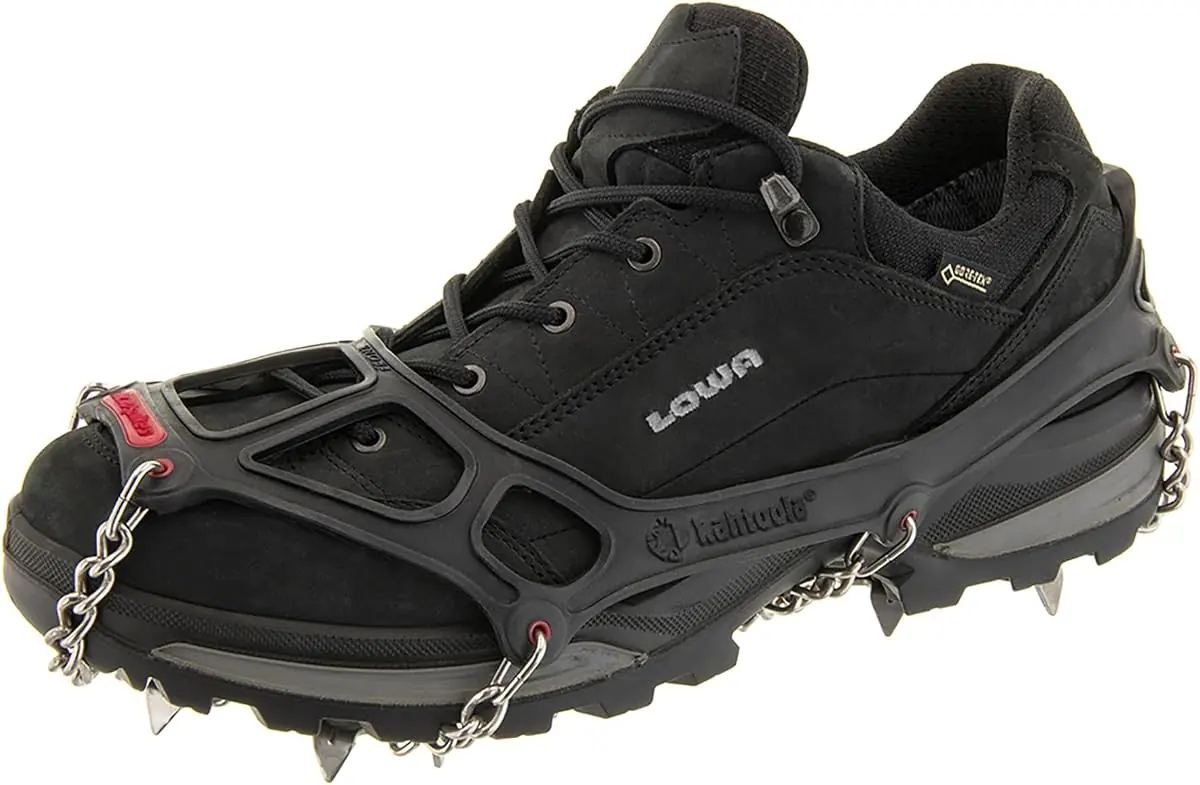
The device the whole category is measured against, and the one I'd hand somebody who told me to just pick one. Twelve spikes a foot at 0.41 in or 10.4 mm on the current fourth generation, on welded stainless chains under a TPE harness with reinforced TPR eyelets and a toe bail. That length is the all-round hiking rung of the ladder: enough to hold on icy trail and moderate slopes, short enough not to feel absurd on packed snow.It's the Best Overall pick at Switchback Travel, Best for Hiking at Treeline Review and CleverHiker, and the first thing Section Hiker lists. It's also the most expensive thing here, and the one place it gives ground is retention, since it has no strap.

Check Price
Best Retention
Hillsound Trail Crampon Ultra Traction Device
4.7

Hillsound Trail Crampon Ultra Traction Device

The best value on this page and the reason a lot of White Mountains regulars carry Hillsound rather than Kahtoola. Eighteen stainless spikes running 12 to 17 mm, with the three longest on the heel where a descent needs them, on double-link side chains and an elastomer harness with a stainless toe bail. The Velcro forefoot strap is the difference, and it's a straightforward answer to the way traction devices get lost.Section Hiker says a lot of winter hikers pick the Ultras over MICROspikes for exactly that reason. At 420 g it's heavier than the Kahtoola and the spikes are long enough to feel intrusive on easy ground, so it rewards knowing when to put it on.

Check Price
Most Bite
Hillsound Trail Crampon Ice Cleat Traction System
4.7

Hillsound Trail Crampon Ice Cleat Traction System

The most aggressive thing on this page and the closest to a real crampon without becoming one. Eleven heat-treated carbon steel spikes at a full 2/3 in or 17 mm, mounted on rigid plates rather than loosely coupled assemblies, with an elastomer harness and a strap. Section Hiker describes it as a cross between the Ultras and the much burlier PROs. The rigid plates are what buy the bite, and they're also the trade: it's the heaviest device here at 462 g and it snowballs more readily than the Ultras.Carbon steel is tougher than stainless but rusts, so this is the one on the page that most needs drying after use.

Check Price
Comparison Table

Every Pick, Side by Side

Compare all 8 picks
Best Overall
Best For
One pair that covers most of winter
Difficulty
Beginner
Price
$$$
Best Retention
Best For
Aggressive bite that will not come off
Difficulty
Intermediate
Price
$$$
Most Bite
Best For
The hardest ice a stretch-on device can handle
Difficulty
Advanced
Price
$$$
Recommended #4
Best For
Mixed ground where half the route is bare
Difficulty
Beginner
Price
$$$
Recommended #5
Best For
Running, and anyone whose toes go numb
Difficulty
Intermediate
Price
$$$
Recommended #6
Best For
All-round winter hiking at 8 mm
Difficulty
Beginner
Price
$$$
Recommended #7
Best For
Icy roads and winter road running
Difficulty
Beginner
Price
$$$
Recommended #8
Best For
Flat frozen ground around town
Difficulty
Beginner
Price
$$$
The Lineup

8 Best Microspikes, Compared

Detailed picks with verdicts, strengths, tradeoffs, and the situations where each one makes the most sense.

Best Overall
Kahtoola MICROspikes Footwear Traction
4.7 (3,582 Amazon ratings)

Kahtoola MICROspikes Footwear Traction

Quick verdict: The device the whole category is measured against, and the one I'd hand somebody who told me to just pick one. Twelve spikes a foot at 0.41 in or 10.4 mm on the current fourth generation, on welded stainless chains under a TPE harness with reinforced TPR eyelets and a toe bail. That length is the all-round hiking rung of the ladder: enough to hold on icy trail and moderate slopes, short enough not to feel absurd on packed snow.

It's the Best Overall pick at Switchback Travel, Best for Hiking at Treeline Review and CleverHiker, and the first thing Section Hiker lists. It's also the most expensive thing here, and the one place it gives ground is retention, since it has no strap.

Why It Stands Out

  • 12 spikes per foot at 10.4 mm on the fourth generation, not the 9.5 mm most roundups quote
  • Welded stainless chains and a TPE harness with reinforced TPR eyelets and toe bail
  • 11.9 oz / 338 g per pair in Medium, inside Switchback's 8-to-12-ounce hiking sweet spot
  • 4-year Kahtoola warranty on anything bought on or after August 1, 2025, the longest here

Pros

  • Best Overall or Best for Hiking at Switchback, Treeline and CleverHiker
  • Packs to about 30 cubic inches and disappears in a daypack
  • Fifteen seconds to put on, and easy enough to do with gloves on
  • Kahtoola publishes separate size charts for hiking shoes and insulated boots

Cons

  • The most expensive device on this page
  • Nothing but the elastomer holds it on, so a pair that rolls off can be gone
  • Balls up in soft wet snow despite the wide chains, which no microspike solves
  • Steel spikes dull on rock and pavement in a way carbide studs do not

Best Situations

Winter day hiking on packed snow and frozen trailShoulder-season summits where the last mile is glazedIcy approaches where you want one device rather than a decision
Difficulty
Beginner
Price Range
$$$
Best Retention
Hillsound Trail Crampon Ultra Traction Device
4.7 (333 Amazon ratings)

Hillsound Trail Crampon Ultra Traction Device

Quick verdict: The best value on this page and the reason a lot of White Mountains regulars carry Hillsound rather than Kahtoola. Eighteen stainless spikes running 12 to 17 mm, with the three longest on the heel where a descent needs them, on double-link side chains and an elastomer harness with a stainless toe bail. The Velcro forefoot strap is the difference, and it's a straightforward answer to the way traction devices get lost.

Section Hiker says a lot of winter hikers pick the Ultras over MICROspikes for exactly that reason. At 420 g it's heavier than the Kahtoola and the spikes are long enough to feel intrusive on easy ground, so it rewards knowing when to put it on.

Why It Stands Out

  • 18 spikes at 12 to 17 mm, with three 2/3 in spikes on the heel for descents
  • A Velcro forefoot strap holds it to the boot even when the harness lets go
  • Stainless toe bail and double-link side chains rather than a single chain run
  • Well under the MICROspikes for more spike length

Pros

  • More bite than the MICROspikes for less money
  • One of only two devices here with a strap, which is what stops you losing one
  • 420 g a pair, lighter than Hillsound's own Trail Crampon by 42 g
  • Section Hiker names it alongside MICROspikes as where a winter hiker should start

Cons

  • 333 ratings, a thin pool next to the MICROspikes' 3,582
  • Long spikes feel clumsy on bare ground, so it is a put-on-when-needed device
  • Hillsound warrants for 2 years against Kahtoola's 4
  • Price moves with size on this listing

Best Situations

Steep icy trail where a descent is the worrying partWinter hiking with a heavy pack, where more bite is worth the weightAnyone who has already lost one traction device in the snow
Difficulty
Intermediate
Price Range
$$$
Most Bite
Hillsound Trail Crampon Ice Cleat Traction System
4.7 (950 Amazon ratings)

Hillsound Trail Crampon Ice Cleat Traction System

Quick verdict: The most aggressive thing on this page and the closest to a real crampon without becoming one. Eleven heat-treated carbon steel spikes at a full 2/3 in or 17 mm, mounted on rigid plates rather than loosely coupled assemblies, with an elastomer harness and a strap. Section Hiker describes it as a cross between the Ultras and the much burlier PROs. The rigid plates are what buy the bite, and they're also the trade: it's the heaviest device here at 462 g and it snowballs more readily than the Ultras.

Carbon steel is tougher than stainless but rusts, so this is the one on the page that most needs drying after use.

Why It Stands Out

  • 11 carbon steel spikes at 17 mm, that full length at every point rather than only on the heel
  • Rigid plate mounting rather than chain-coupled spike groups, for more bite
  • Elastomer harness with a strap and a stainless toe bail
  • 16.3 oz / 462 g per pair excluding the carry case

Pros

  • Holds on thicker, harder ice than anything else here
  • Rated 4.7 across 950 ratings, matching the MICROspikes' average on a serious sample
  • Sold and shipped by Hillsound directly at the mid sizes
  • Includes a puncture-proof carry bag

Cons

  • 462 g a pair, the heaviest device on the page
  • More prone to snowballing than the Hillsound Ultras, per Section Hiker
  • Carbon steel rusts if it goes away wet
  • Fits sloppily on trail runners and hiking shoes, so it wants a boot

Best Situations

Hard refrozen trail where shorter spikes skateSteep winter ascents below the line where crampons take overCold-weather work on ice in boots rather than shoes
Difficulty
Advanced
Price Range
$$$
Recommended #4
Kahtoola EXOspikes Footwear Traction
4.7 (1,035 Amazon ratings)

Kahtoola EXOspikes Footwear Traction

Quick verdict: The most versatile device here and the one that suits an American winter better than its ranking suggests, because most winter walking is not continuous ice. Twelve tungsten carbide tips anchored in aluminum on a TPU traction matrix, 7.4 mm from base to tip, on a TPE harness.

Carbide is the whole argument, and CleverHiker's figure for it is roughly a hundred times the wear resistance of steel, so this survives the plowed road, the parking lot and the bare rock between the icy sections that would blunt a steel spike. At 208 g it's also less than half the weight of the Hillsound Trail Crampon. What it won't do is dig into thick ice, and it fights deeply lugged shoes.

Why It Stands Out

  • 12 tungsten carbide tips in aluminum, on TPU lugs, 7.4 mm overall
  • Carbide tips shrug off the pavement and bare rock that blunt a steel spike
  • 7.3 oz / 208 g per pair, less than half the Hillsound Trail Crampon
  • TPE harness with reinforced TPR eyelets and a toe bail, same family as MICROspikes

Pros

  • Survives rock and pavement, which no steel-spiked device here does
  • Light enough that you'll carry it on the chance you need it
  • Rated 4.7 across 1,035 ratings, sold and shipped by Kahtoola
  • Handles packed snow and shoulder-season glaze without being overkill

Cons

  • 7.4 mm will not dig into thick ice the way 10 to 17 mm does
  • iRunFar found it awkward over shoes with lugs of 5 mm or deeper
  • Only slightly under the MICROspikes for less bite
  • Not the device for a steep icy descent

Best Situations

Shoulder season, when ice comes and goes along the trailRoutes with long bare-rock or road sections between icy patchesWinter trail running on mixed ground
Difficulty
Beginner
Price Range
$$$
Recommended #5
Black Diamond Distance Spike Traction Device
4.7 (49 Amazon ratings)

Black Diamond Distance Spike Traction Device

Quick verdict: The lightest chained device on the page at 200 g and the running category's current favorite. It takes Best Overall at Treeline Review and tops iRunFar's list. Fourteen heat-treated stainless spikes at 8 mm on nylon webbing with TPR elastomer eyelets, and the part that matters is the hybrid upper: a softshell cap that covers the toe instead of a bare elastomer band across it.

That solves a real problem rather than a marketing one, since a plain harness presses on the toe box of a soft shoe and Section Hiker credits this design with fixing both the friction and the cold toes that come with it. It usually sells well under Black Diamond's own list price.

Why It Stands Out

  • 14 heat-treated stainless spikes at 8 mm, on nylon webbing and TPR eyelets
  • 200 g per pair, the lightest device here
  • Softshell toe cover instead of a bare elastomer band, fixing toe-box pressure
  • Sells at this listing's mid size for well under Black Diamond's own list price

Pros

  • Best Overall at Treeline Review and top of iRunFar's running list
  • The only device here that addresses cold toes and toe friction by design
  • Easy on and off with gloves or cold fingers
  • Sold and shipped by Black Diamond Equipment

Cons

  • 49 ratings, by far the thinnest pool on this page
  • Black Diamond states this item contains PFAS and cannot be shipped to California, New York or Colorado
  • 8 mm is a running length, not enough for hard steep ice
  • The X-Large size costs substantially more than S, M and L

Best Situations

Winter trail running and fast hikingAnyone who has had numb toes under an elastomer harnessFast-and-light days where 200 g against 460 g is the deciding number
Difficulty
Intermediate
Price Range
$$$
Recommended #6
Black Diamond Access Spike Traction Device
4.2 (88 Amazon ratings)

Black Diamond Access Spike Traction Device

Quick verdict: The hiking-side sibling of the Distance Spike, and the device CleverHiker calls Best Overall. Same fourteen heat-treated stainless spikes at 8 mm, but on a TPR elastomer and nylon webbing harness with no softshell toe cap, at 220 g. It's a good all-round device that lands in an awkward spot on this particular page. It sits a hair under the EXOspikes, which weigh less and survive pavement, and just under the Distance Spike, which weighs less and solves the toe problem.

Its 4.2 rating is also the lowest here. The list price it discounts from is real, so the discount is too.

Why It Stands Out

  • 14 stainless spikes at 8 mm, the same points as the Distance Spike
  • TPR elastomer and nylon webbing harness, 220 g per pair
  • Named Best Overall by CleverHiker
  • Sells below Black Diamond's own list price

Pros

  • Solid mid-length traction for packed snow and mixed frozen trail
  • 20 g heavier than the Distance Spike, and barely cheaper
  • Sold and shipped by Black Diamond Equipment, all sizes one price
  • Straightforward pull-on harness with nothing to break

Cons

  • 4.2 stars, the lowest rating on this page
  • Black Diamond states this item contains PFAS and cannot be shipped to California, New York or Colorado
  • No toe cover, so it has the toe-box pressure the Distance Spike fixes
  • Priced against an EXOspike that is lighter and survives rock

Best Situations

General winter hiking where the trail is more snow than iceIcy commutes and approaches where 8 mm is plentyAnyone who wants Black Diamond's build without the running price
Difficulty
Beginner
Price Range
$$$
Recommended #7
Kahtoola NANOspikes Footwear Traction
4.7 (215 Amazon ratings)

Kahtoola NANOspikes Footwear Traction

Quick verdict: Not a hiking device and not pretending to be. Ten tungsten carbide studs in aluminum on a dual-compound TPU plate, 5.3 mm from base to tip, which is the shortest bite here and deliberately so. This is for iced pavement and road running, where a 10 mm steel spike would be blunt by February and unpleasant underfoot the whole time. Kahtoola redesigned the stud in the 2023 update so it's concave rather than pointed, which the brand says increases the pressure it puts on ice.

Worth knowing before you buy: despite being the least aggressive Kahtoola, it packs bulkier than the MICROspikes, at 52 cubic inches against their 30, because the plates are rigid.

Why It Stands Out

  • 10 concave tungsten carbide studs on a dual-compound TPU plate, 5.3 mm
  • Carbide survives pavement, which is the entire point of the device
  • 7.4 oz / 210 g per pair on a TPE harness
  • Redesigned concave stud since 2023, which Kahtoola says bites ice harder

Pros

  • The right tool for iced roads and sidewalks, where spikes are wrong
  • Low enough profile to run on mixed dry and icy pavement
  • Rated 4.7 across 215 ratings, sold and shipped by Kahtoola
  • Backed by the same 4-year Kahtoola warranty

Cons

  • 5.3 mm does almost nothing on a slope or in more than an inch of snow
  • 52 cubic inches packed, well over the MICROspikes' 30 despite being the mildest
  • Real money for a device with a narrow job
  • The rigid plates make it the least flexible thing on the page

Best Situations

Winter road running and icy sidewalksCommutes across frozen parking lots and pathsFlat frozen ground where you want grip and nothing more
Difficulty
Beginner
Price Range
$$$
Recommended #8
Yaktrax Diamond Grip All-Surface Traction Cleats
4.4 (1,372 Amazon ratings)

Yaktrax Diamond Grip All-Surface Traction Cleats

Quick verdict: The cheapest thing here and the most misunderstood, because it has more ratings than anything on this page except the MICROspikes and that has convinced a lot of people it's a hiking device. It isn't. Case-hardened steel alloy beads strung on aircraft steel cable, riveted to a rubber sling. The sling is the problem: Switchback is explicit that Yaktrax uses standard rubber rather than an elastomer, stretchy but less durable, and Trailspace reports the web giving out after a single season of moderate use.

For a driveway, a dog walk or a flat frozen path it's fine, and it won't catch on a doorstep. Take it up a hill and it has nothing to give you.

Why It Stands Out

  • Case-hardened steel alloy beads on aircraft steel cable, riveted to a rubber sling
  • No spikes to catch on steps, floors or bare pavement
  • The cheapest device on the page, and usually below its list price
  • Rated 4.4 across 1,372 ratings and carries Amazon's Choice on the mid size

Pros

  • The correct tool for flat frozen ground around town
  • Cheapest way onto ice by a clear margin
  • Beads grip mixed surfaces without the awkwardness of long spikes
  • Sold and shipped by Amazon at the mid size

Cons

  • Rubber sling rather than a thermoplastic elastomer, and it's the part that fails
  • Plan on a season or two, not the years an elastomer harness lasts
  • No meaningful grip on any real slope, which is why it finishes last
  • 14.4 oz a pair, heavier than the 11.9 oz MICROspikes that bite far harder

Best Situations

Icy driveways, sidewalks and parking lotsDog walks and the school run on flat frozen groundA spare pair to keep in the car through winter
Difficulty
Beginner
Price Range
$$$
Buying Guide

What to Check Before You Buy

How long should the spikes be?

Spike length decides where a device works, and spike count matters far less. Five to 7 mm gives you studs for iced pavement and flat frozen paths, 7 to 8 mm covers packed snow and mixed frozen trail, 9 to 11 mm is the all-round winter hiking length, and 12 to 17 mm is what thicker ice and steeper ground need. There's a ladder here, and knowing which rung you need settles the purchase in about a minute.

At 5 to 7 mm you have studs rather than spikes: the Kahtoola NANOspikes are 5.3 mm and Hillsound's FreeSteps6 are 6 to 7 mm, and they're for iced pavement and flat frozen paths. They bite into a hard surface and they won't dig into anything. At 7 to 8 mm sit the Kahtoola EXOspikes at 7.4 mm and both Black Diamonds at 8 mm, which covers packed snow and mixed frozen trail.

The all-round hiking rung is 9 to 11 mm, and that's where the MICROspikes sit, at 10.4 mm since the fourth generation landed. Then 12 to 17 mm, the Hillsound Trail Crampon Ultra and Trail Crampon, which is what you want for thicker ice and a heavy pack on steeper ground. Above that, at 19 to 26 mm, you've left this page. One warning about published numbers: most roundups still print 9.5 mm for the MICROspikes, which was the previous generation.

Kahtoola's own current spec sheet says 10.4 mm, and the manufacturer is the one to believe.

What wears out first on a pair of microspikes?

The harness fails first, not the spikes, and specifically at the holes the chains pass through. The good devices use a thermoplastic elastomer, which Switchback Travel calls the gold standard for this because it keeps rubber's stretch but is tougher and lighter. The cheaper ones use ordinary rubber, and reinforced eyelets are the detail worth hunting for. Yaktrax is the rubber example on this page, and Trailspace's summary of the failure is blunt: the elastomer web seems to fail after one season of moderate use, and the coils roll.

Kahtoola names its reinforced connection points and TPR eyelets as a feature; Snowline makes the same claim about tear resistance for the same reason. On cold ratings, be careful what you trust. Kahtoola's harness is widely quoted as staying elastic to -22F, and Switchback's caution is the honest one: treat all of these numbers with suspicion given that no standardized test for them exists. There is no standard either.

No ASTM, ISO, EN or UIAA specification covers pull-on traction devices at all. Real crampons have one, EN 893:2019, with defined test methods. Spikes have nothing, so every claim on the box is the manufacturer's own.

How do you stop a traction device coming off?

Retention is whatever holds the harness on beyond the stretch of the elastomer itself, and there are four approaches here. Plainest is bare elastomer and nothing else, which is the Black Diamond Access Spike. Above that, elastomer with an integrated toe bail, which is what the fourth-generation Kahtoolas have. Then elastomer, toe bail and a strap across the forefoot, which is both Hillsounds. Black Diamond does it differently again on the Distance Spike, with a softshell cap over the toe instead of a strap.

A device that rolls off your heel halfway along a traverse has failed completely, so this deserves more attention than it usually gets. Section Hiker is direct about why the strap matters: winter hikers often choose the Ultras over MICROspikes because the strap keeps a popped-off spike attached to your boot rather than somewhere back down the trail. The fit test worth doing at home is Treeline Review's: put it on, stand on one foot and twist your ankle side to side.

The harness shouldn't roll, shift across the boot or pop off the heel. And size to the footwear you'll actually wear it on. Kahtoola publishes two separate size charts, one for hiking shoes and one for insulated boots, because a pac boot eats most of a size.

How much should a pair weigh, and does carbide matter?

The heaviest device here is more than double the lightest, 462 g on the Hillsound Trail Crampon against 200 g for the Distance Spike, and Switchback puts the hiking sweet spot at 8 to 12 ounces, which is 227 to 340 g. Section Hiker makes the point that weight on your feet isn't the same as weight in your pack, and an extra pound down there will wear you out over a long day.

The strategy that follows is to put them on when you need them rather than at the trailhead. The other half of the equation is what the spikes are made of, because that decides whether walking on rock and pavement destroys them. Steel spikes dull. Section Hiker describes the tops of the triangular spikes flattening out, which you can fix with a mill bastard file until eventually you can't, and he keeps worn pairs as rock spikes for shoulder-season use so newer ones stay sharp.

Tungsten carbide doesn't do that, which is the whole argument for the EXOspikes and NANOspikes: CleverHiker cites carbide as roughly a hundred times more wear-resistant than steel. If your winter involves plowed roads, parking lots and bare rock between the icy patches, carbide is worth more than the extra millimeters of steel.

One Pair For Winter Hiking
10.4mm spikes

Buy the Kahtoola MICROspikes and stop thinking about it. It runs twelve spikes a foot at 10.4 mm, the length that covers the most winter trail, and nearly every roundup I read picks it first. If you'd rather have a Velcro strap holding them on and more bite for less money, the Hillsound Trail Crampon Ultra is the better buy, and the reason plenty of White Mountains regulars carry them instead.

Winter Running
200g a pair

The Black Diamond Distance Spike is 200 g a pair, and the softshell cap over the toe exists to fix the toe-box pressure a bare elastomer harness causes on a soft running shoe. That's the trail answer. On plowed roads and sidewalks, the Kahtoola NANOspikes are the right tool instead: carbide studs that survive pavement, where steel spikes would be blunt by February.

Sidewalks, Dog Walks, The School Run
Studs, not spikes

This is the one place the cheap answer is the right answer. The Yaktrax Diamond Grip has no spikes to catch on a doorstep and grips flat frozen ground fine. Don't take it up a hill. For a weekend that also involves a frozen trail, spend the extra on the NANOspikes and accept that neither will hold you on a slope.

Full Catalog

Compare All 8 Microspikes

Want to browse beyond the ranked picks? Filter and sort the full microspikes listing below.

FAQ

Frequently Asked Questions

Spike length, how they mount, and what they're rated to hold. Section Hiker's definition is the clean one: microspikes have spikes of roughly 1 to 1.5 cm, and crampons have spikes up to 5 cm. Microspikes stretch over almost any shoe on an elastomer harness in about fifteen seconds; crampons bind rigidly to a stiff-soled boot, and step-in bindings need a welted mountaineering boot to lock into.

The third difference is the one that hurts people. Microspike chains have give in them, which is what lets them flex with a soft shoe, and that same give means the short points cannot penetrate deeply enough to hold your full body weight on a face. Crampons are also governed by a written safety standard with defined test methods, EN 893:2019 and UIAA 153. Microspikes are governed by nothing at all.

Glossary

The words on this page

Every term this guide leans on has its own page with a plain answer at the top.

Browse the whole glossary →
How We Choose Products

How These Picks Are Chosen

Reader-supported and free of paid placements. Every pick is ranked on published specs and Amazon buyer ratings, not on who pays us.

Spec Research

Each pick is compared on published specs, materials, design, and category fit across the major brands.

Practical Fit

Rankings factor in how well each product matches common hiking, backpacking, and trail running needs, not just popularity.

Amazon Buyer Ratings

Star ratings and review volume from verified Amazon buyers are factored in to reflect real-world satisfaction.

Value

A pick earns its spot by delivering useful performance for the money, whether budget or premium.

SPIKES SORTED.
THE BOOTS UNDER THEM AREN'T.

Spikes only work as well as whatever you strap them to, and a three-season boot with a sole that goes hard below freezing is fighting you before the spikes go on. Winter boots are ranked separately, along with insulated jackets, socks and headlamps for the short days.

Best Winter Hiking Boots