Best Backpacking Sleeping Pads of 2026 — hiking gear
Sleeping Pad Buying Guide

Best Backpacking Sleeping Pads of 2026

Ten pads from $50 to $260, ranked on how much R-value you get per ounce carried, then on whether they're thick enough to sleep on.

View Top PicksUpdated 4 August 2026 · Ranked from specs & buyer reviews

If you buy through a link on this page we may earn a commission, at no extra cost to you. It never changes how anything is ranked.

How to Choose

How to Choose a Backpacking Sleeping Pad

Almost everyone buys the sleeping bag first and then wonders why they were cold. The ground is the problem. A sleeping bag works by trapping air in lofted insulation, and the half of it you're lying on has no loft left at all, because your body weight has crushed it flat. Whatever is under you is what's still insulating. So the pad isn't the comfort afterthought you buy once the important gear is sorted. On a cold night it's doing more of the work than the bag, which is why you can spend $400 on a quilt and still lie awake shivering on a $30 pad.

R-value is the spec that tells you how well a pad does that job, and for once in outdoor gear it's a number you can trust across brands. Since 2020 the industry has tested to one shared standard, ASTM F3340, and every major maker on this page rates to it: Therm-a-Rest, NEMO, Big Agnes, Sea to Summit. Before that, R-values were marketing. Now a 4.5 from one brand really is warmer than a 3.8 from another. Under 3 is a summer number. From 3 to 5 covers three-season use for most people, and past 5 is shoulder-season and snow territory. Most backpackers want something around 4.5 to 5.5, which is where the two pads at the top of this list sit.

So the ten below are ordered on warmth per ounce carried, then on whether the pad is comfortable enough to sleep on. Thickness and baffle design decide that, and side sleepers need more of both. After that comes packed size and how quiet the thing is at 3am, and price breaks ties. Amazon review count breaks nothing. The Z Lite Sol and the Klymit between them hold over 8,500 ratings on this page and they rank ninth and tenth, because a rating count measures how many units a listing has moved, not how well the pad works. The lineup runs $50.86 to $259.95, which covers the whole category from a bare foam mat up to a winter pad. What's missing is Exped's Ultra line, which Amazon barely carries; search for it there and you get their car-camping mats instead. Everything below is ranked from published specs, ASTM-standard R-values and the testing other reviewers have put in print. My dad and I haven't slept a season on all ten and I'm not going to pretend otherwise. Ratings and prices were read off the listings on August 4, 2026.

Quick Picks

Top Three at a Glance

Short on time? Start with these top-rated sleeping pads picks.

Best Overall
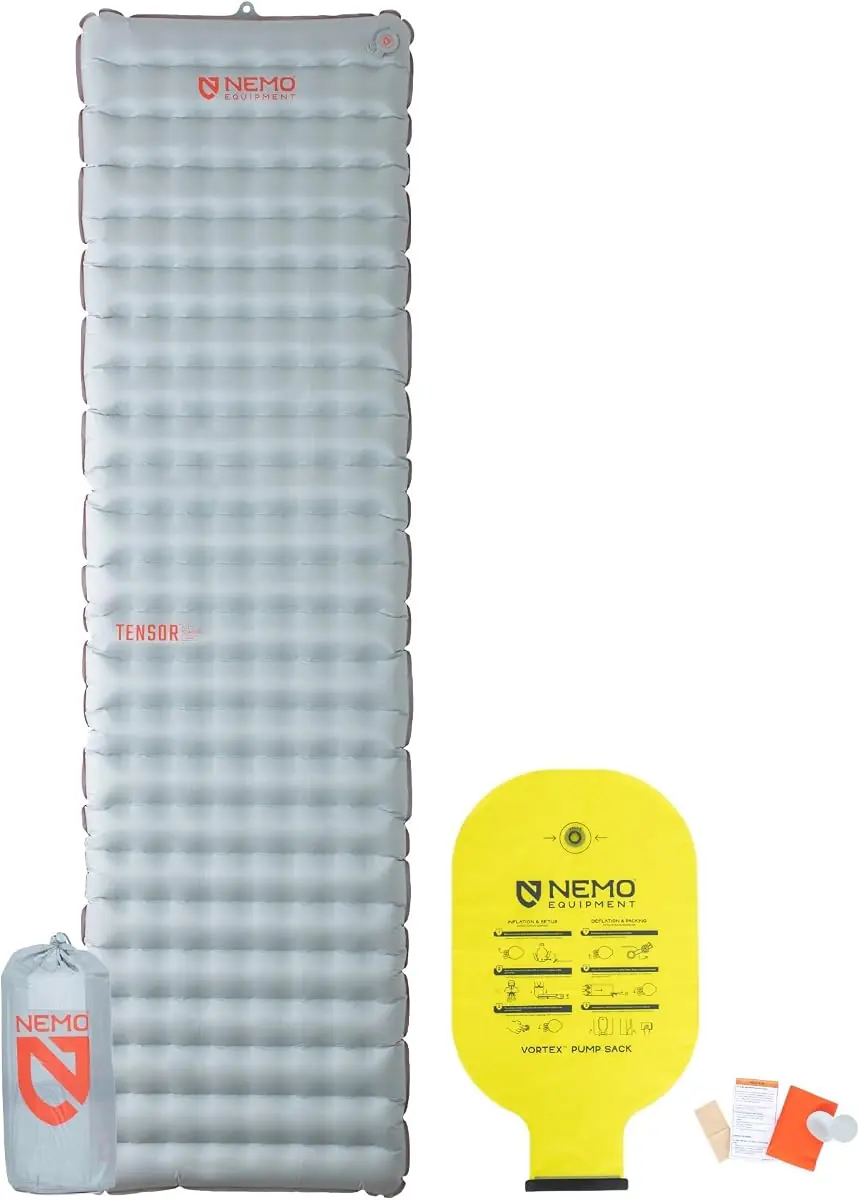
NEMO Tensor All-Season Sleeping Pad, Regular
4.6

NEMO Tensor All-Season Sleeping Pad, Regular

The best warmth-to-weight of any three-season pad here, and the one most people should buy. R 5.4 at 15.4 ounces covers spring through late fall with margin, and it runs quiet, which matters more than you'd expect if you or your tent partner wake at every crinkle.

Check Price
Lightest
Therm-a-Rest NeoAir XLite NXT
4.3

Therm-a-Rest NeoAir XLite NXT

The lightest properly three-season pad most people can buy: 13.6 ounces for R 4.5, and the long-running default on thru-hikes. The NXT revision made it noticeably quieter than the older NeoAirs that earned the crinkling reputation.

Check Price
Best Value
Big Agnes Rapide SL Insulated, Regular
4.4

Big Agnes Rapide SL Insulated, Regular

R 4.8 and up to 4.2 inches of loft for $169.95 makes this the value pick among the premium pads. It reads warmer than the NeoAir XLite NXT and thicker than the Tensor, for $40 to $50 less than either. The weight is where you pay: 18 ounces.

Check Price
Comparison Table

Every Pick, Side by Side

Best Overall
Best For
Three-season backpacking, all-round
Difficulty
Beginner
Price
$$$
Lightest
Best For
Counting every ounce
Difficulty
Intermediate
Price
$$$
Best Value
Best For
Most warmth and cushion per dollar
Difficulty
Beginner
Price
$$$
Recommended #4
Best For
Side sleepers
Difficulty
Intermediate
Price
$$$
Recommended #5
Best For
Winter and snow camping
Difficulty
Advanced
Price
$$$
Recommended #6
Best For
Maximum comfort
Difficulty
Beginner
Price
$$$
Recommended #7
Best For
Self-inflating simplicity
Difficulty
Beginner
Price
$$$
Recommended #8
Best For
A pad that cannot fail
Difficulty
Beginner
Price
$$$
Recommended #9
Best For
A pad that outlasts everything
Difficulty
Beginner
Price
$$$
Recommended #10
Best For
The cheapest pad here
Difficulty
Beginner
Price
$$$
The Lineup

10 Best Sleeping Pads, Compared

Detailed picks with verdicts, strengths, tradeoffs, and the situations where each one makes the most sense.

Best Overall
NEMO Tensor All-Season Sleeping Pad, Regular
4.6 (31 Amazon ratings)

NEMO Tensor All-Season Sleeping Pad, Regular

Quick verdict: The best warmth-to-weight of any three-season pad here, and the one most people should buy. R 5.4 at 15.4 ounces covers spring through late fall with margin, and it runs quiet, which matters more than you'd expect if you or your tent partner wake at every crinkle.

Why It Stands Out

  • R-value 5.4 for 15.4 ounces, the best warmth per ounce of any three-season pad here
  • Two suspended layers of metallized film do the insulating without adding bulk
  • 3.5 inches of loft is enough for most side sleepers
  • Notably quiet compared to older reflective-film pads

Pros

  • Warm enough for spring and late-fall nights near freezing
  • Packs to roughly water-bottle size
  • Vortex pump sack in the box, so you never have to mouth-inflate it

Cons

  • $219.95 is near the top of the category
  • Only 31 ratings on this listing, a thin pool next to the foam mats
  • Thin ultralight fabric wants a cleared pitch

Best Situations

Spring-through-fall trips where nights get near freezingLong carries where 15 ounces versus 25 actually mattersSharing a small tent with someone who wakes easily
Difficulty
Beginner
Price Range
$$$
Lightest
Therm-a-Rest NeoAir XLite NXT
4.3 (127 Amazon ratings)

Therm-a-Rest NeoAir XLite NXT

Quick verdict: The lightest properly three-season pad most people can buy: 13.6 ounces for R 4.5, and the long-running default on thru-hikes. The NXT revision made it noticeably quieter than the older NeoAirs that earned the crinkling reputation.

Why It Stands Out

  • 13.6 ounces is the lightest insulated pad on this page
  • R-value 4.5 sits right in the three-season sweet spot
  • The NXT update addressed the noise the older NeoAirs were known for
  • Packs smaller than anything else here except the foam mats

Pros

  • Hard to beat on weight without losing real warmth
  • Proven design with a long track record on long trails
  • WingLock valve inflates and dumps quickly

Cons

  • 3 inches of loft is less than the thick pads, which side sleepers notice
  • Tapered mummy cut is narrow at the feet
  • At $209.16 it's barely cheaper than the warmer Tensor All-Season

Best Situations

Thru-hikes and long-distance tripsFast-and-light trips where packed size matters as much as weightBack sleepers who don't need four inches of cushion
Difficulty
Intermediate
Price Range
$$$
Best Value
Big Agnes Rapide SL Insulated, Regular
4.4 (54 Amazon ratings)

Big Agnes Rapide SL Insulated, Regular

Quick verdict: R 4.8 and up to 4.2 inches of loft for $169.95 makes this the value pick among the premium pads. It reads warmer than the NeoAir XLite NXT and thicker than the Tensor, for $40 to $50 less than either. The weight is where you pay: 18 ounces.

Why It Stands Out

  • R-value 4.8 is the second-warmest three-season figure here
  • 3.5 to 4.2 inches of loft, deep enough for most side sleepers
  • $169.95 undercuts the other premium pads by $30 to $50
  • Pumphouse inflation sack included

Pros

  • The most warmth and cushion you can get here under $200
  • Deep chambers cradle hips and shoulders well
  • Offered in a wide range of sizes including wide cuts

Cons

  • 18 ounces is heavier than the Tensor for less warmth
  • Bulkier packed than the Tensor or the XLite
  • 54 ratings is a modest pool

Best Situations

Weekend and week-long trips where $50 saved beats 3 ounces savedSide sleepers who don't want to spend $260A first premium pad after outgrowing a foam mat
Difficulty
Beginner
Price Range
$$$
Recommended #4
Sea to Summit Ether Light XR Insulated, Regular
4.4 (82 Amazon ratings)

Sea to Summit Ether Light XR Insulated, Regular

Quick verdict: Four inches thick, built from a grid of small Air Sprung Cells that flex independently, so a shoulder or hip sinks in without levering the rest of you up. R 4.1 is solid three-season warmth rather than exceptional, and the comfort is the reason to buy it.

Why It Stands Out

  • 4 inches of loft, among the thickest pads here
  • Air Sprung Cell grid deforms locally instead of as one big chamber
  • R-value 4.1 covers standard three-season conditions
  • Airstream pump sack and a multi-function valve included

Pros

  • Excellent for side sleepers and restless sleepers
  • One-way inflation port with a fine-tune button for dialing in firmness
  • 17 ounces is reasonable for four inches of pad

Cons

  • R 4.1 is the lowest of the premium inflatables here
  • Tall pads move more on a slippery tent floor
  • $199 for warmth the $169.95 Rapide SL beats

Best Situations

Anyone who sleeps on their side and bottoms out on thin padsRocky or root-strewn pitches where cushion matters mostSleepers who like to fine-tune firmness night to night
Difficulty
Intermediate
Price Range
$$$
Recommended #5
NEMO Tensor Extreme Sleeping Pad, Regular Mummy
4.8 (20 Amazon ratings)

NEMO Tensor Extreme Sleeping Pad, Regular Mummy

Quick verdict: R-value 8.5 from four layers of Thermal Mirror film, about as warm as a backpacking pad gets. It's a purpose-built winter pad and overkill for summer. If you're not camping on snow or frozen ground, the All-Season version saves you $40 and a few ounces.

Why It Stands Out

  • R-value 8.5, the warmest pad on this page by a wide margin
  • Four layers of suspended metallized film rather than two
  • Still packs and weighs like a backpacking pad, not an expedition mat
  • Keeps the Tensor line's quiet fabric

Pros

  • Handles snow camping on its own, with no foam mat underneath
  • Same 3.5 inches of comfortable loft as the All-Season
  • Vortex pump sack included

Cons

  • $259.95, tied with the NeoLoft for the most expensive pad here
  • Far more insulation than three-season trips need
  • Only 20 ratings on this listing

Best Situations

Winter camping and snow travelHigh-altitude trips on frozen groundPeople who sleep very cold and want one pad for everything
Difficulty
Advanced
Price Range
$$$
Recommended #6
Therm-a-Rest NeoLoft, Regular Wide
4 (73 Amazon ratings)

Therm-a-Rest NeoLoft, Regular Wide

Quick verdict: At 4.6 inches this is the most cushioned pad here, and the closest thing to a bed you can carry in a backpack. R 4.7 is proper three-season warmth. The catch is 25.3 ounces, nearly ten more than the Tensor All-Season, which makes it a pad for shorter carries and comfort-first trips.

Why It Stands Out

  • 4.6 inches of loft, the thickest pad on this page
  • R-value 4.7 covers nights down around freezing
  • Regular Wide cut gives more room to move than a mummy pad
  • Two valves speed up inflation and deflation

Pros

  • The most comfortable option here for side and restless sleepers
  • Wide cut suits people who don't sleep still
  • R 4.7 edges the 13.6 oz XLite's 4.5, so the extra weight is all cushion

Cons

  • 25.3 ounces is the heaviest pad on this page
  • Bulky packed compared to the ultralight inflatables
  • 4.0 stars is the lowest rating in this lineup

Best Situations

Short approaches and basecamp tripsAnyone who has given up on sleeping well on a 3-inch padCar-to-camp trips where weight barely matters
Difficulty
Beginner
Price Range
$$$
Recommended #7
Therm-a-Rest Trail ProLite, Regular
4.1 (19 Amazon ratings)

Therm-a-Rest Trail ProLite, Regular

Quick verdict: Open the valve and the foam inside expands and pulls air in, so it mostly sets itself up, and it feels firmer and more stable than an air pad. R 3.8 for a pound and a half is unremarkable warmth-to-weight. What you get for that is the most foolproof inflatable here, at $80 less than the Tensor All-Season.

Why It Stands Out

  • Self-inflating foam core means minimal setup and no pump sack needed
  • R-value 3.8 covers most three-season nights
  • Firmer, more stable feel than a pure air pad
  • $139.95 undercuts every premium pad here

Pros

  • Simplest inflatable to live with, especially in cold or wet weather
  • A puncture deflates it partially rather than completely
  • WingLock valve moves air quickly

Cons

  • 1 lb 8 oz for R 3.8 is poor warmth-per-ounce next to the top picks
  • 2 inches of loft is thin for side sleepers
  • Only 19 ratings on this listing

Best Situations

People who want an inflatable without the fuss of a pump sackCold, wet trips where fiddling with gear is unwelcomeBack sleepers happy with two inches of cushion
Difficulty
Beginner
Price Range
$$$
Recommended #8
NEMO Switchback Foam Sleeping Pad
4.7 (676 Amazon ratings)

NEMO Switchback Foam Sleeping Pad

Quick verdict: Closed-cell foam that folds like an accordion, weighs about 14.5 ounces and cannot puncture. R 2.0 makes it a summer pad on its own. Its other job is going under an inflatable in winter, where R-values add and $59.95 turns a three-season pad into a winter one.

Why It Stands Out

  • Cannot puncture, cannot leak, needs no inflation
  • R-value 2.0 at roughly 14.5 ounces for $59.95
  • Slightly deeper nodes than the Z Lite Sol, so a little more cushion
  • Doubles as a camp seat and a pack frame stiffener

Pros

  • Zero setup and zero failure modes
  • Stacks under an inflatable to add R-value cheaply
  • 676 ratings at 4.7 stars, the highest average of any pad here with more than 100 reviews

Cons

  • Under an inch of padding, hard for side sleepers
  • R 2.0 is summer-only as a standalone pad
  • Doesn't compress, so it rides strapped outside the pack

Best Situations

Summer trips where puncture risk is the main worryA second pad stacked under an inflatable for winterRough scrambling terrain that would shred an air pad
Difficulty
Beginner
Price Range
$$$
Recommended #9
Therm-a-Rest Z Lite Sol
4.6 (4,125 Amazon ratings)

Therm-a-Rest Z Lite Sol

Quick verdict: The long-running foam classic: about 14 ounces, R 2.0, $59.95, and a reflective coating on one side that bounces a little body heat back at you. With 4,125 ratings it's one of the two most-reviewed pads on this page, which tells you it's consistent rather than that it's the best.

Why It Stands Out

  • $59.95 for foam that will outlast every inflatable here
  • R-value 2.0 at around 14 ounces of indestructible foam
  • Reflective ThermaCapture coating adds a little warmth for no weight
  • 4,125 ratings at 4.6 stars means the quality is consistent

Pros

  • Effectively unbreakable and needs no maintenance
  • Folds flat, works as a sit pad and a sleeping-bag stuff-sack filler
  • The standard winter under-layer for a reason

Cons

  • About three-quarters of an inch of padding, thin for side sleepers
  • Summer-only warmth on its own
  • Bulky on the outside of a pack

Best Situations

A first pad on a tight budgetSummer trips and hut-to-hut travelLayering under an inflatable to push a winter setup past R 7
Difficulty
Beginner
Price Range
$$$
Recommended #10
Klymit Static V
4.4 (4,393 Amazon ratings)

Klymit Static V

Quick verdict: The cheapest pick on this page, and an inflatable with real loft for about $51, currently down from $59.99. The catch matters, though: R-value 1.3 makes it a warm-weather pad, and no amount of thickness changes that. Buy it for summer trips and leave the shoulder season to something warmer.

Why It Stands Out

  • $50.86 buys 2.5 inches of air cushion, far more than foam at the price
  • V-shaped chambers limit how much air shifts as you move
  • 4,393 ratings at 4.4 stars, so the build quality is consistent
  • Packs down small, unlike a foam mat

Pros

  • The cheapest way to get real inflatable cushion
  • Comfortable for its price on warm nights
  • Big feedback pool for a budget pad

Cons

  • R-value 1.3 is the coldest on this page, summer use only
  • No insulation layer, so cold ground comes straight through
  • Heavier than the far warmer Tensor All-Season

Best Situations

Summer car camping and warm-weather backpackingA first inflatable before committing to a premium padA cheap spare for guests or a bail-out kit
Difficulty
Beginner
Price Range
$$$
Buying Guide

What to Check Before You Buy

Sleeping pad R-value is the spec, and since 2020 it's finally honest

R-value measures resistance to heat flowing out of you and into the ground, and higher is warmer. What changed in 2020 is that it became comparable. The industry adopted ASTM F3340, a shared test that pins down the ambient temperature, the pressure inside the mat and how the measurement is taken, and REI made an ASTM-tested figure a condition of listing a pad at all, which is why every serious brand now publishes one. A brand used to be able to test however it liked, and the numbers meant nothing from one catalog to the next. So take them at face value now. The Tensor All-Season's 5.4 and the Rapide SL's 4.8 are three-season pads with real margin. The Klymit's 1.3 is a warm-night pad and nothing more, whatever the listing photo of a mountain implies. R-values also add, which makes a $60 foam mat under an inflatable the cheapest warmth you can buy: the Z Lite Sol under the Tensor All-Season puts you past R 7. What the number won't tell you is whether the pad is comfortable, quiet, or likely to survive the season.

Warmth per ounce is what separates good from expensive

Any pad can be made warm by adding insulation and weight. The engineering that costs money is getting the warmth without the weight, and that's the axis this list is ranked on. The NEMO Tensor All-Season is the clearest example: 5.4 R-value at 15.4 ounces, from two suspended layers of metallized film inside the mat. The Therm-a-Rest NeoAir XLite NXT gets 4.5 out of 13.6 ounces, still the lightest properly three-season pad most people can buy. Compare that to the Therm-a-Rest Trail ProLite, a self-inflating pad that carries foam inside it: 3.8 R-value for a pound and a half. It's a perfectly good pad and it costs $70 less than the XLite NXT, but you're carrying 10 more ounces for less warmth. That gap is what the money buys at the top of this category. The foam mats flip the arithmetic. The Z Lite Sol and the Switchback deliver R 2.0 for about 14 ounces at $59.95 apiece, which is unremarkable warmth-to-weight, but they cannot puncture, need no inflating, and cost a quarter as much. On a summer trip that's exactly the right tool.

Thickness and baffle shape decide whether side sleepers actually sleep

Warmth keeps you from getting cold; thickness keeps you from waking up. When you lie on your side, your hip and shoulder concentrate almost all your weight onto two small areas, and a thin pad lets them bottom out onto the ground. Back sleepers spread the load and often get away with two inches. Side sleepers generally don't, and three inches is a sensible floor. The pads here run from about three-quarters of an inch of foam up to the NeoLoft's 4.6 inches, which is the most cushioned option on this page and weighs 25.3 ounces for it. The Sea to Summit Ether Light XR is the other side-sleeper answer at 4 inches, built from a grid of small Air Sprung Cells that deform independently, so a shoulder sinks in without launching the rest of you upward. Horizontal-baffle pads like the Tensor and the XLite feel flatter and more stable; deep-chamber pads like the Rapide SL cradle more. Neither is better in the abstract. This is the one thing on this page worth lying down on in a store if you get the chance, because it's the difference between a pad you tolerate and one you sleep on.

Never inflate it with your breath, and other ways pads die early

Every inflatable pad on this page ships with a pump sack, and it isn't there to save you effort. Blowing a pad up with your breath seals warm, wet air inside a chamber you can never get into again, and that moisture degrades reflective-film insulation and grows things you can't reach to clean. Use the sack. It takes a handful of scoops and about the same twenty seconds. The rest of the habits cost nothing either. Store the pad unrolled with the valve open instead of stuffed tight in its sack, which keeps the foam and the internal coatings from taking a set. Clear the ground before you pitch, because the fabric on an ultralight pad is thin by design and a pine cone doesn't care what it cost. Carry the patch kit that came with it. Finding a slow leak at 2am is bad enough; finding one you can't patch is a very long night. Quiet counts too. Older Therm-a-Rest NeoAir pads were notorious for a crinkling sound, the NXT is substantially quieter than they were, and the NEMO Tensor is quieter still.

Three-Season, Carrying It All Day
$170-$220

The default case: spring through fall, with nights near freezing and every ounce riding on your back all day. The NEMO Tensor All-Season gives you R 5.4 for 15.4 ounces and stays quiet doing it. If you'd rather have two of those ounces back and can live with less warmth margin, take the NeoAir XLite NXT. The Big Agnes Rapide SL saves you $50 and adds cushion, at 18 ounces instead of 15.4.

You Sleep On Your Side
$199-$260

Hips and shoulders bottom out on a 2-inch pad and you'll be awake half the night. Go thick. The Sea to Summit Ether Light XR gives you 4 inches of small cells that flex one at a time. The Therm-a-Rest NeoLoft is 4.6 inches and the most cushioned pad here, and you pay for it in weight: 25.3 ounces.

Summer Trips, Or A Pad You Can't Kill
$51-$60

Closed-cell foam can't puncture and never needs inflating. It also makes a decent camp seat. On its own R 2.0 is warm-night territory only, but the Z Lite Sol and the NEMO Switchback, both $59.95, are what experienced hikers stack under an inflatable when it turns cold. R-values add, so a foam mat is how a three-season setup becomes a winter one for $60.

Full Catalog

Compare All 10 Sleeping Pads

Want to browse beyond the ranked picks? Filter and sort the full sleeping pads listing below.

Best Backpacking Sleeping Pads of 2026 — All Products

10 Products
FAQ

Frequently Asked Questions

For most three-season backpacking in the US, somewhere between 4 and 5.5. That covers nights down around freezing with margin, which is what spring and fall in the mountains deliver even when the forecast says otherwise. Below that, R-values of 1 to 2 are summer only: fine for a July night in the Mid-Atlantic, cold anywhere with altitude. Above 5.5 you're buying for snow, frozen ground, or the fact that you personally sleep cold, and that last one is not a small factor. How warm you sleep varies enormously between people, and your own history is better evidence than a chart. One thing working in your favor: R-values add, so if you already own a $60 foam pad you can put it under a modest inflatable and get a winter-capable setup for far less than a dedicated winter pad costs. And err high rather than low. A warm pad doesn't make you overheat the way an over-rated sleeping bag does, since you can just vent the quilt. Being under-padded is the most common reason people have a miserable night out and then blame their sleeping bag for it.

How We Choose Products

How These Picks Are Chosen

Reader-supported and free of paid placements. Every pick is ranked on published specs and Amazon buyer ratings, not on who pays us.

Spec Research

Each pick is compared on published specs, materials, design, and category fit across the major brands.

Practical Fit

Rankings factor in how well each product matches common hiking, backpacking, and trail running needs, not just popularity.

Amazon Buyer Ratings

Star ratings and review volume from verified Amazon buyers are factored in to reflect real-world satisfaction.

Value

A pick earns its spot by delivering useful performance for the money, whether budget or premium.

WARM OFF THE GROUND.
NOW THE REST.

Tents, water filters, bear canisters, day packs and boots are all up, plus poles, headlamps and GPS watches. My dad and I add guides as we work through the kit ourselves.

Best Budget Backpacking Tents
See Top Picks