Skip to content
Best Backpacking Pillows of 2026 — hiking gear
Backpacking Pillow Buying Guide

Best Backpacking Pillows of 2026

Nine picks ranked on whether they hold your head at the height your neck wants, and what that costs you in ounces. Plus two good ones Amazon doesn't sell.

View the top picksUpdated 20 September 2026 · Ranked from specs & buyer reviews
How to Choose

How to Choose a Backpacking Pillow

A pillow is usually the last piece of a sleep system anyone fixes, and it's the first one they notice when it's wrong. You can spend months getting the pad and the quilt right and still wake up every hour because your head is sitting two inches lower than your neck wants it.

It's a geometry problem more than a comfort one. Lying on your side, there's a gap between the outside of your shoulder and your ear, and something has to fill it. Fill it and your spine stays more or less straight. Leave it and your neck bends sideways all night, which is what a rolled-up jacket does no matter how carefully you fold it.

So the two numbers to look at are inflated height and what that height costs you in ounces. Everything else on a spec sheet follows from those. The nine below are ranked on whether a pillow holds your head at a useful height and whether it stays put while it does. Pack weight is the tiebreaker.

Two good options are missing here because neither is sold on Amazon. Hyperlite Mountain Gear and Zpacks both make stuff-sack pillows: dry bags with a fleece panel on one face that you stuff with your spare clothes. They weigh almost nothing and several testers prefer them. Both companies sell direct only, so if that format appeals, buy it from them.

My dad and I haven't slept on any of these nine, and I'm not going to write as though we have. What's behind the order is each maker's published dimensions and weights, what CleverHiker, Switchback Travel, OutdoorGearLab and Treeline Review found in testing, and what Amazon buyers say after a season with them.

Every star rating, review count and price on this page was read off the linked listing on September 20, 2026, and every one had a live buy box that day. Prices in this category move a lot, so check the current one before you buy.

Quick Picks

Top Three at a Glance

Short on time? Start with these top-rated backpacking pillows picks.

Best Overall
Sea to Summit Aeros Premium Pillow
4.6

Sea to Summit Aeros Premium Pillow

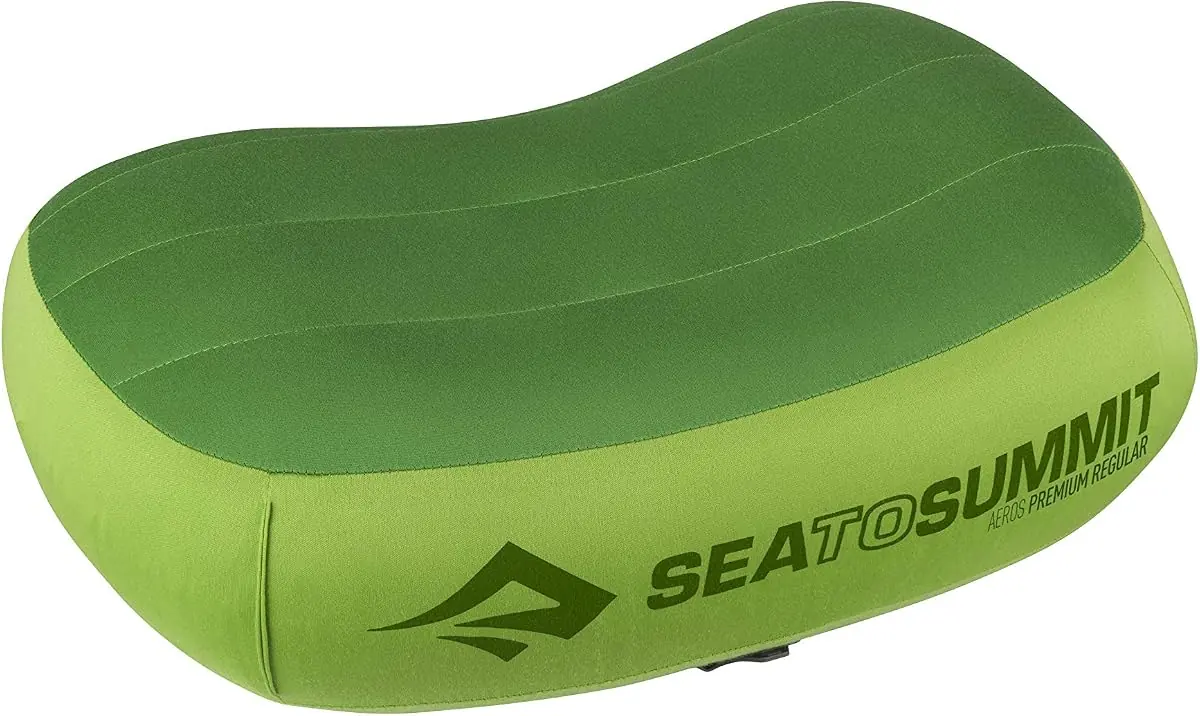
The Aeros Premium is the pillow most people should buy, and it's the one CleverHiker ranks first overall. Memory foam sits bonded under a stretch-knit face, over an air cell, and that sandwich is what makes it work.The regular size inflates to roughly 13.4 by 9.4 inches with about 4.3 inches of loft, weighs 2.8 ounces, and packs down to about the size of a lime. The bottom edge is scalloped so your shoulder tucks under it, and the multi-function valve lets you bleed pressure off while your head's already on it.At 4.6 stars off 1,716 ratings, it has more buyer feedback than any pillow here scoring above 4.5. If you've got no particular reason to pick something else, pick this.

Check Price
Most Like a Real Pillow
NEMO Fillo Camping Pillow
4.6

NEMO Fillo Camping Pillow

Switchback Travel ranks the Fillo first overall, and the reason is simple: it feels more like real bedding than anything else that still fits in a backpack. An inch of foam sits over a baffled air cell, wrapped in a brushed microsuede cover.It measures roughly 17 by 11 inches and weighs 9.2 ounces, more than three times the Aeros Premium. That's the whole trade. What you get for it is a surface with enough give that your ear doesn't compress against a membrane, and enough width that turning over doesn't put you off the edge.It also stuffs into its own integrated sack, so there's nothing separate to lose. If comfort matters more to you than base weight, this is the one.

Check Price
Lightest Soft Top
Sea to Summit Aeros Down Pillow
4.6

Sea to Summit Aeros Down Pillow

The Aeros Down is the Premium's shell with RDS-certified duck down in place of the memory foam. At 2.5 ounces it's the lightest soft-faced pillow on this page.Down does two things foam can't. It's lighter for the same softness, and it insulates, so on a cold night your ear isn't pressed against a cool membrane. The baffles keep the down from migrating to the edges, which is how down usually fails in a panel this small.The regular size gives about 4.7 inches of loft, and that height is what makes it work for side sleepers despite the flat top face. It costs more than the Premium, and it's worth that only if the weight or the warmth matters to you.

Check Price
Comparison Table

Every Pick, Side by Side

Compare all 9 picks
Best Overall
Best For
The best all-around balance of loft, weight and packed size
Difficulty
Beginner
Price
$$$
Most Like a Real Pillow
Best For
The closest thing here to the pillow on your bed
Difficulty
Beginner
Price
$$$
Lightest Soft Top
Best For
The lightest pillow here that still feels soft
Difficulty
Intermediate
Price
$$$
Recommended #4
Best For
Side sleepers who want shaping, not just height
Difficulty
Intermediate
Price
$$$
Recommended #5
Best For
Anyone who never wants to inflate anything
Difficulty
Beginner
Price
$$$
Recommended #6
Best For
The largest sleeping surface that still packs down
Difficulty
Intermediate
Price
$$$
Recommended #7
Best For
The Fillo's shape at half the weight
Difficulty
Advanced
Price
$$$
Recommended #8
Best For
A cheap, very light pillow that holds your head in place
Difficulty
Beginner
Price
$$$
Recommended #9
Best For
The cheapest pillow here that's still worth carrying
Difficulty
Beginner
Price
$$$
The Lineup

9 Best Backpacking Pillows, Compared

Detailed picks with verdicts, strengths, tradeoffs, and the situations where each one makes the most sense.

Best Overall
Sea to Summit Aeros Premium Pillow
4.6 (1,716 Amazon ratings)

Sea to Summit Aeros Premium Pillow

Quick verdict: The Aeros Premium is the pillow most people should buy, and it's the one CleverHiker ranks first overall. Memory foam sits bonded under a stretch-knit face, over an air cell, and that sandwich is what makes it work.

The regular size inflates to roughly 13.4 by 9.4 inches with about 4.3 inches of loft, weighs 2.8 ounces, and packs down to about the size of a lime. The bottom edge is scalloped so your shoulder tucks under it, and the multi-function valve lets you bleed pressure off while your head's already on it.

At 4.6 stars off 1,716 ratings, it has more buyer feedback than any pillow here scoring above 4.5. If you've got no particular reason to pick something else, pick this.

Why It Stands Out

  • CleverHiker's top overall pick in this category
  • Memory foam over the air cell, so the surface doesn't feel like a balloon
  • A scalloped bottom edge that lets a side sleeper's shoulder tuck underneath
  • 2.8 ounces and a packed size that disappears into a hip-belt pocket

Pros

  • Comfortable without a weight penalty
  • Multi-function valve adjusts pressure while you lie on it
  • Stretch-knit face breathes better than bare nylon
  • Usually discounted well below its list price

Cons

  • The regular size is small for anyone who moves around a lot
  • Still an air pillow, with the faint crinkle that implies
  • Cover doesn't come off for washing

Best Situations

A first real pillow to replace a stuffed jacketThru-hiking and any trip counting base weightSide sleepers who want loft without carrying weight for it
Difficulty
Beginner
Price Range
$$$
Most Like a Real Pillow
NEMO Fillo Camping Pillow
4.6 (845 Amazon ratings)

NEMO Fillo Camping Pillow

Quick verdict: Switchback Travel ranks the Fillo first overall, and the reason is simple: it feels more like real bedding than anything else that still fits in a backpack. An inch of foam sits over a baffled air cell, wrapped in a brushed microsuede cover.

It measures roughly 17 by 11 inches and weighs 9.2 ounces, more than three times the Aeros Premium. That's the whole trade. What you get for it is a surface with enough give that your ear doesn't compress against a membrane, and enough width that turning over doesn't put you off the edge.

It also stuffs into its own integrated sack, so there's nothing separate to lose. If comfort matters more to you than base weight, this is the one.

Why It Stands Out

  • Switchback Travel's top overall pick in this category
  • A full inch of foam over the air cell, not a thin bonded layer
  • Brushed microsuede cover that behaves like bedding against skin
  • Integrated stuff sack, so the pillow packs into itself

Pros

  • The most comfortable pillow here that still packs small
  • Wide enough to turn over on
  • Baffled air cell holds its shape under pressure
  • Deep review pool behind a strong rating

Cons

  • Nearly four times the weight of the lightest picks here
  • Packed size is closer to a grapefruit than a lime
  • Overkill for a fast, light trip

Best Situations

Weekend trips where a few extra ounces don't decide anythingAnyone who's tried an air pillow and bounced off itCar camping and backpacking with one pillow for both
Difficulty
Beginner
Price Range
$$$
Lightest Soft Top
Sea to Summit Aeros Down Pillow
4.6 (362 Amazon ratings)

Sea to Summit Aeros Down Pillow

Quick verdict: The Aeros Down is the Premium's shell with RDS-certified duck down in place of the memory foam. At 2.5 ounces it's the lightest soft-faced pillow on this page.

Down does two things foam can't. It's lighter for the same softness, and it insulates, so on a cold night your ear isn't pressed against a cool membrane. The baffles keep the down from migrating to the edges, which is how down usually fails in a panel this small.

The regular size gives about 4.7 inches of loft, and that height is what makes it work for side sleepers despite the flat top face. It costs more than the Premium, and it's worth that only if the weight or the warmth matters to you.

Why It Stands Out

  • 2.5 ounces, the lightest soft-topped pillow on this page
  • Roughly 4.7 inches of loft, near the top of the usable range
  • Down insulates, so the surface isn't cold against your face
  • Baffled construction stops the down migrating to the edges

Pros

  • Down softness at the weight of a bare air pillow
  • Packs down smaller than the foam-topped version
  • Warm against the face on cold nights
  • Responsibly sourced down certified to RDS

Cons

  • Costs more than the better-reviewed Aeros Premium
  • Down needs drying out properly if it gets damp
  • Flat top face, with no shaping to hold your head

Best Situations

Cold-weather and shoulder-season tripsUltralight setups where every ounce is argued overSide sleepers counting grams
Difficulty
Intermediate
Price Range
$$$
Recommended #4
Therm-a-Rest Air Head Down Pillow
4.7 (16 Amazon ratings)

Therm-a-Rest Air Head Down Pillow

Quick verdict: The Air Head Down is the most deliberately shaped pillow here. Instead of a flat rectangle it has a curved profile with a dip where your head sits and raised edges on either side, over a baffled air core topped with down.

CleverHiker picks it as the best ergonomic option, and the shape is the whole argument. The dip cradles the back of your head and stops the slow drift toward the edge that flat air pillows produce, and the raised sides give a side sleeper something to settle into instead of balance on.

The regular size is about 11 by 15.5 inches with roughly 4 inches of loft, and it weighs around 4.9 ounces. The caveat is that it's new enough that the Amazon review pool is still thin, so its 4.5 stars rest on sixteen buyers.

Why It Stands Out

  • Shaped with a central dip and raised sides rather than a flat top
  • CleverHiker's pick for the best ergonomic pillow in the category
  • Baffled air core keeps the profile under the weight of your head
  • Down top layer over the air cell for surface softness

Pros

  • The most head-stable shape on this page
  • Suited to side sleeping straight out of the box
  • Light for how much structure it has
  • Therm-a-Rest's valve is easy to adjust lying down

Cons

  • Sixteen Amazon ratings so far, so the score could still move
  • Among the pricier picks here
  • A shaped pillow either suits you or it doesn't, with little middle ground

Best Situations

Dedicated side sleepersAnyone whose pillow keeps ending up beside their head by morningPairing with a Therm-a-Rest pad and its pillow-pocket bags
Difficulty
Intermediate
Price Range
$$$
Recommended #5
Therm-a-Rest Compressible Cinch Pillow
4.5 (2,319 Amazon ratings)

Therm-a-Rest Compressible Cinch Pillow

Quick verdict: The Compressible Cinch is the only pillow here with no air in it. It's upcycled urethane foam in a soft stretch-knit cover, and it works the way the pillow on your bed works: you take it out, it expands, you put your head on it.

The cinch cord is the useful addition. Pull it and the foam gathers and the loft goes up; let it off and the pillow flattens out, so the same pillow suits a side sleeper and a back sleeper. Nothing else here adjusts without a valve.

It's the heaviest and bulkiest thing here, and that's the entire cost. It also has more buyer ratings than any pillow on this page except the Trekology. Buy it if weight doesn't decide your trip.

Why It Stands Out

  • No inflating, no valve, no pressure to get right
  • Cinch cord adjusts loft between side and back sleeping
  • Nothing to puncture, which no air pillow can claim
  • 2,319 ratings, second only to the Trekology here

Pros

  • Feels like a real pillow immediately, with no setup
  • Adjustable loft without a valve
  • Foam filling is upcycled from sleeping-pad production
  • Machine washable

Cons

  • The heaviest and bulkiest pick here
  • Compresses, but never packs small
  • Needs storing uncompressed or the foam loses loft

Best Situations

Short trips and basecamp nights where pack volume is not tightAnyone who has decided air pillows are not for themDoubling as a car and plane pillow between trips
Difficulty
Beginner
Price Range
$$$
Recommended #6
Exped Mega Pillow
4.8 (22 Amazon ratings)

Exped Mega Pillow

Quick verdict: The Mega is the biggest pillow here by usable area. Its sides are close to vertical instead of tapering, so the whole top face is flat and supportive rather than just the middle of it, and that matters if you shift position at night.

It inflates to roughly 52 by 32 centimeters with about 12 centimeters of loft, and weighs about 6 ounces. The cover is a recycled fleece that unzips off the air cushion completely, so it goes in the wash, and the bladder can be replaced instead of thrown out.

It carries the highest buyer rating on this page, though off only twenty-two ratings so far. It's also tied for the priciest pick here, and what the money buys is surface area and a cover you can actually clean.

Why It Stands Out

  • Near-vertical sides give an unusually large flat sleeping surface
  • Removable, washable recycled fleece cover over a replaceable air cushion
  • Roughly 12 centimeters of loft, at the top of the useful range
  • Exped's flat valve inflates and dumps quickly

Pros

  • The most usable surface area in the lineup
  • Cover comes off completely for washing
  • 4.8 stars, the highest average here
  • Repairable instead of disposable

Cons

  • Twenty-two ratings so far, so treat the score as provisional
  • Tied for the most expensive pick here
  • Large footprint crowds a narrow sleeping pad

Best Situations

Wide pads and anyone who moves around at nightTrips where a clean, washable cover mattersBikepacking and paddling, where bulk matters less than comfort
Difficulty
Intermediate
Price Range
$$$
Recommended #7
NEMO Fillo Elite Luxury Pillow
4.4 (144 Amazon ratings)

NEMO Fillo Elite Luxury Pillow

Quick verdict: The Fillo Elite is what happens when NEMO strips the standard Fillo down for weight. The inch of foam goes, the microsuede goes, and what's left is a baffled air cell inside a light removable cover, at around 4.8 ounces instead of 9.2.

The cover is the part worth noting. It slips off for washing, which is rare at this weight, and it keeps the bare bladder from feeling like one. The baffles hold the profile steady in a way an undivided air pillow can't.

The awkward part is that it costs more than the far more comfortable standard Fillo, and only the Klymit is rated lower here. This is a pillow for someone whose base weight already rules the heavier version out.

Why It Stands Out

  • Roughly half the weight of the standard Fillo with the same footprint
  • Removable cover, which is unusual on an ultralight air pillow
  • Baffled air cell rather than a single undivided bladder
  • Packs smaller than anything else NEMO makes in this category

Pros

  • Real weight saving over the standard Fillo
  • Cover comes off to wash
  • Stable profile under a shifting head
  • Compact enough for an ultralight kit

Cons

  • Costs more than the more comfortable standard Fillo
  • Only the Klymit scores lower on this page
  • Losing the foam loses most of what makes a Fillo a Fillo

Best Situations

Ultralight kits where the standard Fillo is too heavyLong trails where packed volume is the constraintAnyone who wants a washable cover at ultralight weight
Difficulty
Advanced
Price Range
$$$
Recommended #8
Klymit Pillow X
4.2 (1,442 Amazon ratings)

Klymit Pillow X

Quick verdict: The Pillow X is the odd shape on this page, and the shape is the point. An X-shaped depression across the face pulls the middle down and pushes the corners up, so your head sits in a hollow instead of on a dome.

At 2.5 ounces it ties for the lightest thing here, and it's one of the cheapest. It inflates to roughly 15 by 11 inches, but only about 3.5 inches of loft, the lowest published height in the lineup and the main reason it sits where it does.

It's also bare nylon with no soft layer, so most people end up throwing a buff or a shirt over it. Treat it as a very good cheap pillow instead of a comfortable one and it makes a lot of sense.

Why It Stands Out

  • The X-shaped face cradles the head rather than pushing it off
  • 2.5 ounces, tied for the lightest pillow here
  • Among the cheapest picks in the lineup
  • Inflates fully in about three breaths

Pros

  • Excellent head stability for the weight
  • Packs down to about the size of a golf ball
  • Cheap enough to be an easy first pillow
  • Long track record with a large review pool

Cons

  • The lowest published loft here, which limits it for side sleepers
  • Bare nylon face, so most people add a layer over it
  • The lowest buyer rating in the lineup

Best Situations

Back sleepers who want the weight savingA first pillow before committing to an expensive oneHammocks and airplanes, where the X shape works well
Difficulty
Beginner
Price Range
$$$
Recommended #9
Trekology Aluft 2.0 Pillow
4.4 (25,119 Amazon ratings)

Trekology Aluft 2.0 Pillow

Quick verdict: The Aluft 2.0 is the budget answer, and it's a better one than the price suggests. It's a shaped inflatable with a dipped center, about 16 by 12 inches and 4 inches of loft, in a stretchy TPU-laminated fabric that feels softer than bare nylon.

The detail worth knowing is on the underside: a grid of rubber dots that grip the sleeping pad. That's a direct fix for the sliding problem, and nothing else on this page solves it that way.

It carries an enormous number of Amazon ratings, and that's worth reading carefully. A review count that size measures how much a listing has sold, not how good the pillow is, and marketplace brands sell in far bigger volumes than outdoor brands. Take it as evidence the quality is consistent. It doesn't mean the Aluft beats the pillows above it.

Why It Stands Out

  • Rubber dots on the underside grip the pad and stop it sliding
  • A dipped center that cradles the head instead of a flat face
  • Roughly 4 inches of loft, enough for most side sleepers
  • The cheapest pick here by a clear margin

Pros

  • Far more pillow than the price implies
  • The anti-slip backing does what it claims
  • 3.9 ounces, light enough for most trips
  • Water-resistant shell that wipes clean

Cons

  • Review count reflects sales volume more than quality
  • Shell feels synthetic next to a knit or brushed cover
  • Cover doesn't come off

Best Situations

A first backpacking pillow on a tight budgetA spare to lend to whoever forgot theirsAnyone whose main complaint is the pillow sliding away
Difficulty
Beginner
Price Range
$$$
Buying Guide

What to Check Before You Buy

How much loft does a backpacking pillow actually need?

Enough to fill the gap between your shoulder and your ear. For most side sleepers that's about four inches of inflated height that stays put under load. Back sleepers need less, because the gap between the back of the head and the pad is smaller to begin with.

Published heights cluster between three and a half and five inches, and that range matters more than it sounds. The Klymit sits at the bottom of it. The Aeros Down and the Exped sit near the top.

The catch is that an air pillow only holds its stated height at the right pressure. Inflate it hard and it turns into a drum that pushes your head off; underinflate it and it bottoms out. Most people run theirs firmer than they should on the first night and softer every night after.

What actually stops a pillow sliding out from under your head?

Shape does most of the work. A scalloped or curved front edge lets your shoulder tuck in underneath, so the pillow sits against you instead of getting pushed away by your own arm. A flat-fronted rectangle gives your shoulder nowhere to go, and it is the shape that migrates first.

Then there's the surface it rests on. A slick nylon pillow on a slick nylon sleeping pad will migrate, and the fix is either a grippy backing or a cover with some texture. Trekology puts rubber dots on the underside for that reason; several makers use a brushed fabric instead.

Internal structure is the part nobody reads off a spec sheet. An air pillow with baffles inside holds its shape as you press into it. A single undivided bladder squashes flat on one side and balloons on the other, and that's what tips your head off the edge.

Is an air pillow or a compressible foam pillow better for backpacking?

Air wins on weight and packed size. The lightest options here are two and a half ounces and pack down to a fist; the foam alternative is closer to three-quarters of a pound and stays the size of a loaf of bread however hard you squash it.

Foam wins on feel, and for some people that settles it. You pull it out of the pack and it's already a pillow: nothing to inflate, nothing to puncture, no pressure to get right and no crinkle of plastic under your ear.

Most of this page is the middle ground, an air cell with foam or down laid over it. You keep most of the weight saving and most of the softness, and you give up a little of each.

Which top layer you get is a smaller decision than it looks. Foam buys softness for a fraction of an ounce; down buys the same softness for less weight and a little warmth against your cheek. Fill power, the number that decides a sleeping bag, matters far less in a panel this small, because comfort here comes from how the down is held in place rather than how far it lofts.

Does the shell fabric on a backpacking pillow matter?

More than on almost any other piece of gear, because it's the only one you press your face into for eight hours. A bare coated nylon shell is light and cheap, but it doesn't breathe, so a warm night leaves the side of your face damp.

Stretch knit and brushed polyester are the two common upgrades. Both feel closer to bedding and both soak up a little sweat instead of beading it, for a fraction of an ounce. Every pillow in the top half of this page has one or the other.

Denier tells you how tough the shell is, not how it feels. The feature worth paying for is a removable, washable cover, because a pillow picks up sunscreen, bug spray and hair oil in a way nothing else in your pack does.

If you want one pillow that suits most people
Air, with a soft top

This format has taken over the category. Foam or down laid over an air cell gives you the packed size and the weight of an air pillow, plus enough surface softness that you stop noticing you're on one.

The Aeros Premium is the cleanest example and the cheapest way in. The NEMO Fillo runs the same idea with more foam and more fabric, which costs you several ounces and buys the most bedding-like surface here.

If you sleep on your side
Scalloped or curved

Side sleeping is where a flat rectangle fails. Your shoulder needs somewhere to go, and a pillow with a straight front edge gets levered away from your neck by your own upper arm within about twenty minutes.

So look for a scalloped bottom edge or a real curve to the profile, and don't skimp on height. The Therm-a-Rest Air Head Down is shaped for side sleeping on purpose; the Aeros Down gets there on loft alone.

If air pillows aren't your thing
No inflating at all

Some people never make peace with an air pillow. The crinkle, the firmness that's always slightly too much or slightly too little, the two minutes of blowing at the end of a long day. None of it improves with practice.

Compressible foam is the answer, and the trade is honest: you carry the extra weight, and you get a pillow that behaves like the one at home. The Compressible Cinch adds a drawcord so you can tune the loft.

Full Catalog

Compare All 9 Backpacking Pillows

Want to browse beyond the ranked picks? Filter and sort the full backpacking pillows listing below.

Best Backpacking Pillows of 2026 — All Products

9 Products
FAQ

Frequently Asked Questions

For most people, yes, because the alternatives are worse than they sound. A stuffed jacket compresses to nothing within an hour and a stuff sack full of clothes slides away, and neither holds a consistent height.

The cheapest pillow here runs under four ounces. Set against the chance of sleeping badly for three nights, that's one of the easier trades in a pack.

The honest exception is anyone already sleeping fine without one. If you wake up rested on a folded fleece, there's nothing here you need.

Glossary

The words on this page

Every term this guide leans on has its own page with a plain answer at the top.

Browse the whole glossary →
How We Choose Products

How These Picks Are Chosen

Reader-supported and free of paid placements. Every pick is ranked on published specs and Amazon buyer ratings, not on who pays us.

Spec Research

Each pick is compared on published specs, materials, design, and category fit across the major brands.

Practical Fit

Rankings factor in how well each product matches common hiking, backpacking, and trail running needs, not just popularity.

Amazon Buyer Ratings

Star ratings and review volume from verified Amazon buyers are factored in to reflect real-world satisfaction.

Value

A pick earns its spot by delivering useful performance for the money, whether budget or premium.

PAD, QUILT, PILLOW.
THAT'S THE BED.

Pads, quilts and bags are all up now, and the pillow is the piece that finishes the set. My dad and I are working through the rest of the backcountry kit the same way, one category at a time.

Browse All Guides