Skip to content
Best Backpacking Backpacks of 2026 — hiking gear
Backpacking Pack Buying Guide

Best Backpacking Backpacks of 2026

Nine multi-day packs ranked on fit, how much load the frame really moves onto your hips, and weight. Amazon review count didn't get a vote.

View the top picksUpdated 9 August 2026 · Ranked from specs & buyer reviews

If you buy through a link on this page we may earn a commission, at no extra cost to you. It never changes how anything is ranked. Prices were last checked on and move around; the figure on Amazon is the one that counts.

How to Choose

How to Choose a Multi-Day Backpacking Pack

A multi-day pack is the one piece of gear you can research perfectly on paper and still hate by lunchtime on day one, because the number that decides whether it works isn't the price or the liters. It's the length of your back. Two people the same height routinely wear different pack sizes, and a pack that's off by a couple of inches can't be rescued with straps: the hipbelt sits above your hip bones instead of on them, so the load slides onto your shoulders.

Six miles later you're carrying a $350 pack badly. So the order on this page runs fit and adjustability first, then how much weight the frame transfers to your hips, then capacity, then weight. Get the first one wrong and nothing further down the list can save it.

That order matters because it isn't the order Amazon would give you. The most-reviewed 65-liter pack on Amazon is a $110 TETON Explorer with more than 8,200 ratings; the Granite Gear Blaze 60, which OutdoorGearLab rates as a top performer that comfortably carries 50 pounds, has 114. Review volume measures how many units moved through a listing, and in packs that mostly tracks price. What ratings are good for is checking that a pack gets built consistently.

They don't tell you which pack carries better. A thin pool usually means a relisting rather than a problem, and in this category that goes deep enough to change what could be ranked at all: Gregory rebuilt its whole Amazon catalog this year, so every current Baltoro listing carries either a handful of ratings or none, and the two with any feedback are down to single-unit stock. That's why the pack most reviewers set against the Atmos isn't on the list.

Prices here run from a budget-lightweight pick up to the top of Osprey's line, and five of the nine are packs that OutdoorGearLab, CleverHiker, GearJunkie or Treeline Review named as award winners, most of them at or near list price. So this really is the top of what Amazon stocks. There are holes in it, though, and they're worth knowing about before you shop. The real ceiling in this category is around $595, the Mountain Hardwear Alakazam 60, a 30-ounce 60-liter pack.

And almost everything the ultralight world considers best is sold direct and isn't buyable here at all: Durston's Kakwa 55, Gossamer Gear's Mariposa 60, ULA's Circuit, Zpacks' Arc Haul, Hyperlite's Southwest 55, all between roughly $280 and $420, all a pound or more lighter than anything on this page at similar load ratings. So are REI's Flash 55 and Trailmade 60, which win most of this category's budget awards.

Going direct buys you weight, and it costs you the things Amazon is good at: a pack that turns up in two days, goes back easily if the torso length is wrong, and can be tried on against your own measurement while the return window is still open. Ratings, review counts and prices came off the listings on August 9, 2026. My dad and I haven't carried all nine of these; they're ranked from published specs, manufacturer load ratings, buyer feedback and the testing other people have put in print.

Anatomy

The six parts that do the carrying

A backpacking pack is a load-transfer machine with a bag attached, and once you can name the parts of the machine the spec sheets stop being noise. Four of these are what separate a backpacking pack from a big daypack; two are conveniences worth knowing about.

Internal frame

Essential

Aluminum stays, a perimeter wire hoop, or a framesheet inside the packbag, and the reason the whole thing works. It gives the pack a rigid path to push weight down from your shoulders to your hipbelt. Its stiffness sets the pack's load rating, which is why a 45-pound-rated pack cannot be turned into a 60-pound one by tightening straps. Some packs, including both Granite Gear packs here, let you pull the frame out to save weight on light loads.

Hipbelt

Essential

The wide padded belt that closes over the top of your hip bones, and where 75 to 80 percent of the weight is meant to end up. It has to sit on the iliac crest, not on your waist, and it needs enough padding to spread that load without crushing. Sized by circumference separately from torso length on most good packs, and heat-moldable on a few, including the Aether 65.

Shoulder harness and load lifters

Essential

The straps stabilize the load against your back. Holding it up is the hipbelt's job. The load lifters are the two thin webbing straps running from the top of the shoulder straps back to the frame; tension them and they pull the top of the pack in toward you. Set right, the shoulder straps end up at about 45 degrees. If they're flat or pointing down, the pack's torso is too long for you.

Adjustable torso backpanel

Nice to Have

A sliding or ladder-locked panel that lets one shell cover a range of torso lengths instead of one. Osprey calls its version Fit-on-the-Fly; both Granite Gear packs and the Rook use their own. Not strictly essential if you know your measurement and it sits comfortably inside a size band, and close to essential if you're near a boundary, buying without trying it on, or fitting a growing teenager.

Lid, and how you get into the bag

Nice to Have

Most traditional packs are top-loaders with a floating lid, sometimes called a brain, plus a drawcord collar underneath. Some add side or front zip access into the main compartment, which the Atmos and Aether both do, and that's the difference between finding your rain shell in ten seconds and unpacking the top third of your bag. A separate zippered sleeping bag compartment at the base is common on traditional packs and pointless on ultralight ones.

Side compression and external pockets

Essential

Compression straps pull a partly empty pack in so the load can't shift, which matters more than it sounds on uneven ground. Stretch side and front pockets are where the water bottles, filter, wet fly and snacks live, because those are the things you need without stopping. A pack with generous external storage effectively behaves a size larger than its liter figure.

Categories

The five kinds of backpacking pack

Packs sort into families by how much weight they're built to carry, and that is downstream of how light the rest of your kit is. Picking the family before the model removes most of the confusion, and it's decided by your loaded weight on day one rather than by ambition.

Traditional internal frame

$200-$400Loads of 40 to 55 pounds

Four to six pounds empty, 60 to 70 liters, a stiff frame, a thick hipbelt and full organization. The Atmos AG 65, Aether 65, Aura AG 65, Deuter Aircontact Core and Kelty Coyote all live here. This is the right family for a first big pack, for anyone carrying group gear or winter kit, and for anyone whose sleeping bag and tent are ordinary rather than ultralight.

Lightweight framed

$155-$300Loads of 30 to 40 pounds

Two and a half to three and a half pounds, still with a real frame and hipbelt, but less padding and thinner fabric. The Blaze 60, Crown 3 60 and Exos 58 are the three here. The sweet spot for most people who've done a few trips and trimmed their kit, and the family where you get the largest comfort gain per dollar.

Ultralight framed

$280-$595Base weights under 10 pounds

Under two and a half pounds, usually Dyneema or high-tenacity nylon, rated 35 to 45 pounds. Almost entirely direct-to-consumer: Durston, Gossamer Gear, ULA, Zpacks, Hyperlite. Superb if your kit is already light, and a bad buy if it isn't, since you'll be over the rating and the thin belt will tell you about it.

Frameless

$200-$325Loads under 25 pounds

One to one and a half pounds and no support structure at all, so the contents are the frame and packing technique becomes a skill. Rated 18 to 25 pounds and unforgiving past it, since everything lands on your shoulders. A specialist choice for experienced ultralight hikers on short resupply intervals, not a first pack.

Expedition

$400-$60070 liters and up, loads past 55 pounds

Five to six-plus pounds, built for a week of winter food, climbing hardware, or carrying for two. Gregory's Baltoro 100 Pro and Mountain Hardwear's AMG 75 are the archetypes. Necessary for mountaineering and long unsupported trips, and far more pack than a three-season week requires.

Quick Picks

Top Three at a Glance

Short on time? Start with these top-rated backpacking backpacks picks.

Best Overall
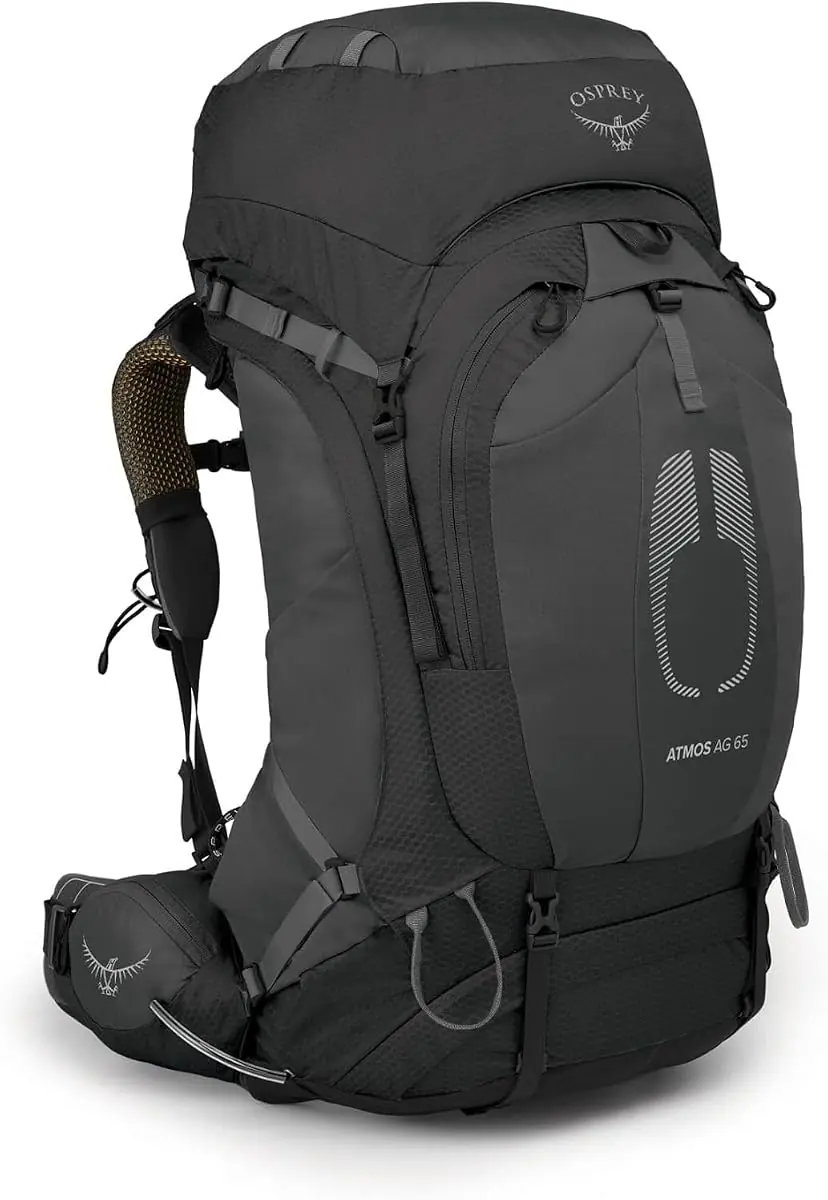
Osprey Atmos AG 65
4.8

Osprey Atmos AG 65

The default recommendation, and the reasons are unglamorous: the torso and hipbelt both adjust, the Anti-Gravity mesh wraps your hips instead of just resting on them, and at 410 ratings averaging 4.8 it has both the biggest pool of buyer feedback on this page and the highest average. It also currently sells below its list price, and below the lighter LT version. Buy this one if you don't want to think about it.

Check Price
Most Load Per Pound
Granite Gear Blaze 60
4.5

Granite Gear Blaze 60

An OutdoorGearLab top performer that comfortably carries up to 50 pounds and weighs three empty. No other pack here gets that much rated carry per pound. The frame comes out if you want it lighter still, and the torso adjusts. It's the pack to buy once you've done a few trips and know your kit.

Check Price
Best Ventilated
Osprey Exos 58
4.6

Osprey Exos 58

CleverHiker and GearJunkie both name the Exos the best-ventilated pack in the category, and at 2 lb 13 oz it undercuts every traditional pack here by a pound and a half. The catch is that it's sold in fixed S/M/L shells with no torso adjustment, so it rewards knowing your measurement. Redesigned for 2025, which is why the ratings pool is only 57.

Check Price
Comparison Table

Every Pick, Side by Side

Compare all 9 picks
Best Overall
Best For
A first serious multi-day pack
Difficulty
Beginner
Price
$$$
Most Load Per Pound
Best For
The most load per pound on this page
Difficulty
Intermediate
Price
$$$
Best Ventilated
Best For
The coolest carry, and the lightest framed pack here
Difficulty
Intermediate
Price
$$$
Recommended #4
Best For
Loads past 45 pounds
Difficulty
Intermediate
Price
$$$
Recommended #5
Best For
A women's-specific fit on the top-ranked chassis
Difficulty
Beginner
Price
$$$
Recommended #6
Best For
Trips where the volume needs to grow
Difficulty
Intermediate
Price
$$$
Recommended #7
Best For
The best value on the page
Difficulty
Intermediate
Price
$$$
Recommended #8
Best For
A full-featured 65L pack at a mid price
Difficulty
Beginner
Price
$$$
Recommended #9
Best For
Heavy loads on the smallest budget
Difficulty
Beginner
Price
$$$
The Lineup

9 Best Backpacking Backpacks, Compared

Detailed picks with verdicts, strengths, tradeoffs, and the situations where each one makes the most sense.

Best Overall
Osprey Atmos AG 65
4.8 (410 Amazon ratings)

Osprey Atmos AG 65

Quick verdict: The default recommendation, and the reasons are unglamorous: the torso and hipbelt both adjust, the Anti-Gravity mesh wraps your hips instead of just resting on them, and at 410 ratings averaging 4.8 it has both the biggest pool of buyer feedback on this page and the highest average. It also currently sells below its list price, and below the lighter LT version. Buy this one if you don't want to think about it.

Why It Stands Out

  • Fit-on-the-Fly adjusts both the harness and the hipbelt, so one shell covers a range rather than a single torso length
  • Anti-Gravity runs one sheet of tensioned mesh from the shoulders down around the hipbelt, giving internal-frame load transfer with external-frame airflow
  • Comfortable well into the 40s in pounds, which covers a week of food without drama
  • Dual curved side zips reach into the main compartment, so a rain shell doesn't mean unpacking the top third
  • 4.8 stars from 410 ratings, the highest average here and the largest pool

Pros

  • Both torso and hipbelt adjust, which is the safest possible buy sight-unseen
  • Suspended mesh backpanel is the coolest carry here on hot climbs
  • Integrated raincover, side zip access and a zippered sleeping bag compartment
  • Well under list at the time of writing

Cons

  • 4.61 lb empty, roughly a pound and a half more than the lightweight packs here
  • A suspended mesh panel holds the load slightly further off your spine, which costs a little balance as weight climbs
  • OutdoorGearLab measured the LT version at 52 liters of usable space against its 65L label

Best Situations

A first pack bought online, where an adjustable torso covers a wrong guessFour to seven nights with ordinary rather than ultralight gearHot, humid climbs where a foam backpanel becomes unpleasant
Difficulty
Beginner
Price Range
$$$
Most Load Per Pound
Granite Gear Blaze 60
4.5 (114 Amazon ratings)

Granite Gear Blaze 60

Quick verdict: An OutdoorGearLab top performer that comfortably carries up to 50 pounds and weighs three empty. No other pack here gets that much rated carry per pound. The frame comes out if you want it lighter still, and the torso adjusts. It's the pack to buy once you've done a few trips and know your kit.

Why It Stands Out

  • Carries up to 50 lb comfortably per OutdoorGearLab, at 3.0 lb empty
  • Removable frame, so the pack can be stripped down for light loads
  • Adjustable torso length rather than fixed size bands
  • Generous external pockets make it behave larger than its 60L label

Pros

  • 50 lb of rated carry at 3 lb empty, the best ratio on this page
  • Frame removes for lighter trips
  • A long-standing thru-hiker favorite rather than a new design

Cons

  • Less padding than the traditional packs, so it's less forgiving past 45 lb
  • OutdoorGearLab measured 58L against the 60L label
  • 114 ratings is a modest pool next to the Osprey line

Best Situations

Weekend and week-long trips at 30 to 50 lbHikers trimming weight who still want a real frame and hipbeltAnyone who wants one pack for both light and heavy trips
Difficulty
Intermediate
Price Range
$$$
Best Ventilated
Osprey Exos 58
4.6 (57 Amazon ratings)

Osprey Exos 58

Quick verdict: CleverHiker and GearJunkie both name the Exos the best-ventilated pack in the category, and at 2 lb 13 oz it undercuts every traditional pack here by a pound and a half. The catch is that it's sold in fixed S/M/L shells with no torso adjustment, so it rewards knowing your measurement. Redesigned for 2025, which is why the ratings pool is only 57.

Why It Stands Out

  • 2 lb 13 oz empty, over a pound and a half lighter than the traditional packs
  • Suspended mesh backpanel that ventilates better than anything else on this page
  • 58 liters is enough for most weeks if your kit is even slightly compact
  • Named best ventilated by both CleverHiker and GearJunkie

Pros

  • Under three pounds empty, with a full harness and hipbelt
  • Excellent airflow on hot, steep ground
  • Sells close to its list price

Cons

  • Fixed torso sizes, so a wrong guess means a return
  • Thinner hipbelt padding gets uncomfortable past about 35 lb
  • 57 ratings, because the 2025 redesign started a new pool

Best Situations

Hikers whose base weight is already trimmed downHot and humid trips where ventilation matters mostAnyone who knows their torso measurement precisely
Difficulty
Intermediate
Price Range
$$$
Recommended #4
Osprey Aether 65
4.6 (213 Amazon ratings)

Osprey Aether 65

Quick verdict: The load-hauler of the group and an OutdoorGearLab and CleverHiker top pick. Where the Atmos suspends the load on mesh, the Aether carries it closer and stiffer, and its hipbelt can be heat-molded to your hips. That's what you want when the pack is really heavy: group gear, winter kit, or a week of food plus water carries.

Why It Stands Out

  • Stiffer, closer carry than the Atmos, which holds up better as weight climbs
  • Heat-moldable hipbelt for a fit no amount of strap tension replicates
  • Built for the 45 lb-plus range where lighter frames start to flex
  • 213 ratings averaging 4.6, a solid pool for a premium pack

Pros

  • The most capable frame here for heavy loads
  • Moldable hipbelt makes a real difference on long carries
  • Full traditional organization, including a sleeping bag compartment

Cons

  • About 5 lb empty, the second heaviest pack here
  • The most expensive pick on the page
  • OutdoorGearLab measured only 45L of usable space against the 65L label

Best Situations

Carrying group gear, a bear canister, or shared foodWinter and shoulder-season trips with bulky insulationWater carries where the load spikes well past 45 lb
Difficulty
Intermediate
Price Range
$$$
Recommended #5
Osprey Aura AG 65 Women's
4.7 (90 Amazon ratings)

Osprey Aura AG 65 Women's

Quick verdict: The Atmos AG 65's women's counterpart, and effectively tied with it if this is the shell that fits you: same Anti-Gravity suspension and same Fit-on-the-Fly adjustment, on a frame with shorter torso options, S-curved shoulder straps that clear the chest, and a hipbelt angled for a wider iliac crest. It currently sells meaningfully cheaper than the men's version despite the same list price.

Why It Stands Out

  • Same Anti-Gravity suspension and adjustable harness and hipbelt as the top pick
  • Shorter torso range, S-curved straps and a conical hipbelt shaped for different pelvic geometry
  • The largest discount on this page against list
  • 4.7 stars from 90 ratings

Pros

  • Real geometry changes rather than a color swap
  • Both torso and hipbelt adjust
  • Cheapest route onto the Anti-Gravity chassis right now

Cons

  • Around 4.6 lb empty, same weight penalty as the men's version
  • Smaller ratings pool than the Atmos at 90 versus 410
  • The fit only helps if your torso and hips suit this shell, so measure first

Best Situations

Anyone whose torso falls in the shorter bands, regardless of labelHikers who find straight-cut shoulder straps chafe across the chestFour to seven nights with ordinary gear
Difficulty
Beginner
Price Range
$$$
Recommended #6
Deuter Aircontact Core 65+10
4.7 (7 Amazon ratings)

Deuter Aircontact Core 65+10

Quick verdict: An OutdoorGearLab top pick and one of the oldest respected trekking pack lines in Europe. The +10 is a drawcord extension collar that lets 65 liters become 75 when a trip runs long, which earns its keep on resupply-light routes. Be aware the Amazon pool is tiny at 7 ratings, and that reflects Deuter's thin US listings rather than the pack.

Why It Stands Out

  • Extension collar adds roughly 10 liters when a trip needs it
  • Built noticeably burlier than the lightweight packs, with heavier fabric
  • Named a top pick by OutdoorGearLab, which measured its torso adjustment as more range than most packs it tested
  • Mid-pack on price against the other traditional-frame packs here

Pros

  • The most durable-feeling construction on this page
  • Real volume flexibility rather than just compression
  • VariSlide back length slides continuously from an 18 to a 22 inch torso
  • A long-established, respected trekking-pack lineage in Europe

Cons

  • About 5.2 lb empty, the heaviest pack here
  • Only 7 Amazon ratings, so buyer feedback is close to no signal
  • Stock on the US listing has been thin, so the link is the least reliable here

Best Situations

Long routes where food volume swings between resuppliesRough, abrasive terrain that punishes thin pack fabricHikers who prioritize durability over weight
Difficulty
Intermediate
Price Range
$$$
Recommended #7
Granite Gear Crown 3 60
4.6 (37 Amazon ratings)

Granite Gear Crown 3 60

Quick verdict: Treeline Review and CleverHiker both name the Crown 3 a budget-lightweight award winner, and at a deep discount off list it's the cheapest pack here while also being effectively tied with the Exos for lightest. Roughly 2.4 to 2.8 pounds, rated to about 35, with a removable frame sheet and an adjustable torso. Also one of very few packs at this price sold in both men's and women's designs.

Why It Stands Out

  • The cheapest pack on the page, and among the two lightest
  • Rated to around 35 lb, which covers most three-season weekends
  • Removable frame sheet and adjustable torso length
  • An award winner at both Treeline Review and CleverHiker

Pros

  • Remarkable value, at a deep discount from list
  • Light enough to feel like an upgrade over a traditional pack
  • Available in men's and women's versions, unusual at this price

Cons

  • 35 lb rating means it is the wrong pack for a heavy week
  • Minimal hipbelt padding compared with the traditional packs
  • 37 ratings, and stock has been limited

Best Situations

Weekend trips at 25 to 35 lbA second, lighter pack for people who already own a big oneAnyone wanting lightweight gear without a premium outlay
Difficulty
Intermediate
Price Range
$$$
Recommended #8
Osprey Rook 65
4.7 (316 Amazon ratings)

Osprey Rook 65

Quick verdict: The value pick in Osprey's own line: 4.7 stars from 316 ratings, the highest average of any pack in the lower half of this page on price. You get an adjustable AirSpeed backpanel, a LightWire frame that moves real weight onto the hipbelt, and an integrated raincover. What you give up against the Atmos is padding, refinement and side zip access.

Why It Stands Out

  • Adjustable AirSpeed suspension covers a range of torso lengths
  • LightWire frame moves real weight onto the hipbelt rather than just holding shape
  • Integrated, removable raincover included
  • 316 ratings at 4.7 stars, one of the three biggest pools here

Pros

  • Adjustable torso at close to half the price of the Atmos
  • Ventilated tensioned backpanel
  • Raincover included rather than a paid extra

Cons

  • Simpler organization, with no side zip into the main compartment
  • Thinner hipbelt and harness padding than the Atmos or Aether
  • Osprey doesn't publish it as a heavy-load pack, so treat 40 lb as the sensible ceiling

Best Situations

A first backpacking pack on a real budgetOccasional trips a few times a yearAnyone unsure of their torso length who wants adjustability cheaply
Difficulty
Beginner
Price Range
$$$
Recommended #9
Kelty Coyote 65
4.6 (330 Amazon ratings)

Kelty Coyote 65

Quick verdict: The cheapest way here to carry 50-plus pounds. Kelty publishes an optimal carry range of 30 to 55 pounds, more than any of the lightweight packs above it manage, and it has 330 ratings at 4.6 stars. The cost is weight: 4 lb 10 oz empty, with a perimeter frame and full traditional organization.

Why It Stands Out

  • Published optimal carry of 30 to 55 lb, the highest figure on this page
  • Perimeter frame and an adjustable fit system
  • Wing pockets, two front zip pockets, J-zip main access and a sleeping bag compartment
  • 330 ratings at 4.6 stars, near the bottom of the page on price

Pros

  • Carries more weight than anything else near this price
  • Deep pool of consistent buyer feedback
  • Easy access to the main compartment through the J-zip

Cons

  • 4 lb 10 oz empty, heavy for 65 liters
  • Less refined suspension than the Osprey and Granite Gear packs
  • Sold in a size-variant family, so check you're ordering the 65L version

Best Situations

First-timers carrying borrowed, heavier gearScout and group trips where someone carries the shared loadAnyone who needs 55 lb of capacity without paying up
Difficulty
Beginner
Price Range
$$$
Buying Guide

What to Check Before You Buy

Torso length decides this, and it isn't your height

Packs are sized by the distance along your spine from the bony bump at the base of your neck, the C7 vertebra you can feel when you tilt your head forward, down to the level of the top of your hip bones. Find the top of your iliac crest with your thumbs, draw an imaginary line straight back to your spine, and measure between those two points.

Most adults land between 15 and 22 inches, and each manufacturer size band covers only about three to four inches, which is why a single pack model is sold in two or three shells rather than one. Height is not a substitute and neither is shirt size. There's a second number to take while you're there: how far around you are at the top of your hip bones, which is where the hipbelt closes and is not the same thing as your natural waist.

Getting either wrong produces the same failure. The belt rides up above the crest, loses the shelf of bone it was supposed to sit on, and hands the load back to your shoulders. Nothing about that is adjustable away.

Six of the nine packs here soften the problem with an adjustable-torso backpanel that slides through a range instead of fixing one length: the Atmos AG 65 and Aura AG 65 with Osprey's Fit-on-the-Fly harness and hipbelt, the Rook 65 with its adjustable AirSpeed panel, both Granite Gear packs, and the Deuter, whose VariSlide panel covers an 18 to 22 inch torso continuously rather than in fixed increments.

The Exos 58 is the opposite, sold in fixed S/M/L shells, so it rewards knowing your number before you order. If you fall near a boundary between two sizes, the adjustable packs are the safer buy.

How much load the frame will actually move onto your hips

The frame exists to get weight off your shoulders and onto your pelvis, and how much it can move is a real, published, finite number. REI's own guidance is that 80 percent or more of a loaded pack's weight should be carried by your hips; CleverHiker puts the target at 75 to 80 percent. That only happens if the frame is stiff enough for the load you put in it, which is why load ratings track frame type so closely.

Frameless packs top out around 18 to 25 pounds, because there's nothing but the contents holding their shape. Framed ultralight packs manage 30 to 45 pounds. Traditional internal-frame packs handle 45 to 50-plus; OutdoorGearLab puts the Blaze 60 at a comfortable 50. Go past a pack's rating and comfort doesn't tail off gently. The frame flexes, the load leans away from your back, and the belt starts to slip.

Both of the suspension designs you'll see named on a spec sheet are on this page. Osprey's Anti-Gravity, on the Atmos and Aura, is a single sheet of tensioned mesh that runs continuously from the shoulders down and around the hipbelt over a perimeter wire frame, so the mesh itself grips your hips rather than the pack merely resting on them. It's a deliberate hybrid, and you get internal-frame load transfer with external-frame airflow.

The trade is real and OutdoorGearLab names it: a suspended mesh backpanel holds the load slightly further off your spine, which costs you a little balance as the weight climbs. The Aether takes the other path with a closer, stiffer carry and a hipbelt you can heat-mold, which is why it's the one here to reach for past 45 pounds.

Your kit's bulk sets the volume you need more than the trip length does

The volume you need is set by the physical bulk of your sleeping bag, pad and shelter far more than by the length of the trip, which is why experienced hikers give volume advice conditionally and beginners get confused by it. CleverHiker's rough ladder is about 40 liters for one to three nights, around 60 for four to six, and 70-plus for a week or more, which it calls expedition territory.

Switchback Travel's answer for the same one-to-three-night trip is 50 to 70 liters, and both are right: the gap between them is entirely down to whether you're packing a compressible down quilt or a synthetic bag the size of a football. Two people can walk the identical weekend loop, one comfortably in 40 liters and one needing 65. Advertised volume isn't measured consistently either.

OutdoorGearLab measured the Osprey Atmos AG LT 65 at 52 liters of usable space and the Aether 65 at 45, both against a 65 on the label. So treat the number on the pack as a category rather than a spec, and compare it against gear you already own instead of against another brand's number.

Every ounce off the empty pack comes out of the frame, the padding or the fabric

There's no free weight saving in a backpack. A lighter pack has less aluminum in the frame, less foam in the belt, or thinner fabric on the body, and each of those lowers the load it can carry well. Ultralight is under 3 pounds, and a traditional 50 to 80 liter pack runs 3.5 to 6.

On this page the Crown 3 60 is roughly 2.4 to 2.8 pounds, the Exos 58 is 2 pounds 13 ounces, the Blaze 60 is 3, the Atmos AG 65 is 4.61, the Kelty Coyote 65 is 4 pounds 10 ounces, the Aether 65 is about 5 and the Deuter Aircontact Core 65+10 about 5.2.

Carrying the 2-pound option only pays off if your total load stays under what it's rated for, so the sequence is backwards from how most people shop: fix the weight of everything else first, then buy the pack that matches the pile. A pack rated to 30 pounds is the wrong pack at 45 whatever it weighs empty, and at that load the extra three pounds of frame and foam is the cheapest comfort you'll ever buy.

REI suggests a loaded pack shouldn't exceed about 20 percent of your body weight, which is 30 pounds for a 150-pound hiker, while noting that very petite hikers often end up above that simply because gear only gets so light. And base weight, the figure the ultralight world argues about, means your kit without food, water or fuel: under 10 pounds is ultralight, under 20 is lightweight, under 30 is traditional.

Consumables are what push a 20-pound base weight to a 35-pound carry on day one, and it's the day-one number the frame has to handle.

The Weekend Trip
50-60L

One to three nights with ordinary gear doesn't need 65 liters. A 50 to 60 liter pack with a real frame covers it, and it won't tempt you into filling space you didn't need. The Blaze 60 and the Crown 3 60 both land here at around three pounds empty, and either one handles a 30 to 35 pound weekend load.

A Week Out
~65L

Four to seven nights, or three nights in shoulder season when the bag and layers get bulky. This is where 65 liters and a stiffer suspension earn their weight, because food for a week is what pushes you past 40 pounds. Start with the Atmos AG 65, and move to the Aether 65 if you'll be over 45 pounds.

Base Weight Under 10 lb
Buy direct

If your kit without food and water is already under ten pounds, the best packs for you aren't on Amazon. Durston, Gossamer Gear, ULA and Zpacks sell direct for roughly $280 to $420 and save a pound or more at the same load rating. The Exos 58 is the closest thing here to that pack.

Getting started

Fitting and loading your first big pack

Most first-pack misery is a fitting problem rather than a gear problem, and all of it is fixable in an afternoon at home. These six steps are in order, and the order is the part that matters.

  1. 1

    Measure your torso before you shop

    Two minutes with a friend and a tape measure gets you your torso length and your hip circumference. Write both down, then look up the size chart for the exact pack you're considering, because the bands move around between brands. Doing this first turns pack shopping from a gamble into a filter, and it's the step almost everyone skips.

  2. 2

    Buy the pack last

    Buy the Big Three first: shelter, sleeping bag, pad. Then weigh and measure the pile they make with a trip's worth of food and water added. That total is what the pack's load rating has to cover, and its bulk is what sets the volume. Buying in this order routinely means a smaller, lighter and cheaper pack than you would have chosen first.

  3. 3

    Load it with real weight before you commit

    An empty pack tells you nothing; every pack feels fine empty. Put 25 or 30 pounds in it, ideally your actual gear, and walk for ten minutes including some stairs. If you bought online, do this at home on carpet while everything is still returnable. Most fit problems reveal themselves inside the first five minutes under load and are invisible without it.

  4. 4

    Adjust it in the right order, from the hips up

    Loosen everything. Settle the hipbelt so its padding sits square on your hip bones and tighten it firmly; this is the load-bearing step and it comes first. Then snug the shoulder straps just until they contact your shoulders, without pulling weight onto them. Then set the load lifters until they angle back at roughly 45 degrees. Then the sternum strap, loosely. Then side stabilizers on the hipbelt. Reversing this order is why so many people carry a good pack badly.

  5. 5

    Pack it in zones

    Sleeping bag and camp shoes at the bottom, since you don't need them until you stop. The heaviest items, food bag and water, in the middle and pressed against your back, because weight held away from your spine acts like a lever. Bulky light things like the tent body and spare clothing around them to stop the heavy stuff moving. Rain shell, map, snacks and headlamp in the lid and side pockets where you can reach them without taking the pack off.

  6. 6

    Do a shakedown walk, then change one thing

    Walk two or three miles on a local trail with the full load a week before the trip. You're looking for hot spots on your shoulders and hips, whether the belt slips as the load settles, and what you couldn't reach without stopping. Fix one thing at a time so you learn which change helped. This walk is also where you find out that something you packed weighs more than it's worth, which is the cheapest weight saving available.

Plain language

The words on the spec sheet, translated

Torso length
The distance along your spine from the C7 vertebra at the base of your neck to the level of the top of your hip bones. Usually 15 to 22 inches in adults, and the measurement pack sizes are actually based on. Unrelated to your height.
Iliac crest
The top ridge of your hip bones, which you can feel by putting your hands on your hips with your thumbs pointing backward. The shelf of bone the hipbelt has to sit on, and the bottom reference point for measuring torso length.
Load lifters
The pair of thin straps running from the top of the shoulder straps back to the frame. Tensioning them pulls the top of the pack toward you. Correctly set, they leave the shoulder straps at roughly a 45-degree angle.
Load rating
The manufacturer's published maximum comfortable carry weight, set by how stiff the frame is. Frameless packs are 18 to 25 pounds, framed ultralight 30 to 45, traditional internal-frame 45 to 50-plus. Exceeding it makes the belt slip rather than the pack break.
Base weight
The weight of your whole kit excluding consumables, meaning no food, water or fuel. Under 10 pounds is ultralight, under 20 lightweight, under 30 traditional. Useful because it's the number that doesn't change day to day, unlike your actual carried weight.
Trampoline or suspended backpanel
A sheet of tensioned mesh held off the pack body so air can move behind your back. Osprey's Anti-Gravity is the best-known version. Cooler than a foam panel, at the cost of holding the load slightly further from your spine.
Brain or lid
The padded pocket that sits on top of a top-loading pack, over the drawcord collar. A floating lid can be raised to cover an overfilled pack, and on some models detaches to work as a small daypack.
Extension collar
The fabric tube above the main compartment, closed with a drawcord, that lets a pack carry above its stated volume. It's what the +10 in Deuter's Aircontact Core 65+10 refers to.
Avoid These

Mistakes worth avoiding on a first big pack

  • Buying by height instead of measuring your torso, which is the most common reason an online pack purchase doesn't work out.
  • Buying the pack before the shelter, sleeping bag and pad, which locks you into a volume and a load rating before you know what you need.
  • Over-buying liters because it seems safer. An oversized pack gets filled to its capacity almost regardless of what the trip required, and you carry the difference.
  • Tightening the shoulder straps to take the weight. The hipbelt carries the load; the shoulder straps only stabilize it. If your shoulders ache early, the belt isn't doing its job.
  • Ignoring the load rating because a pack is on sale. Two pounds saved empty means nothing if the frame gives up 15 pounds short of what you're carrying, and no amount of adjustment closes that gap.
  • Buying ultralight before your kit is ultralight. The pack only saves you weight if your load stays under what its frame can move onto your hips.
  • Judging a pack empty, in a store or in your hallway. Every pack is comfortable with nothing in it, and load is what exposes a fit problem.
  • Treating a big Amazon review count as proof of quality. In this category it mostly identifies the cheapest listings, not the best packs.
Explore Individual Gear

Once you know which setup fits your situation, dig into the full guide library for in-depth picks and buying advice:

Full Catalog

Compare All 9 Backpacking Backpacks

Want to browse beyond the ranked picks? Filter and sort the full backpacking backpacks listing below.

Best Backpacking Backpacks of 2026 — All Products

9 Products
FAQ

Frequently Asked Questions

The rough ladder most experts use is around 40 liters for one to three nights, about 60 for four to six, and 70 or more for a week-plus, which is where it starts being called expedition territory. But treat those as starting points rather than answers, because volume is driven by the bulk of your gear more than the number of nights.

Switchback Travel recommends 50 to 70 liters for that same one-to-three-night trip, and the difference between their answer and the 40-liter one is entirely whether you own compressible ultralight gear or ordinary gear. A down quilt and an inflatable pad might take up a third of the space a synthetic sleeping bag and a foam pad do.

Food is the other variable, and it's the one people forget: a week of food is roughly 10 to 14 pounds and takes real volume, so the same pack that feels roomy on a Friday-to-Sunday trip can be packed to the collar on day one of a seven-day one. So skip the arithmetic. Lay out everything you plan to carry including a week's worth of food if that's the trip, stuff it into the biggest duffel you own, and see how much space it takes up.

Then buy to that. If you land between two sizes, size down rather than up, because a pack with spare room in it tends to get filled to the brim whatever the trip needed.

How We Choose Products

How These Picks Are Chosen

Reader-supported and free of paid placements. Every pick is ranked on published specs and Amazon buyer ratings, not on who pays us.

Spec Research

Each pick is compared on published specs, materials, design, and category fit across the major brands.

Practical Fit

Rankings factor in how well each product matches common hiking, backpacking, and trail running needs, not just popularity.

Amazon Buyer Ratings

Star ratings and review volume from verified Amazon buyers are factored in to reflect real-world satisfaction.

Value

A pick earns its spot by delivering useful performance for the money, whether budget or premium.

PACK SORTED.
NOW FILL IT.

A pack is sized by what goes in it, so the pad, the shelter and the stove are the next things to sort. Guides for all three are up, along with water filters, and my dad and I add them as we work through the kit ourselves.

Best Backpacking Sleeping Pads