Skip to content
Best Backpacking Hammocks of 2026 — hiking gear
Hammock Camping Buying Guide

Best Backpacking Hammocks of 2026

Nine hammocks and hammock shelters. Four of them arrive with no tree straps in the bag, and straps are the cheapest of the parts you still have to go and buy.

View the top picksUpdated 26 August 2026 · Ranked from specs & buyer reviews

If you buy through a link on this page we may earn a commission, at no extra cost to you. It never changes how anything is ranked. Prices were last checked on and move around; the figure on Amazon is the one that counts.

How to Choose

How to Choose a Backpacking Hammock

Nobody tells you this before you buy your first one, so here it is: a hammock isn't a shelter. It's one of the four parts a shelter is made of. The other three are a bug net, a rain tarp, and something underneath you that stops the night pulling heat out of your back. Skip any of them and you'll find out which one at about two in the morning.

ENO sells its Sub6 hammock bare. The same hammock sold as a shelter, with straps, a bug net and a tarp added, is the SubLink, which costs about three and a half times as much and weighs two pounds more, and there's still no insulation in it. The gap between those two prices is what this page is about.

So the order below runs on how close each one gets you to an actual night's sleep off the ground, weighed against what it costs to carry and what it costs to buy. Four things decide that: what's in the bag, what the whole thing weighs once it is, how long the body is, and whether the tree straps are included and wide enough to be legal where you're going.

Length is the one nobody shops on. It's what lets you lie flat on the diagonal, and width barely matters next to it. Amazon review count doesn't come into it, and this category would punish it if it did. The ENO DoubleNest here carries 5,330 ratings, more than the other eight products on this page put together, and it finishes eighth: nineteen ounces of very good nylon with nothing else in the bag.

Search the category on Amazon and the first screen is $15 to $40 hammocks with twenty and thirty thousand ratings each. Those are lounging hammocks, and they're excellent at lounging.

This page runs the full span rather than stopping at the cheap end. OutdoorGearLab's tested roundup puts the category's ceiling around $220 to $300, and the lineup below reaches past it, with two complete systems and the Haven Tent above them. Two of the nine carry an award from that roundup: the Kammok Roo Double is its Editors' Choice and the ENO DoubleNest a Top Pick.

One gap here is worth saying out loud, and that's the cottage tier. Warbonnet and Dutchware build what a lot of experienced hangers consider the best gathered-end hammocks made, the Blackbird and the Chameleon, and neither sells through Amazon at all, so neither is here. If you get deep into this, that's where you end up, and you buy direct. Ratings, prices and availability came off the listings on August 26, 2026.

Weights, fabrics and capacities are the manufacturers' published figures. My dad and I haven't slept in all nine of these and I'm not going to pretend we have. The ranking comes from published specs, buyer feedback, and the testing other people have put in print.

The Anatomy

What a Hammock System Is Actually Made Of

The hammock is the part everybody shops for and the part that matters least to whether you sleep. Here's the whole system, roughly in the order the weather will test it, with an honest note on which pieces you can skip and which you can't.

The hammock body

Essential

A rectangle of ripstop nylon bunched to a point at either end. Two numbers on it matter. Length decides how flat you lie once you go diagonal, and ten to eleven feet suits most adults, while nine feet is short. Denier is the thread weight of the fabric, and it trades durability against ounces: 70D nylon is the workhorse and takes 400 pounds, 40D is the sweet spot for backpacking, and the 20D and 30D fabrics in ultralight models drop the capacity along with the weight.

The suspension

Essential

Flat webbing around the tree, then something adjustable running back to the hammock. Wide webbing is what protects bark, and it's the dimension park rules police. Longer straps are the upgrade that opens up the most campsites, because what usually defeats you at a site is tree spacing, not hammock length. If you're counting grams the ladder runs webbing and carabiners at the heavy end, then daisy chains, then whoopie slings.

The bug net

Essential

Not optional anywhere with mosquitoes, and a hammock presses your back flat against the fabric where they can bite straight through it. Integrated nets zip or roll away and weigh less than a separate one. A sock-style net drops over the outside of everything instead, which is heavier but can be left at home in winter. A symmetrical net is worth looking for either way, since it lets you lie on whichever diagonal the site allows.

The tarp

Essential

A hammock has no roof. A diamond tarp is the lightest thing that counts as one. A hex or catenary-cut tarp actually reaches the ends, which is where most people land. A full winter tarp closes those ends off with doors. Silnylon is the affordable default at nine or ten ounces, and Dyneema is roughly half that for several times the price. Expect $80 to $170 buying one on its own.

The underquilt

Nice to Have

Marked non-essential only because you can start with a pad. It's the piece that turns a summer hammock into a three-season one: an insulated quilt slung under the outside of the hammock, cradling it, so nothing you do can flatten it. Full-length quilts run about sixteen ounces and three-quarter ones about eleven, and prices start near $120 and climb past $230. Keep hammock camping past the first cold snap and you'll end up buying one.

The top quilt or sleeping bag

Essential

Something over you, which is the part people remember to pack. A sleeping bag works fine, though zipping yourself into one inside a hammock is a wrestling match, and its underside is doing nothing for you anyway. A top quilt is the same insulation minus the crushed half and minus the zip. That's why hammock campers drift toward them.

A structural ridgeline

Nice to Have

A cord strung end to end that locks in how deep the hammock hangs. It costs an ounce and about $25 if yours doesn't have one, and it buys you the same bed at every site regardless of tree spacing, so you stop fiddling with tension by feel in the dark. It also gives you somewhere to clip a headlamp and hang wet socks. Four of the hammocks on this page include one.

Drip lines and a few feet of cord

Nice to Have

Two short lengths of cord knotted onto the suspension between the tarp and the hammock. Water tracking along the straps hits the knot, gathers, and falls off there instead of carrying on into bed with you. Costs nothing, weighs nothing, and in a real storm it decides whether you wake up dry.

The Formats

Three Ways to Buy Into Hammock Camping

The same night's sleep is sold three different ways at three very different prices, and the cheapest route often isn't the cheapest once you've finished assembling it. Which one suits you mostly comes down to whether you already own a tarp.

The complete system, one box

$160-$360A first hammock, or anyone who wants to stop shopping

Hammock, netting, tarp and straps designed together and sold in one sack. Hennessy has been building these for decades, and ENO's OneLink and JungleLink do the same job. You give up mixing and matching, and the tarp is usually the piece you'd have upgraded first, but you can go camping the day it arrives. The caveat most of these kits share: none of them includes insulation, except the Haven Tent, which ships with its own insulated pad.

Netting sewn into the hammock

$75-$110People who already carry a tarp, and gram counters

The middle path, and where most backpackers end up. Sewn-in netting weighs less than a separate net and can't be forgotten, and the good ones zip or roll away entirely so the hammock still works as a chair at lunch. Then add whatever tarp you like. The ENO JungleNest and the Onewind both sit here, and at 20 ounces the JungleNest under a light tarp is the lowest realistic total on this page.

The bare hammock

$55-$95Lounging, day trips, and building a custom setup piece by piece

Fabric, carabiners and nothing else. There are two good reasons to buy one. Either you want a hammock for afternoons and camp chairs rather than for sleeping, or you already know what you're doing and you're building a Dutchware or Warbonnet-grade setup around netting, a tarp and a quilt you've picked yourself. The bad reason is mistaking one for a shelter, and if you read the reviews on these listings that's what a lot of people did.

Quick Picks

Top Three at a Glance

Short on time? Start with these top-rated backpacking hammocks picks.

Best Overall
Hennessy Hammock Expedition Classic
4.4

Hennessy Hammock Expedition Classic

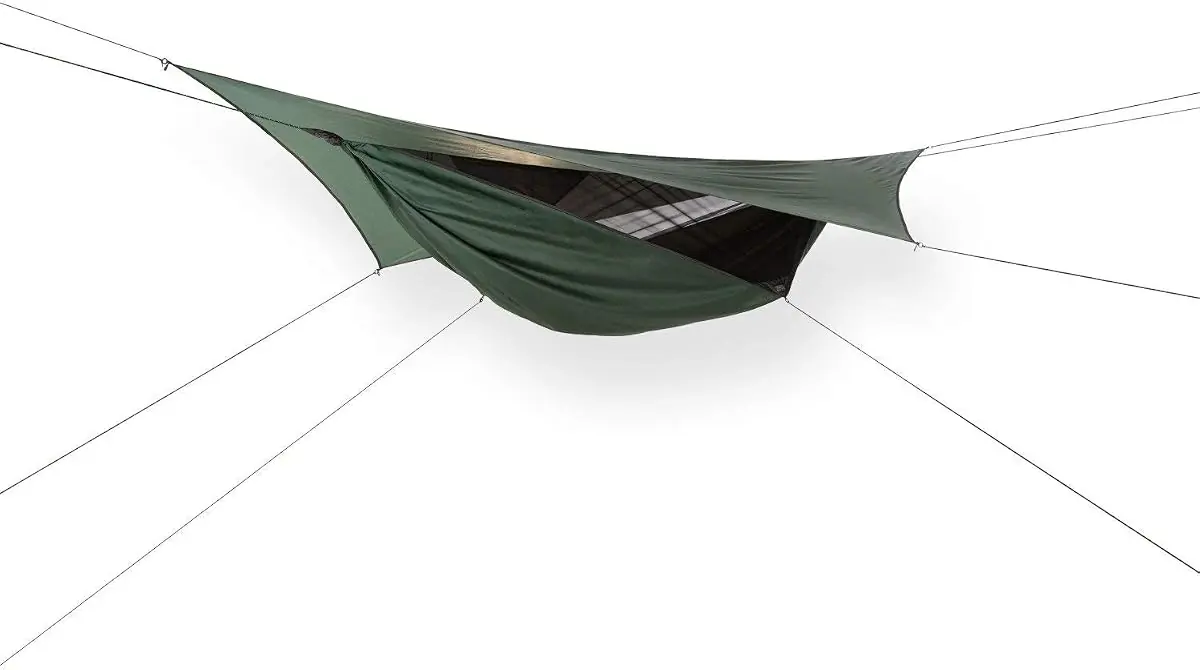
The one I'd point almost anybody at, because it's the only product on this page that's both a complete shelter and light enough to carry happily. Hennessy publishes it at 2 lb 12 oz plus three ounces of tree straps, and that figure already includes the 70-denier polyurethane-coated polyester body, the 30-denier no-see-um netting, a 63-by-99-inch rainfly and 1,500-pound-test suspension ropes.The asymmetric cut and the built-in structural ridgeline are both Hennessy patents, and both earn their keep: the cut hands you the diagonal without hunting for it, and the ridgeline means it hangs the same way every night. It undercuts both complete systems below it and beats them on weight.

Check Price
Lightest Bug-Proof Hang
ENO JungleNest Hammock
4.7

ENO JungleNest Hammock

Twenty ounces buys a ten-foot body in 40-denier NewWave ripstop, a zip-away SkyWeave net held open by a DAC Featherlite spreader bar, a structural ridgeline and a gear loft. That's a lot of hammock for 20 oz, and It is the pick to make when you want a big brand's warranty behind the fabric. It isn't a complete shelter, since there's no tarp and ENO sells the straps separately for about thirty dollars.But hang it under a tarp you already own and you have the lightest sleepable setup on this page, at well under half the weight of either complete system. The spreader bar is what separates it from cheaper netted hammocks: it lifts the mesh off your face instead of draping it across you.

Check Price
Best for Tall Campers
Hennessy Hammock Explorer Deluxe Zip XL
4.5

Hennessy Hammock Explorer Deluxe Zip XL

The same complete-system idea as the Expedition Classic, scaled up and given a real zip. Hennessy rates it to 7 feet and 300 pounds against the Classic's 6 feet and 250, the rainfly is substantially bigger, the suspension ropes go to 1,800-pound test, and the tree straps widen to two inches, which is the number a handful of state park systems insist on. Entry is a heavy-duty number 10 YKK double-slider down the side, so you climb in like a normal person instead of pushing up through a velcro slit.Packed weight is 3 lb 5 oz plus four ounces of straps. If you're tall, heavy, or you just want the zip, this is the one to buy, and sixty dollars is what those things cost.

Check Price
Comparison Table

Every Pick, Side by Side

Compare all 9 picks
Best Overall
Best For
The only single purchase here that is a whole shelter, and the lightest of them
Difficulty
Beginner
Price
$$$
Lightest Bug-Proof Hang
Best For
The lightest way to get bug-proof, if you already carry a tarp
Difficulty
Beginner
Price
$$$
Best for Tall Campers
Best For
Campers up to seven feet tall or three hundred pounds
Difficulty
Beginner
Price
$$$
Recommended #4
Best For
The most hammock per dollar, tarp excepted
Difficulty
Beginner
Price
$$$
Recommended #5
Best For
The full ENO ecosystem in a single sack
Difficulty
Beginner
Price
$$$
Recommended #6
Best For
Side sleepers and anyone the diagonal lay never worked for
Difficulty
Intermediate
Price
$$$
Recommended #7
Best For
A bare hammock built to last, and OutdoorGearLab's Editors' Choice
Difficulty
Beginner
Price
$$$
Recommended #8
Best For
The default bare hammock, and the one most people already own
Difficulty
Beginner
Price
$$$
Recommended #9
Best For
The lowest weight here, once you accept it is not a shelter
Difficulty
Intermediate
Price
$$$
The Lineup

9 Best Backpacking Hammocks, Compared

Detailed picks with verdicts, strengths, tradeoffs, and the situations where each one makes the most sense.

Best Overall
Hennessy Hammock Expedition Classic
4.4 (236 Amazon ratings)

Hennessy Hammock Expedition Classic

Quick verdict: The one I'd point almost anybody at, because it's the only product on this page that's both a complete shelter and light enough to carry happily. Hennessy publishes it at 2 lb 12 oz plus three ounces of tree straps, and that figure already includes the 70-denier polyurethane-coated polyester body, the 30-denier no-see-um netting, a 63-by-99-inch rainfly and 1,500-pound-test suspension ropes.

The asymmetric cut and the built-in structural ridgeline are both Hennessy patents, and both earn their keep: the cut hands you the diagonal without hunting for it, and the ridgeline means it hangs the same way every night. It undercuts both complete systems below it and beats them on weight.

Why It Stands Out

  • Complete shelter at 2 lb 12 oz plus 3 oz of straps, the lightest full system here
  • Asymmetric cut and structural ridgeline come built into the hammock
  • 70d PU-coated polyester body with 30d no-see-um mesh and a 63 x 99 in rainfly
  • Includes 1.5-inch Tree Hugger webbing, which clears the Leave No Trace one-inch guidance

Pros

  • Cheaper than either complete system here and lighter than both
  • Everything, including the tarp and ropes, packs into one 4 x 7 x 9 in sack
  • Structural ridgeline means the hang is repeatable at any tree spacing
  • Hennessy has been refining this design for decades and supports it directly

Cons

  • Bottom entry through a velcro slit divides people; you can't sit on the edge and swing in
  • Rated to 6 feet and 250 pounds, which rules out a lot of people
  • No insulation underneath, true of every kit here except the Haven Tent
  • The zip-entry sibling that reviewers usually test isn't reliably stocked on Amazon

Best Situations

A first hammock where you want one order and no follow-up purchasesThree-season forest trips where you cannot go without a tarpAnyone under six feet who wants the lightest complete system on this page
Difficulty
Beginner
Price Range
$$$
Lightest Bug-Proof Hang
ENO JungleNest Hammock
4.7 (267 Amazon ratings)

ENO JungleNest Hammock

Quick verdict: Twenty ounces buys a ten-foot body in 40-denier NewWave ripstop, a zip-away SkyWeave net held open by a DAC Featherlite spreader bar, a structural ridgeline and a gear loft. That's a lot of hammock for 20 oz, and It is the pick to make when you want a big brand's warranty behind the fabric. It isn't a complete shelter, since there's no tarp and ENO sells the straps separately for about thirty dollars.

But hang it under a tarp you already own and you have the lightest sleepable setup on this page, at well under half the weight of either complete system. The spreader bar is what separates it from cheaper netted hammocks: it lifts the mesh off your face instead of draping it across you.

Why It Stands Out

  • 20 oz for a 10-foot body with an integrated net, ridgeline and spreader bar
  • 40D NewWave ripstop with SkyWeave Lite mesh, ENO's lighter backcountry fabric
  • DAC Featherlite spreader bar holds the mesh up off your face
  • The net stows away entirely, so it works as a bare hammock in winter and at lunch

Pros

  • The lightest bug-proof hang here, thirteen ounces under the next one
  • Structural ridgeline included, which most hammocks at this price omit
  • Hanging interior storage keeps a headlamp and a phone off the ground
  • Sold as the JungleLink system if you later want ENO's tarp and straps

Cons

  • No tarp and no straps in the bag, so budget another $115 or so if you own neither
  • 300-pound capacity, against the 400 and 500-pound ratings on four hammocks below it
  • The 4-foot-10 width is narrower than a true double, so the diagonal is tighter
  • The sewn-in net comes along even on trips with no bugs

Best Situations

Backpackers who already own a tarp and want the lightest hammock under itSummer trips where the net matters more than the rain coverAnyone assembling a setup one piece at a time who wants the net decision settled
Difficulty
Beginner
Price Range
$$$
Best for Tall Campers
Hennessy Hammock Explorer Deluxe Zip XL
4.5 (140 Amazon ratings)

Hennessy Hammock Explorer Deluxe Zip XL

Quick verdict: The same complete-system idea as the Expedition Classic, scaled up and given a real zip. Hennessy rates it to 7 feet and 300 pounds against the Classic's 6 feet and 250, the rainfly is substantially bigger, the suspension ropes go to 1,800-pound test, and the tree straps widen to two inches, which is the number a handful of state park systems insist on. Entry is a heavy-duty number 10 YKK double-slider down the side, so you climb in like a normal person instead of pushing up through a velcro slit.

Packed weight is 3 lb 5 oz plus four ounces of straps. If you're tall, heavy, or you just want the zip, this is the one to buy, and sixty dollars is what those things cost.

Why It Stands Out

  • Fits to 7 feet and 300 pounds, the largest capacity of the complete systems here
  • Number 10 YKK double-slider side entry, in place of the Classic's bottom slit
  • Two-inch Tree Hugger webbing meets even the strictest state-park strap rules
  • 1,800-pound-test suspension ropes and a noticeably larger parallelogram rainfly

Pros

  • The zip entry answers the standing complaint about Hennessy hammocks
  • Larger fly covers gear and the ends far better in sideways rain
  • Same asymmetric cut and structural ridgeline as the top pick
  • Sells at Hennessy's own list price, with no Amazon markup on top

Cons

  • 3 lb 5 oz plus straps, about ten ounces heavier than the Expedition Classic
  • Oversized and over-specified if you're average height and weight
  • Sixty dollars more than the Classic for capacity many buyers won't use
  • Amazon's listing copy quotes a 140-denier body; Hennessy's own page says 70d, so treat the fabric spec with care

Best Situations

Anyone over six feet, where the Expedition Classic runs out of lengthBigger campers who need headroom in the capacity rating, not just the lengthWet-country trips where the larger fly earns its extra ounces
Difficulty
Beginner
Price Range
$$$
Recommended #4
Onewind 11ft Ultralight Camping Hammock
4.6 (300 Amazon ratings)

Onewind 11ft Ultralight Camping Hammock

Quick verdict: Seventy-five dollars for eleven feet of 40-denier hexagon ripstop, an integrated no-see-um net on a full two-way zip, an adjustable UHMWPE ridgeline rated to 1,500 pounds, two twelve-foot tree straps, cinch buckles, continuous loops, shock cords and two aluminum stakes. The only thing missing is the tarp. Eleven feet is the longest body on this page, and that extra foot is what you feel across the diagonal.

Single-panel construction means there's no center seam ridging up under your spine either. Capacity ties the Kammok for the highest here at 500 pounds. It's the value pick on this page, and the twelve-foot straps are longer than most brands include, which quietly solves the tree-spacing problem before you hit it.

Why It Stands Out

  • Eleven-foot body, the longest here, so the most diagonal to stretch out along
  • Integrated bug net on a two-way zip, plus an adjustable structural ridgeline
  • Ships with 12-foot tree straps, cinch buckles, continuous loops and stakes
  • 500-pound capacity in 40D hexagon ripstop, tied with the Kammok for the highest

Pros

  • Everything but the tarp, for a hair under the price of a bare ENO DoubleNest
  • Single wide panel with no center seam under your back
  • Adjustable ridgeline lets you tune the sag instead of living with a fixed one
  • Twelve-foot straps, where most brands hand you nine, which is a lot more usable trees

Cons

  • Still no tarp, so you can't sleep out under it however much else is in the bag
  • 2.1 lb packed is heavier than the ENO JungleNest for a similar job
  • Onewind is a direct-to-Amazon brand with no dealer network behind it
  • 300 ratings is a shallow pool next to the 5,330 on ENO's DoubleNest

Best Situations

A first hammock camping setup on a budget, paired with any cheap tarpTaller sleepers who want length without paying Hennessy pricesAnyone who has been defeated by tree spacing and wants longer straps
Difficulty
Beginner
Price Range
$$$
Recommended #5
ENO OneLink Shelter System
4.8 (83 Amazon ratings)

ENO OneLink Shelter System

Quick verdict: ENO's answer to the complete-kit question: a DoubleNest hammock, Atlas suspension straps, the Guardian bug net and the ProFly rain tarp with DAC stakes, all in one bag at 4 lb 3 oz and rated to 400 pounds. It's the heaviest nylon system here and also the roomiest, because the DoubleNest underneath it is 6 feet 3 inches wide. Amazon's price sits under ENO's own MSRP, so it's a real saving and not a marked-up bundle.

The Guardian is a sock-style net that slides over the whole hammock instead of zipping into it, so in winter you can simply leave it at home. None of the sewn-in designs let you do that.

Why It Stands Out

  • Complete kit at 4 lb 3 oz: DoubleNest, Atlas straps, Guardian net, ProFly tarp, DAC stakes
  • 400-pound system capacity in 70D high-tenacity nylon taffeta
  • The sock-style net comes off entirely, so winter trips do not have to carry it
  • Sells under ENO's own list price, and the ProFly tarp alone accounts for a good part of it

Pros

  • Every part is a standard ENO component you can replace or upgrade individually
  • Widest hammock body of the complete systems at 6 feet 3 inches
  • ProFly's six connection points give more pitch options than a basic diamond tarp
  • 4.8 stars, level with the DoubleNest and the highest average here

Cons

  • 4 lb 3 oz is the heaviest of the nylon systems, about ten ounces over the Hennessy XL
  • No structural ridgeline on the DoubleNest, so the hang shifts with tree spacing
  • Atlas webbing tapers from 1.5 inches to 0.75 at the tree, below the LNT guidance
  • Only 83 ratings behind the bundle, though the components are individually well proven

Best Situations

Anyone already invested in ENO straps, tarps and accessoriesCampers who want a bug net they can leave at home in winterTrips where the extra pound buys width and durability you actually want
Difficulty
Beginner
Price Range
$$$
Recommended #6
Haven Tent Original Lay-Flat Hammock Tent
4.3 (259 Amazon ratings)

Haven Tent Original Lay-Flat Hammock Tent

Quick verdict: The only truly flat bed on this page, and the only product here that includes insulation. Spreader bars hold a rectangular platform open so you sleep on your back, side or stomach the way you would in a tent, and the insulated air mattress in the box takes care of the underquilt purchase every other kit leaves you to make. The body is 210T polyester with a 4,000 mm coating, and the removable rainfly matches it.

It also pitches on the ground with trekking poles, which is this page's only answer to camping above treeline. What it costs is weight and money: 6 lb 1.3 oz trail weight, and the highest price here. If the diagonal has already let you down once, that isn't an unreasonable trade.

Why It Stands Out

  • A flat sleeping platform, so side and stomach sleepers aren't fighting the fabric
  • Insulated air mattress included, which is the $120-plus purchase every other kit omits
  • 4,000 mm waterproof rating on both the body and the removable rainfly
  • Pitches on the ground with trekking poles when there are no trees

Pros

  • The one design here that solves the diagonal-lay problem outright
  • Complete out of the box: pad, fly, straps, stakes and guylines
  • The trekking-pole ground pitch removes hammock camping's biggest limitation
  • A lounge strap converts it into a suspended chair in camp

Cons

  • 6 lb 1.3 oz trail weight, roughly five times the ENO JungleNest
  • The most expensive product on this page by a wide margin
  • 4.3 stars is the lowest average here across a reasonable 259-rating pool
  • Spreader-bar designs are more prone to tipping than gathered-end ones

Best Situations

Side sleepers who have already tried and rejected a gathered-end hammockTrips that mix forest and above-treeline camps in the same weekShort approaches and basecamps where six pounds is not what decides it
Difficulty
Intermediate
Price Range
$$$
Recommended #7
Kammok Roo Double Hammock
4.5 (78 Amazon ratings)

Kammok Roo Double Hammock

Quick verdict: OutdoorGearLab gives this its Editors' Choice, and the reasoning holds up on paper: ten feet long and 5 feet 9 inches wide, 500-pound capacity, GravitasX 40-denier diamond ripstop that's fully recycled and bluesign approved, eight gear loops down the sides, a roll-top stuff sack attached so you can't lose it, and a lifetime guarantee behind all of it. It's a hammock and only a hammock.

No net, no tarp, and the Python straps are a separate purchase. But of the three bare hammocks here it's the longest and the strongest, and that ten-foot body is what puts it ahead of the DoubleNest below.

Why It Stands Out

  • OutdoorGearLab's Editors' Choice in its tested hammock roundup
  • Ten-foot body, longer than the ENO DoubleNest below it, so more diagonal to lie along
  • 500-pound capacity in 40D GravitasX diamond ripstop, fully recycled and bluesign approved
  • Eight gear loops for clipping a pillow, a quilt or small items off the ground

Pros

  • Kammok's lifetime Adventure Grade guarantee covers it outright
  • Attached roll-top stuff sack, so there is no separate bag to lose
  • Recycled fabric with a real environmental certification behind the claim
  • Sells at Kammok's own MSRP, so Amazon isn't adding anything to it

Cons

  • Netting, a tarp and tree straps are all still to buy
  • Kammok's Python straps are another fifty dollars or so on top
  • 78 ratings is the thinnest pool on this page
  • Amazon's listing photography is a marketing collage, not product shots

Best Situations

Piecing together a setup where you pick the netting, the tarp and the quiltCamp lounging and day trips where a bare hammock is the whole pointAnyone who wants one hammock to still be good in fifteen years
Difficulty
Beginner
Price Range
$$$
Recommended #8
ENO DoubleNest Hammock
4.8 (5,330 Amazon ratings)

ENO DoubleNest Hammock

Quick verdict: An OutdoorGearLab Top Pick with more buyer feedback behind it than anything else here, and it still finishes eighth, which tells you how this category works. Nineteen ounces of 70-denier high-tenacity nylon taffeta, triple-stitched, 400-pound capacity, over six feet wide, carabiners in the bag and nothing else. It's an excellent hammock and an incomplete shelter, both at once. Want one for the back yard, the beach and camp afternoons?

Buy it and be happy. Trying to sleep out? Understand that netting, a tarp and about thirty dollars of Atlas straps are three more orders, and that the ENO OneLink above is those same parts bundled for less than they cost apart.

Why It Stands Out

  • OutdoorGearLab Top Pick, and the reference point the whole category is measured against
  • 19 oz of 70D high-tenacity nylon taffeta with triple-stitched seams, rated to 400 pounds
  • 4.8 stars across 5,330 ratings, seventeen times the pool behind any other product here
  • Over six feet wide, so there's plenty of fabric for a comfortable diagonal

Pros

  • Cheapest way into a durable, well-made hammock from a real outdoor brand
  • Works with ENO's entire accessory range, which is the widest in the category
  • The 70D fabric is more abrasion tolerant than the 40D and 30D ultralight nylons
  • Enormous rating pool, so the 4.8 average is about as trustworthy as they get

Cons

  • No straps in the bag despite the price, and Atlas straps are about thirty dollars more
  • No bug net, no tarp, no structural ridgeline
  • At about nine feet it's shorter than the Kammok Roo Double above it
  • Bought piece by piece, these parts come to more than the OneLink bundle costs

Best Situations

Camp afternoons, beaches and back yards, which is what it's best atA second hammock for a partner who isn't yet sold on sleeping in oneThe starting point of a custom setup, if you know what else you're buying
Difficulty
Beginner
Price Range
$$$
Recommended #9
Grand Trunk Nano 7 Single Hammock
4.4 (95 Amazon ratings)

Grand Trunk Nano 7 Single Hammock

Quick verdict: Just over seven ounces, which is well under half the next-lightest hammock here and less than the silnylon tarp you'd hang over it. Grand Trunk publishes 7.3 oz for a nine-by-four-foot body in 1.5 oz ripstop nylon rated to 300 pounds, triple-lock stitched, packing to six inches by four with two wiregate carabiners in the bag. No straps, no net, no tarp, no ridgeline. It's a very good hammock and it finishes last because it's the least shelter on this page.

Carry it as the luxury item on a fast trip, or as the hammock that lives permanently in a day pack, and it earns its weight.

Why It Stands Out

  • 7.3 oz published weight, well under half the 19 oz ENO DoubleNest
  • 1.5 oz ripstop nylon with triple-lock stitched seams and a 300-pound rating
  • Packs to 6 by 4 inches, small enough to forget it's in the pack
  • The only real discount on this page against a list price

Pros

  • The lightest and smallest option here, and the cheapest after the discount
  • Two ultralight wiregate carabiners included
  • Backed by Grand Trunk's lifetime warranty
  • The obvious choice for a hammock you carry on the chance you use it

Cons

  • Nothing in the bag but fabric and two carabiners, so it's the least complete product here
  • Nine by four feet is short and narrow, so the diagonal is cramped for tall sleepers
  • 300-pound capacity, and thin fabric is less forgiving of rough ground and branches
  • 95 ratings is not much feedback for a product that's been on sale this long

Best Situations

Fastpacking and day trips where it is a lunch stop, not a bedThe permanent day-pack hammock that costs you nothing to carryUltralight setups built around a separate tarp and net you already own
Difficulty
Intermediate
Price Range
$$$
Buying Guide

What to Check Before You Buy

What's actually in the bag, and what do the missing parts cost?

This is the first question, and most listings dodge it. Before you can sleep in one you're buying the hammock, netting, a tarp and tree straps, with insulation on top of that. Treeline Review's breakdown of buying those separately puts straps at $30 to $50, a bug net at $40 to $80, and a tarp at $80 to $170. So a $75 hammock is realistically a $225 shelter by the time it keeps rain and mosquitoes off you.

Read the included-components line before you look at the price. ENO's DoubleNest ships with carabiners and no straps at all, and its Atlas straps are about thirty dollars more. Kammok's Roo hammocks come with slings and claws but no straps either. Warbonnet charges $20 to $45 for suspension on top of the hammock. On this page, four products arrive as complete shelters and three arrive as a hammock and nothing else.

How long is the body, and does it have a structural ridgeline?

Length is the spec that decides whether you sleep flat, and it's the one that gets ignored. A gathered-end hammock curves like a banana until you lie across it on the diagonal, roughly ten to fifteen degrees off the centerline, and a longer body gives you more diagonal to work with. Nine feet is short. Eleven feet lies noticeably flatter. Ed Speer's rule of thumb is that the distance between the gathered ends wants to be your height plus about two feet.

The other half of this is a structural ridgeline, a fixed cord running end to end that pins the hammock at whatever sag the maker intended, however far apart the trees happen to be. The figure hammock campers have settled on is a ridgeline about 83 percent of the body length. Without one you're guessing at every campsite, and re-tensioning in the dark.

Where is your bottom insulation coming from?

The thing people call cold-butt syndrome, and the reason a first hammock night in October goes badly. Your body weight crushes the loft of your sleeping bag flat, so underneath you it insulates nothing while moving air pulls heat off the fabric. SectionHiker's figures are the ones worth remembering: most people start feeling cool in a hammock around 65 to 70 degrees, and below about 45 to 50 degrees experienced hangers give up on pads and switch to an underquilt, which hangs outside the hammock where nothing can compress it.

That's another $120 to $230 and eleven to sixteen ounces. Where this gets interesting is the middle ground. A closed-cell foam pad costs a couple of ounces and pennies by comparison, but in a single-layer hammock it wanders off sideways all night, and an inflatable is slicker still. A double-layer hammock has a sleeve between its two sheets of fabric that traps the pad where you put it, and if you're going the pad route that one feature is worth paying for.

Are the tree straps included, and are they wide enough to be legal?

Strap width is one of the few numbers on a piece of backpacking gear that a land manager actually regulates. Leave No Trace asks for webbing an inch or wider so the suspension doesn't girdle bark. REI's own how-to says three quarters of an inch is the floor, an inch and a half is better, and a few parks mandate two inches. Texas State Parks is one of those, and it also wants trees at least eight inches across where the strap touches.

Glacier National Park's compendium allows only single-person hammocks in campgrounds, on straps an inch or wider. Superior National Forest is blunter still: flat webbing an inch or more, and never rope, including the rope some hammocks ship with. Watch for tapered straps too. ENO's Atlas webbing starts at an inch and a half and narrows to three quarters of an inch, and the width where it touches the tree is the number that counts.

If you want one purchase and a night's sleep
$160-$220

Buy a complete Hennessy or the ENO OneLink and stop shopping. The Expedition Classic is the lightest full system here, and the netting, the fly and the suspension ropes all come in one sack. You'll still want insulation underneath before it gets cold. But you can go camping this weekend without placing a second order.

If you already own a tarp
$75-$110

Skip the systems. You've already bought the expensive part, and the kits will only hand you a second tarp. The ENO JungleNest gets you bug-proof for 20 ounces of 40-denier nylon, with a zip-away net and a structural ridgeline on it. The Onewind 11ft Ultralight is longer, rated to 500 pounds, and throws in the straps and stakes too. Hang either one under the tarp you already carry and that's the lightest realistic way into this.

If you sleep on your side
About $360

The diagonal lay works for most people. It doesn't work for everyone. If you've already tried a gathered-end hammock and hated the way it pinched your shoulders, the Haven Tent is the answer on this page: a flat platform held open by spreader bars, with an insulated pad in the box and a rainfly over the top. Six pounds, and the most this page asks. For some sleepers that's what a night off the ground costs.

Getting Started

Your First Night in a Hammock

Almost every bad first hammock night comes down to something that costs nothing to get right. Work through these in order and the first night is the one that sells you on it.

  1. 1

    Hang it in the yard first, twice

    Set the whole thing up somewhere you can walk away from, tarp included, then take it down and do it again. Once you know a hammock it goes up faster than a tent. The first time, in the dark, in rain, it is much slower. Learn where the straps sit and how much sag you like while getting it wrong costs you nothing.

  2. 2

    Get the angle and the height right

    Straps up to the tree at roughly thirty degrees, lowest point of the hammock no more than about eighteen inches off the ground. If the trees sit too close for thirty degrees, hang it steeper instead of hauling it tight. A flat, drum-tight hammock is one of the most common reasons people decide hammocks aren't for them.

  3. 3

    Lie on the diagonal, not down the middle

    Get in, then push your shoulders one way and your feet the other until you're lying ten or fifteen degrees off center. Your back should flatten and the fabric should stop pressing on the sides of your shoulders. It feels wrong for about a minute and then it feels like a bed. If it never does, you might be a flat-lay person, and that's worth finding out before you spend money on a quilt.

  4. 4

    Put something under you, even in summer

    A cheap foam pad on the first trip is fine, and it'll teach you more than any article can. Take a warmer bag than you'd take to a tent at the same temperature. If you wake up cold, you'll wake up cold underneath, and at that point you know exactly what an underquilt is for.

  5. 5

    Pitch the tarp even on a clear forecast

    It takes four more minutes and it's the difference between a night out and a night in the car. It also cuts the wind, which matters more up in a hammock than it does on the ground, and it gives you somewhere dry to leave boots. Tie your two drip lines while you're at it.

  6. 6

    Check the rules before you drive

    Find the park or forest's own page and read the hammock line. Strap width, minimum tree diameter and whether hammocks are allowed at all vary by unit, and rangers do enforce them. Zion says no, full stop. Some state parks want two-inch webbing. It's a two-minute check that can save the whole trip.

The Vocabulary

Hammock Words, in Plain English

Gathered-end
The standard camping hammock: a flat rectangle of fabric bunched to a point at each end. Everything on this page except the Haven Tent is one.
Diagonal lay
Lying across the hammock ten to fifteen degrees off its centerline instead of straight down it. This is what flattens your back, and the whole design depends on you learning it.
Structural ridgeline
A fixed cord between the gathered ends that holds the hammock at one repeatable amount of sag, so tree spacing stops changing how it hangs.
Underquilt
Insulation that hangs on the outside of the hammock rather than inside it, so your body weight never compresses it. The three-season answer to a cold back.
Cold-butt syndrome
The beginner's night of a freezing back and a warm front, caused by your sleeping bag's loft being crushed flat underneath you.
Double layer
Two sheets of fabric with a sleeve between them, sized to hold a sleeping pad so it cannot slide out from under you in the night.
Whoopie sling
An adjustable loop of hollow Dyneema that replaces webbing and buckles on the hammock end of the suspension. Lighter, and adjusts by sliding.
Continuous loop
A small closed loop of cord sewn or larks-headed into each gathered end, giving the suspension something to attach to without knots.
Bridge hammock
A hammock held open by spreader bars at head and foot, giving a true flat lay and taking a rectangular pad. Heavier and tippier than gathered-end.
Drip line
A short length of cord tied to the suspension under the tarp, giving water running down the strap somewhere to fall off before it reaches you.
Avoid These

Six Ways a First Hammock Purchase Goes Wrong

  • Buying a hammock and thinking you've bought a shelter. Netting, a tarp and straps are three more purchases and roughly $150 to $300 more, and nothing on the listing page says so.
  • Hanging it flat and tight. Every instinct says a tight hammock is a comfortable one, and every instinct is wrong. The sag is what lets you lie diagonally in the first place.
  • Sleeping straight down the middle. Down the centerline you're in a banana; across it you're in a bed. Plenty of people try one night the wrong way and write off hammocks entirely.
  • Bringing the same sleeping bag you use in a tent, with nothing underneath. Half of that bag is compressed flat and doing no work at all, which is what ends first trips early.
  • Ignoring strap width. Leave No Trace asks for an inch or wider and some parks mandate two inches. Thin cord, and the rope that ships with cheap hammocks, cuts into bark and will get you moved on.
  • Booking a trip above treeline or into the desert. This is the one drawback with no workaround: no trees, no hammock. A few parks, Zion among them, prohibit them regardless of the trees.
Explore Individual Gear

Once you know which setup fits your situation, dig into the full guide library for in-depth picks and buying advice:

Full Catalog

Compare All 9 Backpacking Hammocks

Want to browse beyond the ranked picks? Filter and sort the full backpacking hammocks listing below.

Best Backpacking Hammocks of 2026 — All Products

9 Products
FAQ

Frequently Asked Questions

A pad works, and it costs a fraction of what a quilt does: under three ounces of closed-cell foam against eleven to sixteen ounces of quilt. The catch is that a flat pad and a curved hammock argue with each other all night, and inflatables are the worst of it because nothing grips them. So the decision splits two ways. If your budget stops at a pad, spend it on a double-layer hammock with a pad sleeve, which holds the pad still for far less than a quilt costs.

If your nights are already dropping under about 45 to 50 degrees, buy the quilt instead. It hangs outside the hammock where your weight never touches it, so you get its full rating rather than half of one.

Glossary

The words on this page

Every term this guide leans on has its own page with a plain answer at the top.

Browse the whole glossary →
How We Choose Products

How These Picks Are Chosen

Reader-supported and free of paid placements. Every pick is ranked on published specs and Amazon buyer ratings, not on who pays us.

Spec Research

Each pick is compared on published specs, materials, design, and category fit across the major brands.

Practical Fit

Rankings factor in how well each product matches common hiking, backpacking, and trail running needs, not just popularity.

Amazon Buyer Ratings

Star ratings and review volume from verified Amazon buyers are factored in to reflect real-world satisfaction.

Value

A pick earns its spot by delivering useful performance for the money, whether budget or premium.

OFF THE GROUND.
NOW STAY WARM ON IT.

A hammock leaves your back hanging in moving air, which is why a bag that works at 30 degrees in a tent leaves you cold at 55 in a hammock. Whatever goes underneath you has to survive being sat on all night. We ranked the sleeping pads on tested R-value rather than the number printed on the box.

Best Backpacking Sleeping Pads