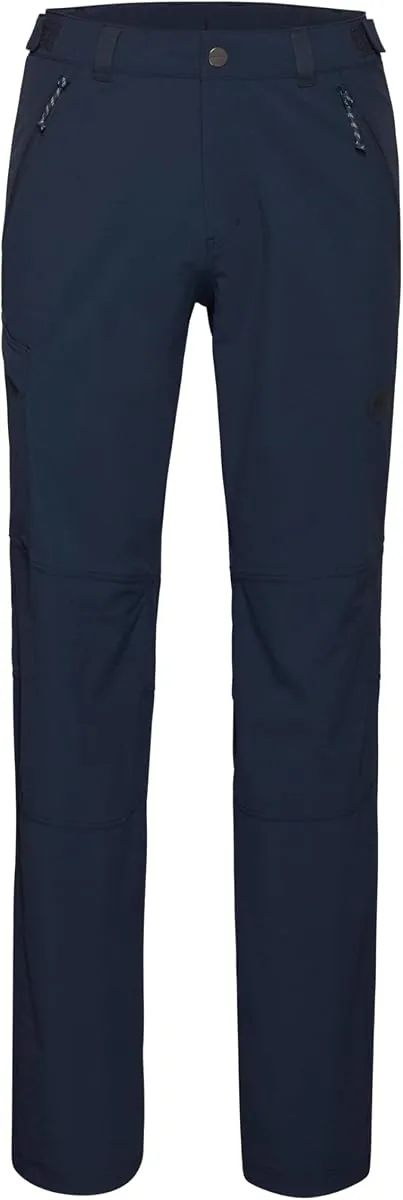
Hiking pants are the thing people think about last and wear longest. You'll take a jacket on and off six times in a day and never once touch your pants, so when they're wrong, they're wrong for eight straight hours. A waistband that digs in under a hipbelt, a crotch seam that catches halfway through a high step, a fabric that soaks up creek spray and is still damp at dinner.
None of that will turn you around. It just grinds on you all day, and that's worse than it sounds.
What separates a good pair from a bad one is the pattern, not the fabric. Two details do most of the work: a gusset set into the crotch, and knees already shaped for a bent leg. Both cost the maker almost nothing, you can't spot either one on a rack, and between them they decide whether a pair disappears on you or fights you from the trailhead on.
So the cut is what this page ranks on first. Then breathability under a pack, then how much weather the fabric turns on its own, then how well it survives being dragged across granite.
Amazon review count sets none of that order, and here it would wreck it. The cheapest pants here carry more ratings than the other seven put together and still finish eighth, while the pair I'd hand somebody first has fewer than a hundred and fifty. Review volume measures how much a listing has sold. It says nothing about how the thing walks.
On price, this is one of the categories where the top of the market really is on Amazon: the Arc'teryx and the Fjällräven below sit at the ceiling the specialist reviewers hand out, so nothing here is a budget stand-in for something better you can't buy. What's missing is missing because Amazon doesn't sell it. KUHL's Renegade, around $100, and REI Co-op's own Trailmade, around $80, both win awards elsewhere and neither has a listing, and Patagonia barely shows up here either.
Buy those direct if they appeal. Then the caveat that matters. My dad and I have not worn any of these pants, not one pair, not for a day, and I'm not going to dress that up. The ranking comes from published specs, the makers' own material data, the testing other reviewers have put in print, and Amazon buyer reviews.
Every rating and price was read on August 27, 2026, off one specific listing, and since pants sell as waist-by-inseam-by-color combinations with a separate listing for each, your size will land somewhere else on the scale. All eight links go to men's listings.
Quick Picks
Top Three at a Glance
Short on time? Start with these top-rated hiking pants picks.
If you only want to own one pair of hiking pants, own these. They get the cut right, turn enough wind to matter on a ridge, and stay comfortable under a hipbelt from the trailhead back to the car.
The pair to reach for when it's hot. Ferrosi is the fabric that made Outdoor Research's name, and it's still what everything light, stretchy and wind-resistant gets measured against.
The pair a lot of people end up owning twice. It hikes like a hiking pant, it looks like something you'd wear to dinner afterwards, and it undercuts the softshells above it by enough to notice.
Quick verdict: If you only want to own one pair of hiking pants, own these. They get the cut right, turn enough wind to matter on a ridge, and stay comfortable under a hipbelt from the trailhead back to the car.
Why It Stands Out
Four-way stretch through the seat and knee, so a high step onto a rock doesn't drag at the waistband or bind behind the knee.
A light softshell hand that cuts wind noticeably better than a plain stretch woven, which is something you notice on a ridge and never in a fitting room.
Zippered hand pockets and a thigh pocket you can still reach with a pack hipbelt buckled over them.
4.7 stars, the highest average on this page, across enough ratings to say the quality is consistent rather than lucky.
Pros
Best all-round balance of stretch, wind resistance and comfort here
Waistband sits well under a loaded hipbelt
4-way stretch moves with technical terrain instead of binding
Highest rated pant on this page
Cons
Warmer than the Ferrosi when it's really hot
No zip-off or roll-up option
Sold in fewer size and color combinations on Amazon than the mainstream names
Best Situations
Day hiking and backpacking across spring, summer and fallExposed ridges and windy summitsAnyone who wants one pair to cover almost everything
Quick verdict: The pair to reach for when it's hot. Ferrosi is the fabric that made Outdoor Research's name, and it's still what everything light, stretchy and wind-resistant gets measured against.
Why It Stands Out
A light stretch-woven softshell with an open enough weave that air moves through it, and it still cuts wind.
Carries a UPF 50+ rating, so covering up in open country beats reapplying sunscreen to your legs all day.
Articulated knees and four-way stretch that move with a high step without needing a cut gusset to do it.
Light enough that plenty of people carry it as their only pant on a multi-day trip.
Pros
Most breathable pant here
UPF 50+ sun protection stated on the listing
Barely there for a fabric that still cuts wind
Excellent stretch and range of movement
Cons
Thin face fabric picks up scuffs on rough granite faster than the heavier pants here
Not as warm as the Runbold IV on cold, windy days
Fit runs trim through the thigh for some people
Best Situations
Desert and canyon hiking in summerFast-moving days and scramblingWarm-weather backpacking where every ounce counts
Quick verdict: The pair a lot of people end up owning twice. It hikes like a hiking pant, it looks like something you'd wear to dinner afterwards, and it undercuts the softshells above it by enough to notice.
Why It Stands Out
A gusseted crotch on a relaxed-fit stretch nylon that doesn't read as technical clothing, which is most of why it sells the way it does.
Roll-up leg snaps hold the cuff at mid-calf, so you can vent real heat and keep the hems out of mud without carrying a zip-off.
A DWR finish that handles wet grass and passing drizzle, and a fabric that dries fast when it does get soaked.
More buyer feedback behind it than either softshell ranked above it, and it costs less than both of them.
Pros
Strong value against the softshells above it
Roll-up cuffs vent heat without a zip
Looks like normal clothing off the trail
A design that's been around long enough to have a settled reputation
Cons
Less wind resistance than a true softshell
Heavier than the Ferrosi in hot weather
The relaxed cut won't suit everyone
Best Situations
General day hiking and travelTrips where one pair has to work on and off the trailWarm days where you want to roll the cuffs up
Quick verdict: A stripped-down alpine softshell built for moving fast in weather that keeps changing its mind. It turns wind and light precipitation at a weight closer to a summer pant than an alpine one.
Why It Stands Out
A superlight softshell face that shrugs off wind and abrasion better than its weight suggests, which is the whole argument for the pant.
An integrated webbing belt, so there's no bulky waistband hardware pressing into you under a hipbelt or a harness.
A trim, tapered lower leg that stays clear of crampon points and boot laces instead of flapping around them.
A DWR finish that sheds spindrift and light rain on days when carrying rain pants would be overkill.
Pros
Very light for a wind-resistant softshell
Integrated belt keeps the waist low-profile under a pack
Tapered leg suits scrambling and technical ground
Arc'teryx construction and detailing
Cons
Only nine Amazon ratings behind it so far, so the pool says very little either way
Among the most expensive pants here
The trim alpine cut is restrictive if you like a relaxed fit
Best Situations
Alpine approaches and scramblingCold, windy days above treelineFast-and-light trips where a softshell replaces rain pants
Quick verdict: Built to a completely different brief from everything else here. The Vidda Pro is a dense, waxable work pant for people who push through brush and kneel on rock, and it should outlast the rest of this page by years.
Why It Stands Out
G-1000, a dense polyester-cotton weave, reinforced at the seat and knees where off-trail travel actually destroys pants.
Designed to be waxed: rub in Greenland Wax and the cotton swells to close the weave, so you can dial weather resistance up or down by season.
Long thigh ventilation zips, which is how a fabric this heavy stays wearable when the day warms up.
Knee pad pockets and a deep, usable set of cargo and thigh pockets for people who carry things in their pants.
Pros
The toughest fabric here, and it isn't close
Reinforced seat and knees for kneeling and scrambling
Thigh vents keep a heavy fabric wearable when it warms up
Waxable, so weather resistance is adjustable
Cons
Heavy, dense canvas that you feel on a hot climb
Slow to dry once it's soaked through
Little stretch next to the softshells above it
The most expensive pair here
Best Situations
Bushwhacking and off-trail travelCold, wet forest hikingAnyone who would rather buy once and repair than replace
Quick verdict: The convertible worth owning if you actually want one. Light nylon with a real sun rating and legs that zip off at the knee, cheap enough that the whole question answers itself.
Why It Stands Out
Zip-off legs at the knee, so a cold start turns into shorts by mid-morning without taking your boots off.
A UPF 50 sun rating on a light nylon that dries quickly after a creek crossing or a downpour.
A gusseted crotch, so it moves like a hiking pant instead of a pair of pants with zippers added.
A deep, consistent rating pool for a convertible, which is a category with a lot of junk in it.
Pros
Real two-garments-in-one for long approach days
UPF 50 sun protection
Light and quick-drying
Cheap for what it does
Cons
Some people notice the knee zipper all day
Thin fabric with little wind resistance
Cut and finish are cruder than the softshells above it
Best Situations
Summer hiking with cold starts and hot afternoonsTravel and trips where packing light mattersAnyone unsure whether they want pants or shorts
Quick verdict: A plain stretch-woven hiking pant that gets the basics right and doesn't ask much of you. It isn't the most technical thing here and it's a lot of pant for the money.
Why It Stands Out
A stretch-woven nylon with a relaxed, comfortable cut that suits people who find alpine pants restrictive.
A zippered thigh pocket that stays usable with a loaded hipbelt sitting over it, which the back pockets on a casual pant can't manage.
Dries quickly and packs down small, which is most of what a three-season hiking pant has to do.
The second-deepest rating pool on this page, so the consistency isn't down to one good production run.
Pros
Comfortable, roomy cut
Good value for a stretch-woven hiking pant
Usable zippered thigh pocket
Second-deepest rating pool here, and a steady one
Cons
Little wind resistance next to the softshells here
Less technical detailing than the pants above it
The relaxed fit flaps in wind
Best Situations
Day hiking on maintained trailsShoulder-season walks in mixed weatherAnyone who wants hiking pants without hiking-pant styling
Quick verdict: The budget pick, and a real one. It's cut for walking rather than styled to look like it, and at this price you can drag it across scree without wincing.
Why It Stands Out
A gusseted crotch at this price, which is the detail most cheap outdoor-styled pants leave out.
Synthetic fabric that dries fast, which is the property jeans fail worst and the one that matters most on a wet day.
A utility thigh pocket and a comfortable waistband that works under a light daypack belt.
The largest rating pool on this page, and a steady one, which is real evidence the quality holds up even though it sets none of the ranking.
Pros
Half the price of the next-cheapest pants here
Gusseted for real, not just outdoor-styled
Dries fast
Thousands of buyers behind it and a steady 4.4 average
Cons
No meaningful wind resistance
Heavier and less breathable than the technical pants above it
Fabric and finish won't last like the Vidda Pro or the softshells
No women's version of this specific model
Best Situations
First pair of hiking pants on a tight budgetRough ground where you expect to trash a pairCasual day hikes and trail work
Why do a gusseted crotch and articulated knees matter more than the fabric?
Because a seam runs out of slack before the fabric does, and then it's the seam that stops your leg. Look for a gusseted crotch and articulated knees, in that order, and treat both as the price of entry rather than as features. A gusset is a separate diamond or triangle of fabric sewn into the crotch instead of four seams running into one point.
That single point is what it fixes. Make a high step onto a rock and everything in that junction goes tight at once, which is what you feel as the pant grabbing you, and it's also where cheap pants split. Set a diamond in there and the load spreads across four seams, so the pant never reaches the end of its travel on a normal stride.
Articulated knees are the same idea moved down the leg. Instead of a straight tube, the knee gets darts or a curved panel so its resting shape is already slightly bent, which is the shape your leg is in for most of a hike. A straight-legged pant has to stretch across your kneecap every time you bend it. That drags the cuff up your boot and bags the knee out permanently inside a season.
Neither detail costs a manufacturer much and neither one shows on a hanger, which is why they're the fastest way to tell a walking pant from a pant that just looks like one. Stretch content helps but won't cover for a bad pattern: four percent elastane in a badly cut pant still binds, and a well-cut pant with no stretch at all moves fine.
Every pair on this page moves the way it should, but not all of them get there with a cut gusset: the prAna, the Arc'teryx, the Columbia and the ATG each list a gusseted crotch on their own spec sheet, while the Ferrosi's retailer listing lists none at all and leans on four-way stretch to do the same job. Fabric and weather are what separate them from there.
What should hiking pants be made of, softshell or nylon, and why never cotton?
Almost always a nylon-based stretch woven or a softshell. Never plain cotton, because it soaks up water, quits insulating the moment it's wet, and takes most of a day to dry. That's the one rule in this category with no exceptions worth chasing, and denim is the worst offender of all. Everything else is a set of trades.
Stretch-woven nylon, usually somewhere near 95% nylon with the rest elastane, is the mainstream answer and what most of this page is made of: light, quick to dry, packs small, takes a durable water repellent finish well. Softshell is a woven face with a brushed or knitted back. It buys you real wind resistance and a warmer hand for a small weight penalty, which is what makes it the better three-season pick in anything short of real heat.
Then there's Fjällräven's G-1000, a dense polyester-cotton weave that's the exception proving the cotton rule. The cotton is in there to swell when you rub wax into it, closing the weave against wind and light rain, so the fabric is a system with that wax rather than a garment on its own. It's heavy, it's slow to dry, and it'll outlive everything else here. Two numbers are worth knowing when you compare fabrics.
Denier is the weight of the yarn, so a higher number means a tougher, heavier cloth. And a UPF figure on the label means the sun protection was tested rather than assumed: in the United States the labelling is governed by ASTM D6603 with the test method set by AATCC 183, so UPF 50 is a measured ratio of blocked UV and not a marketing word. That matters a lot if you hike open country.
How much weather resistance do hiking pants really need?
Enough to shrug off wind and twenty minutes of drizzle, and no further, because the fabrics that actually stop rain don't move enough air to walk in. What you want is a working DWR finish and, if you hike cold or exposed, a face fabric tight enough to cut wind. What you don't want is to buy hiking pants hoping they'll save you carrying rain pants.
A DWR is a surface treatment. There's no membrane involved anywhere. How well it works is measurable rather than a matter of opinion: the spray test behind those 0-to-100 repellency ratings is AATCC 22, standardised internationally as ISO 4920, and a fresh finish scores near the top of it while a worn one does not. So it buys you wet grass and twenty minutes of drizzle, and then it's done: the face fabric gives up, the beading stops, and your legs are wet without anything having leaked.
That's the finish working as designed, and it's the reason rain pants are a separate item you carry. Wind resistance is the underrated half of this. Moving air strips heat far faster than still cold air does, and legs are a lot of surface area with almost no insulation on them, so a fabric tight enough to cut wind is worth more on an exposed ridge than any amount of extra thickness.
That's most of what a softshell buys you over a plain stretch woven. For three-season hiking the setup that works is one breathable pair with the DWR still alive and rain pants in the pack for when it turns. You get damp legs in between and you live with it.
Are convertible hiking pants worth it, or is a roll-up cuff enough?
Zip-offs earn their keep in one situation, which is a long day where the temperature swings hard and you can't stop to change. For everybody else a roll-up cuff covers most of it. The zip is a real feature with real costs, so it comes down to whether you'll use it more than a couple of times a year. A convertible puts a full-circumference zipper across each leg just above or below the knee.
Leave camp at dawn in pants, be in shorts by ten, never take your boots off. You pay for that with a hard zipper track sitting right where your knee bends, a little more weight and bulk, and one more component that can fail. Roll-up cuffs are the cheaper compromise: a snap or a tab inside the leg that holds the hem at mid-calf. It vents a surprising amount of heat, keeps hems out of the mud on a wet trail, and adds essentially nothing to the pant.
It also won't turn into shorts, so treat it as ventilation and not as two garments in one. The option most people land on is neither of those. One pair of full-length pants, plus shorts if you want them, wins on comfort and on sun and scratch protection. If you hike in heat, what actually matters is a light fabric with a UPF rating and enough room for air to move, not a zipper at the knee.
This page carries one convertible, one roll-up and six full-length pairs, which is about the ratio worth owning.
If you're buying one pair
$90-$125
Buy a light softshell and stop thinking about pants. The Mammut Runbold IV is the best-rounded pair here: four-way stretch, a waist that stays comfortable under a loaded hipbelt, enough wind resistance to matter on a ridge. Take the Outdoor Research Ferrosi instead if your hiking skews hot. It breathes better and it carries a UPF 50+ rating. Either one covers three-season hiking for years.
If you hike in heat and dust
$30-$115
Once it's really hot, weight and airflow beat everything else on the list. The Ferrosi is the technical answer, at the light end of this page with sun protection built into the fabric, and the Columbia Silver Ridge Convertible is the pragmatic one, UPF 50 with legs that come off at the knee. If the pants are getting shredded on scree anyway, buy the ATG. It's cheap enough to write off and it's still cut like a hiking pant.
If you go off-trail
$150-$200
Bushwhacking and scree eat light nylon, and this is the one place on the page where the extra money buys something you can point at. The Fjällräven Vidda Pro is built for it: reinforced seat and knees in dense G-1000, thigh vents for when it gets warm, and a fabric you can wax to close it up against weather. The Arc'teryx Gamma SL comes at the same problem from the other end, turning wind and abrasion at a fraction of the weight.
Full Catalog
Compare All 8 Hiking Pants
Want to browse beyond the ranked picks? Filter and sort the full hiking pants listing below.
Look at the pattern before the fabric. A gusseted crotch and articulated knees are what let a pant move with you, and they're the two things most reliably missing from pants that only look outdoorsy. After that, in order: a stretch-woven nylon or softshell that dries fast, a working DWR finish so drizzle beads off, a waistband that sits comfortably under a pack hipbelt, and pockets you can still get into with that hipbelt buckled, which usually means a zippered thigh pocket instead of back pockets.
Weight is worth checking if you hike hot. A UPF rating is worth having if you hike open country. What you can mostly ignore is the pocket count, the branding, and anything sold as waterproof, because a pant that really keeps water out is a pant you'll cook in. Then try them on and make a deliberately ridiculous high step in the fitting room. If anything grabs, that's the pant telling you what it plans to do on a rock all day.
You can, and on a short walk in settled weather nothing bad will happen. But cotton is the wrong material, and it stops being a style question the moment the weather turns. Cotton holds a lot of water, loses essentially all its insulating value once it's wet, and dries very slowly. Wet cotton against your skin in wind pulls heat out of you fast, which is the mechanism behind hypothermia in weather that never got especially cold.
That's where the old hiking-club line about cotton killing comes from, and while the line is dramatic, the physics under it isn't in dispute. Denim is the worst version: heavy dry, much heavier wet, no stretch to speak of, and it chafes badly once damp, especially at the inner thigh where it stays wet longest. Add a crotch with no gusset and a straight leg and you've got a garment that restricts exactly the movement hiking asks for.
Athletic leggings and joggers make a better emergency substitute, since most are synthetic and dry reasonably fast, though they give you almost no abrasion or sun protection and usually no pockets worth having. If you already own synthetic pants of any kind, wear those and spend the money somewhere else first. If you're buying on purpose, the cheapest pair here is a real purchase and not a compromise, and it costs less than most jeans.
Close enough that fabric isn't flapping around your knees, loose enough that air moves, and cut so a full high step doesn't pull anywhere. Standing still in front of a mirror tells you nothing. Put them on, step up onto something knee-high, then drop into a deep squat. Nothing should grab at the crotch, the waistband shouldn't slide down at the back, and the cuff shouldn't ride up past the top of your boot.
If any of that happens the pattern is wrong for you, and no amount of stretch content fixes a pattern. The waist deserves its own look, because a pack hipbelt sits directly on it. A thick, stiff or heavily riveted waistband under a loaded belt turns into a pressure point over a full day, which is why a lot of good hiking pants use a low-profile waistband, an integrated webbing belt, or some elastic at the sides.
If you're carrying a real pack, go for one of those. On length, a hiking pant wants to break right at the top of the boot or sit a touch above it, because a cuff dragging under your heel wears through and collects mud. Plenty of pants come in one inseam and are meant to be worn slightly short, and a roll-up or cinch tab is the fix.
Between waist sizes, size up. You'll have base layers under these in the cold, and a pant you have to unbutton to sit down in is a pant you'll stop packing.
No, and they're not built to. What a hiking pant carries is a DWR finish, a treatment on the outside of the fabric that makes water bead up and roll off. It handles wet grass, spray from a creek crossing, an hour of on-and-off drizzle, light snow. Under sustained rain it wets out: the outer fabric saturates, water stops beading, and you're wet even though nothing has leaked through a hole.
That's the finish reaching the end of what it was designed to do, and it isn't a defect. It also wears off with use, fastest at the thighs and seat where pack straps and rock scrape at it, and you can bring it back with a wash-in or spray-on DWR treatment plus, on most products, a warm tumble to reactivate it. If you need to stay dry, carry rain pants and pull them on over the top when it turns.
Those use a waterproof-breathable membrane, which does stop rain and, as the price of that, breathes far worse than the pants underneath. Which is exactly why nobody hikes all day in them. Fjällräven's G-1000 works on a different principle and is worth understanding on its own terms: rubbing Greenland Wax into the weave swells the cotton content and closes the fabric up, which pushes its weather resistance a long way up.
It still isn't waterproof, and more wax means less breathability, so treat it as a dial you set for the season.
Only if you regularly hike days where the temperature swings a long way and stopping to change is a real hassle. Most people do better owning full-length pants and buying shorts separately. The case for a convertible is good on the right day: zip the legs off mid-morning and you've got shorts without taking your boots off, and it's one garment in the pack instead of two.
The case against is a pile of small things. A full-circumference zipper sits right where your knee flexes, and while plenty of people never notice it, some find it rubs by the end of a long day. It adds weight and bulk. It's another component that can fail, usually at the slider. Reattaching legs in the field is fiddly once you're sweaty, and getting them the right way round on the first try is not a given.
And a lot of people just don't like how they look, which sounds trivial right up until you own a pair you never wear. The middle path is a roll-up cuff, which several pants here have. You get most of the ventilation, none of the hardware, and no way to end up in shorts. And if you mostly hike in heat, a light full-length pant with a UPF rating usually beats a convertible outright, because keeping your skin covered beats reapplying sunscreen all day.
All eight linked listings are the men's versions. Every model here except the ATG is also made in a women's cut, sold as its own Amazon listing with its own price, its own stock and its own review pool. One naming quirk is worth knowing: prAna's women's equivalent of the Stretch Zion is the Halle, not a women's Zion, so searching the men's name won't find it.
The rest carry the same model name with a women's designation. A women's cut is a differently patterned garment, not the same pant relabeled, and in this category that matters more than it does in a jacket. Women's hiking pants are generally cut with a higher rise, more room through the hip and seat relative to the waist, and a different knee position for a shorter average inseam.
This whole page argues that the pattern is what makes a hiking pant work, so wearing one drafted for the wrong body produces exactly the binding and the dropped waistband it warns about. A couple of things about the listings themselves. Every waist, inseam and color combination is its own Amazon listing at its own price, so the figures here belong to the one listing linked and your size may sit some way off it.
And Amazon pools star ratings across a garment's whole variation family, so a rating describes the model rather than the particular color on screen.
Because Amazon review count measures how many units a listing has moved, and on this page that points almost exactly the wrong way. The pair with the deepest pile of ratings finishes eighth, and the pair I ranked first sits near the bottom of the review column and near the top of everything else. Nothing about those numbers is suspicious. They're measuring a different thing.
Review volume mostly tracks price and how long a listing has been up: an inexpensive pant sold through a mass-market channel for years piles up ratings at a rate a specialist pant never will, however much better the specialist pant walks. Rank on that and you systematically promote the cheap and the long-listed over the well-made, which is how plenty of gear roundups end up recommending things nobody who hikes much would buy.
So the order here runs cut first, then how well the fabric breathes with a pack pressing on it, then weather resistance, then durability, and price only breaks ties. Where review counts do earn their keep is consistency. A 4.4 average across eleven thousand ratings tells you the ATG is reliably the pant it claims to be, with very few duds, and that's real information.
It's part of why it earns a place here at all. It just doesn't tell you it's the best pant on the page. Treat a small rating pool as less information, not as a warning, and lean on published specs and independent testing to fill the gap.
From Basecamp
Where this gear goes
Basecamp is the half of the site about hiking itself. These go deeper on what this guide is for.
Twelve one-page checklists, one for each trip and season, with our pick for each item. Leave your email and the PDF is yours, plus a short note when a new guide goes up.
How We Choose Products
How These Picks Are Chosen
Reader-supported and free of paid placements. Every pick is ranked on published specs and Amazon buyer ratings, not on who pays us.
Spec Research
Each pick is compared on published specs, materials, design, and category fit across the major brands.
Practical Fit
Rankings factor in how well each product matches common hiking, backpacking, and trail running needs, not just popularity.
Amazon Buyer Ratings
Star ratings and review volume from verified Amazon buyers are factored in to reflect real-world satisfaction.
Value
A pick earns its spot by delivering useful performance for the money, whether budget or premium.
PANTS SORTED. NOW THE SHELL.
Hiking pants handle drizzle and wind on their own. What they can't do is sustained rain: a DWR finish wets out in an hour of it, and then you're wet whether or not anything leaked. The shell that goes over the top is the next decision, and it's the one that keeps every layer underneath it working.