Skip to content
Best Sun Hoodies for Hiking of 2026 — hiking gear
Sun Hoodie Buying Guide

Best Sun Hoodies for Hiking of 2026

Eight long-sleeve hooded shirts ranked on published sun protection first. They look identical on the hanger and rate anywhere from UPF 15 to 50+, and only three clear the Skin Cancer Foundation's bar.

View the top picksUpdated 4 September 2026 · Ranked from specs & buyer reviews

If you buy through a link on this page we may earn a commission, at no extra cost to you. It never changes how anything is ranked. Prices were last checked on and move around; the figure on Amazon is the one that counts.

How to Choose

How to Choose a Sun Hoodie

A sun hoodie is a long-sleeve shirt with a hood cut to cover your neck and ears. The point of it is that fabric doesn't wear off. Sunscreen does, roughly every two hours, and fastest on the day you sweat hardest. On a full day above treeline the shirt is the only sun protection still working at four in the afternoon, and that's the whole argument for owning one.

The catch is that the eight shirts below look almost identical and are not remotely equivalent. Their published UPF ratings run from 15 to 50 or higher, and the label on the hanger usually doesn't say which. A UPF 15 shirt lets through more than three times the ultraviolet a UPF 50 shirt does. Two garments that photograph the same can sit that far apart, and almost nobody prints the number where you'd see it.

So that's the axis this page ranks on. Published UPF first, then whether the shirt breathes well enough that you keep it on when the day heats up, then hood and cuff detailing, then how it smells on day three. Price breaks ties. Amazon review count sets nothing here, and following it would send you wrong: the shirt with more ratings than the other seven combined finishes sixth.

Several of the shirts the specialist reviewers rank highest aren't sold on Amazon at all. Cotopaxi's Sombra tops CleverHiker's list at around $75. Patagonia's Tropic Comfort runs about $99, REI's Sahara Shade about $60, and Ridge Merino's Solstice Pro around $100. All four are direct-only. If one of those is the shirt you want, buy it from the brand and don't feel bad about it.

What you can buy on Amazon isn't the leftovers, though. The Mountain Hardwear Crater Lake is Treeline Review's number one sun shirt outright, and the Free Fly Shade and the Outdoor Research Astroman Air both sit in their top ten.

I haven't worn all eight of these through a desert summer, and neither has my dad, so treat this as reading rather than field notes. The ranking comes from published specs, the makers' own material data, the ASTM rating scale, and the field testing other reviewers have put in print.

Every price and rating here was read on September 4, 2026, off one specific listing. Sun hoodies sell as size-and-color combinations, each with its own listing, so your size will land somewhere else on the price ladder, occasionally by a lot. All eight links go to men's listings. Every model here comes in a women's cut too, and that's a separate listing again.

Quick Picks

Top Three at a Glance

Short on time? Start with these top-rated sun hoodies picks.

Best Overall
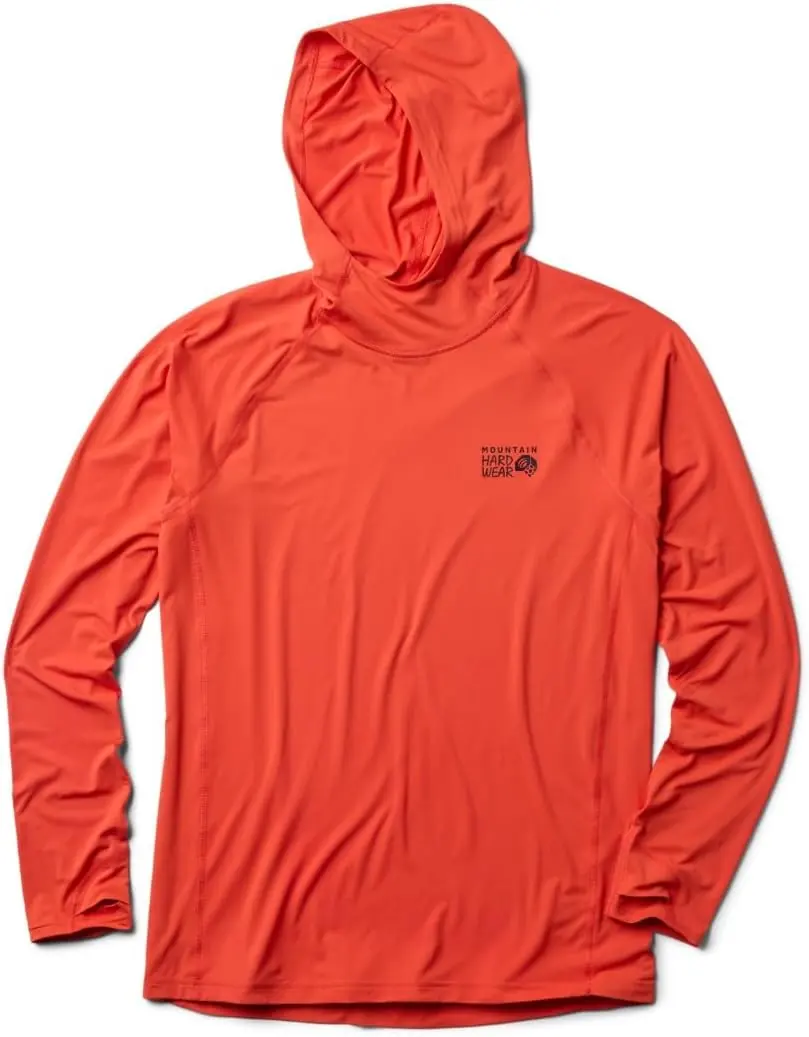
Mountain Hardwear Crater Lake Hoody
4.6

Mountain Hardwear Crater Lake Hoody

The Crater Lake clears UPF 50 at a published 5.9 ounces in a men's medium, and that pairing is what the whole category keeps chasing. Treeline Review ranks it first outright and CleverHiker has it in their top ten, so it isn't one outlet's outlier.The fabric is 88 percent polyester with 12 percent elastane, and the elastane is what makes it disappear under pack straps. Thumb loops keep the backs of your hands covered while you're on poles, and the hood stays where you put it.Watch the price spread across sizes and colors, which on this model runs wider than most. The figure on the tile belongs to the one listing linked here, and your size may sit somewhere else entirely.

Check Price
Best for Hot and Dry
Free Fly Shade Hoodie
4.7

Free Fly Shade Hoodie

The Shade Hoodie is 68 percent bamboo viscose over polyester and spandex, and it feels closer to a favorite old cotton shirt than to a technical knit. That's why people buy it, and the ratings follow: it holds the highest average of any premium pick here.It still holds UPF 50 or higher despite the soft hand, which is the part that surprises people. Bamboo viscose dries slowly, and in dry heat that is an advantage: a damp shirt keeps cooling you by evaporation long after a synthetic has gone dry.Reverse the conditions and the same property turns on you. In a wet week this is the shirt you'll still be pulling on damp in the morning.

Check Price
Best Everyday Pick
The North Face Adventure Sun Hoodie
4.6

The North Face Adventure Sun Hoodie

The Adventure sits in the middle of everything, and on this page that is a compliment, not a shrug. It's published at UPF 40 or higher, which the ASTM scale calls excellent protection, and The North Face sells it in seventeen colors across a size run from XS to 5X.The knit is light and hangs loose instead of clinging, so it moves air on a climb. There are no thumb loops, and the hood is a simpler two-piece design than the climbing shirts above it. That's where the money didn't go, and for most people it doesn't matter.If it's your first sun hoodie and you'd rather not make a study of it, this is the safe answer, and the buyer ratings back that up.

Check Price
Comparison Table

Every Pick, Side by Side

Compare all 8 picks
Best Overall
Best For
The one sun hoodie to own if you only buy one
Difficulty
Beginner
Price
$$$
Best for Hot and Dry
Best For
Desert and canyon heat, and comfort against skin
Difficulty
Beginner
Price
$$$
Best Everyday Pick
Best For
A first sun hoodie without overthinking it
Difficulty
Beginner
Price
$$$
Recommended #4
Best For
Long approaches where odor and heat both matter
Difficulty
Intermediate
Price
$$$
Recommended #5
Best For
Climbers and anyone who wants a half-zip and a pocket
Difficulty
Intermediate
Price
$$$
Recommended #6
Best For
UPF 50 for the least money on this page
Difficulty
Beginner
Price
$$$
Recommended #7
Best For
Multi-day trips where odor beats maximum UPF
Difficulty
Intermediate
Price
$$$
Recommended #8
Best For
Maximum airflow in heat, where shade is available
Difficulty
Beginner
Price
$$$
The Lineup

8 Best Sun Hoodies, Compared

Detailed picks with verdicts, strengths, tradeoffs, and the situations where each one makes the most sense.

Best Overall
Mountain Hardwear Crater Lake Hoody
4.6 (204 Amazon ratings)

Mountain Hardwear Crater Lake Hoody

Quick verdict: The Crater Lake clears UPF 50 at a published 5.9 ounces in a men's medium, and that pairing is what the whole category keeps chasing. Treeline Review ranks it first outright and CleverHiker has it in their top ten, so it isn't one outlet's outlier.

The fabric is 88 percent polyester with 12 percent elastane, and the elastane is what makes it disappear under pack straps. Thumb loops keep the backs of your hands covered while you're on poles, and the hood stays where you put it.

Watch the price spread across sizes and colors, which on this model runs wider than most. The figure on the tile belongs to the one listing linked here, and your size may sit somewhere else entirely.

Why It Stands Out

  • UPF 50, the rating the Skin Cancer Foundation now asks for
  • A published 5.9 ounces, with 12 percent elastane in the blend
  • Ranked first among sun shirts by Treeline Review
  • Thumb loops and a hood that holds its shape in wind

Pros

  • Full UPF 50 in a shirt you forget you're wearing
  • Stretches enough that a loaded pack doesn't pull it tight
  • Independently ranked at the top of its category
  • Usually the least expensive of the premium picks as listed

Cons

  • Price swings a long way between sizes and colors
  • Synthetic, so it'll smell after one hard day
  • Thin enough that you won't want to bushwhack in it

Best Situations

All-day exposure above treelineThree-season hiking where one shirt has to cover everythingAnything under a loaded pack
Difficulty
Beginner
Price Range
$$$
Best for Hot and Dry
Free Fly Shade Hoodie
4.7 (151 Amazon ratings)

Free Fly Shade Hoodie

Quick verdict: The Shade Hoodie is 68 percent bamboo viscose over polyester and spandex, and it feels closer to a favorite old cotton shirt than to a technical knit. That's why people buy it, and the ratings follow: it holds the highest average of any premium pick here.

It still holds UPF 50 or higher despite the soft hand, which is the part that surprises people. Bamboo viscose dries slowly, and in dry heat that is an advantage: a damp shirt keeps cooling you by evaporation long after a synthetic has gone dry.

Reverse the conditions and the same property turns on you. In a wet week this is the shirt you'll still be pulling on damp in the morning.

Why It Stands Out

  • UPF 50 or higher in a fabric that doesn't feel technical
  • The most comfortable thing on this page against bare skin
  • Slow drying keeps evaporative cooling going in dry heat
  • Top-ten placement at both CleverHiker and Treeline Review

Pros

  • Soft in a way that's rare at this protection level
  • Strong buyer ratings across a decent-sized pool
  • Drapes loosely enough to move air
  • Wears well enough off the trail to travel with

Cons

  • Slowest drying fabric here, which hurts in a wet week
  • Viscose is less abrasion resistant than nylon or polyester
  • No thumb loops

Best Situations

Desert and canyon country in summerMulti-day trips where comfort beats drying speedTravel days where you want one shirt that looks normal
Difficulty
Beginner
Price Range
$$$
Best Everyday Pick
The North Face Adventure Sun Hoodie
4.6 (114 Amazon ratings)

The North Face Adventure Sun Hoodie

Quick verdict: The Adventure sits in the middle of everything, and on this page that is a compliment, not a shrug. It's published at UPF 40 or higher, which the ASTM scale calls excellent protection, and The North Face sells it in seventeen colors across a size run from XS to 5X.

The knit is light and hangs loose instead of clinging, so it moves air on a climb. There are no thumb loops, and the hood is a simpler two-piece design than the climbing shirts above it. That's where the money didn't go, and for most people it doesn't matter.

If it's your first sun hoodie and you'd rather not make a study of it, this is the safe answer, and the buyer ratings back that up.

Why It Stands Out

  • UPF 40 or higher, inside the ASTM band labeled excellent
  • Light, loose knit that moves air on a climb
  • Seventeen colors and a size run from XS to 5X
  • Well rated across a decent number of buyers

Pros

  • Almost always in stock in a normal size
  • Relaxed cut that doesn't cling when you sweat
  • Solid protection without a specialist price
  • Reads as an ordinary shirt off the trail

Cons

  • Doesn't reach the UPF 50 threshold
  • No thumb loops, so the backs of your hands are exposed
  • Simpler hood than the climbing-oriented picks

Best Situations

A first sun hoodie for general hikingSummer day hikes with mixed sun and shadeEveryday wear that doubles on the trail
Difficulty
Beginner
Price Range
$$$
Recommended #4
Black Diamond Alpenglow Hoody
4.4 (5 Amazon ratings)

Black Diamond Alpenglow Hoody

Quick verdict: The Alpenglow is the most technically interesting shirt here and the hardest to judge from its listing, because it carries a handful of Amazon ratings and nothing more. What Black Diamond publishes is a UPF 40 or higher fabric built around two treatments most sun hoodies don't have.

The first is a mineral-based in-fiber cooling technology the brand says reflects most incoming near-infrared radiation, the part of sunlight you feel as heat rather than the part that burns you. The second is Polygiene, an embedded antimicrobial that holds odor down with no wool involved.

It is also the heaviest shirt on the page at a published 8.6 ounces, and the priciest. The porous knit and the helmet-compatible hood point squarely at climbers on long, hot approaches, which is who should be buying it.

Why It Stands Out

  • UPF 40 or higher with an in-fiber cooling treatment on top
  • Polygiene odor control gets synthetic close to merino on multi-day trips
  • Textured porous knit moves moisture unusually well
  • Hood cut to sit under a climbing helmet

Pros

  • The only shirt here attacking radiant heat as well as UV
  • Odor control without wool's abrasion problem
  • Substantial enough to take some abuse
  • Hood works with a helmet, which most here don't

Cons

  • Very few Amazon ratings, so buyer evidence is thin
  • Nearly three ounces heavier than the Crater Lake
  • The most expensive pick here

Best Situations

Long alpine approaches in strong sunClimbing days where a helmet goes over the hoodMulti-day trips with no chance to wash anything
Difficulty
Intermediate
Price Range
$$$
Recommended #5
Outdoor Research Astroman Air Sun Hoodie
4.3 (14 Amazon ratings)

Outdoor Research Astroman Air Sun Hoodie

Quick verdict: The Astroman Air has more going on than anything else here. It's 85 percent recycled nylon with 15 percent spandex at a published 5.64 ounces, and it carries a three-panel hood, a zip chest pocket, a front zip you can open to dump heat, and laser-perforated venting down the side panels.

Treeline Review lists it among their top ten, and it's the pick if you want a sun layer that behaves like climbing gear instead of a long-sleeve tee. The half-zip is the feature people miss most once they've had one.

Read the UPF carefully. Outdoor Research publishes UPF 30 or higher for the lighter colors and 50 or higher for the darker ones, and the listing linked here is a light gray, so it is the lower figure. Buy a dark color if protection is what you're here for.

Why It Stands Out

  • Three-panel hood that stays put in crosswind, helmet or not
  • Front zip and laser-perforated side venting for dumping heat
  • A published 5.64 ounces, with 15 percent spandex for stretch
  • Zippered chest pocket, which nothing else here has

Pros

  • The best-engineered hood on this page
  • Actual vents, not just thin fabric
  • Stretchy enough for high steps and overhead reaches
  • Currently listed under Outdoor Research's own list price

Cons

  • Light colors are only UPF 30 or higher, including the one linked
  • Small review pool so far
  • The most complicated shirt here, which isn't what everyone wants

Best Situations

Sport climbing and scrambling approachesHot days with big swings between sun and shadeAnywhere a chest pocket saves you stopping
Difficulty
Intermediate
Price Range
$$$
Recommended #6
Columbia Terminal Tackle Hoodie
4.8 (1,661 Amazon ratings)

Columbia Terminal Tackle Hoodie

Quick verdict: The Terminal Tackle is a fishing shirt that hikers adopted, and the arithmetic is simple. It is UPF 50, which clears the Skin Cancer Foundation's current minimum, at a fraction of what the premium picks cost. Nothing else here does both.

It's also the most-reviewed garment on this page and it isn't close, at the highest average of the eight into the bargain. Read that as evidence of consistency, not of quality, which is exactly why it finishes sixth and not first.

The knit is heavier and less breathable than the shirts above it, the cut is loose in a way that catches wind, and there are no thumb loops. On a climb you'll notice all three. Standing in a river or walking a flat desert trail, you won't notice any of them.

Why It Stands Out

  • UPF 50 at the lowest price on this page
  • More than 1,600 buyer ratings at the highest average here
  • Antimicrobial treatment on the fabric
  • Sold in a wide range of sizes and colors

Pros

  • The cheapest way on this page to clear the UPF 50 bar
  • The deepest buyer evidence of anything here
  • Easy to replace and cheap enough to be careless with
  • Long tail hem stays tucked under a pack hipbelt

Cons

  • Heavier, less breathable knit than the top three
  • No thumb loops
  • Cut for standing in a boat, not for climbing in

Best Situations

Flat, hot, exposed trail milesPaddling, fishing and river daysA second sun shirt so you always have a dry one
Difficulty
Beginner
Price Range
$$$
Recommended #7
Smartwool Merino Sport 150 Hoodie
4.5 (21 Amazon ratings)

Smartwool Merino Sport 150 Hoodie

Quick verdict: This is the odor-control pick, and it earned its place on that and not on its sun rating. The fabric is 56 percent merino wool over 44 percent polyester, a blend that keeps wool's resistance to smelling while the synthetic half covers the abrasion and the drying speed wool is bad at.

Smartwool publishes UPF 20 for it. The ASTM scale calls that good protection, and it's the second-lowest figure on this page. If sun protection is what brought you here, buy one of the top three instead.

Where it wins is a five-day trip with no laundry. A merino blend goes three or four days before it turns where a synthetic goes one, and over five days that is a whole spare shirt you don't have to carry.

Why It Stands Out

  • Merino's odor resistance without pure wool's fragility
  • Polyester content fixes merino's slow drying and poor abrasion resistance
  • Flatlock seams placed to survive pack straps
  • Hidden zip pocket at the side seam

Pros

  • Goes several days between washes without smelling
  • Blend is far more durable than a thin all-merino shirt
  • Regulates temperature better than synthetics across a wide range
  • Comfortable enough to sleep in

Cons

  • UPF 20, the second-lowest rating on this page
  • Among the most expensive picks here
  • Small review pool

Best Situations

Multi-day backpacking with no chance to washCool mornings and hot afternoons in the same dayShoulder season, where it doubles as a light base layer
Difficulty
Intermediate
Price Range
$$$
Recommended #8
Outdoor Research Echo Hoodie
4.6 (306 Amazon ratings)

Outdoor Research Echo Hoodie

Quick verdict: The Echo is the thinnest, airiest shirt here, and that is why it sells: it carries the second-deepest review pool on the page at a strong average, behind only the Columbia.

It's also the least protective thing on this list, and not by a little. Outdoor Research publishes UPF 15 for it, the bottom rung of the ASTM scale's good band, which blocks 93.3 percent where the UPF 50 shirts above it block 98 percent or more.

So it's a specific tool, not a general one. On a hot forest trail, a humid summer run, or anywhere you're ducking in and out of shade, that airflow is the whole point and the rating stops mattering. Out on an open ridge all day, buy something else.

Why It Stands Out

  • The most breathable fabric on this page
  • Very light and packs down to almost nothing
  • 306 buyer ratings at 4.6 stars
  • Cheap enough to keep purely as a hot-weather shirt

Pros

  • Barely registers as a layer in still, hot air
  • Dries almost instantly
  • Weighs nothing worth counting as a spare
  • The least you can spend on an Outdoor Research shirt here

Cons

  • UPF 15, the lowest rating on this page
  • Thin enough that snagging it is a real risk
  • Synthetic, so odor arrives fast

Best Situations

Hot, humid forest trails with plenty of shadeTrail running in summerA spare shirt where packed weight is the constraint
Difficulty
Beginner
Price Range
$$$
Buying Guide

What to Check Before You Buy

What UPF rating do you actually need?

Buy UPF 50 if you can, and treat UPF 30 as the floor. UPF is the fabric version of SPF: the ratio of unprotected to protected ultraviolet reaching your skin, measured under AATCC TM183, the transmittance test from the American Association of Textile Chemists and Colorists, and labeled under ASTM D6603. Both sides of that comparison get measured the same way, which is why the numbers on two different shirts really are comparable.

The scale has three named bands. ASTM International's D6603 calls UPF 15 to 24 good, 25 to 39 very good, and 40 to 50 or higher excellent. In blocked-radiation terms that is 93.3 percent at UPF 15, 96.7 percent at UPF 30 and 98 percent or more at UPF 50. Those percentages look almost identical. They are not: what gets through drops from about one part in fifteen to one part in fifty.

In May 2025 the Skin Cancer Foundation raised the bar for its own Seal of Recommendation, from a minimum of UPF 30 to a minimum of UPF 50. It is the most useful single reference point out there, and by it only three of these eight shirts qualify: the Crater Lake and the Columbia at UPF 50, and the Free Fly Shade at UPF 50 or higher.

That doesn't make a UPF 15 shirt useless. It makes it a hot-weather shirt that happens to cover your arms, which is worth having on a shaded forest trail. It's just not what you want across an exposed ridge in July. The Outdoor Research Echo at the bottom of this page is exactly that shirt, and it's ranked last for exactly that reason.

Does the fabric matter more than the UPF number?

The fabric decides whether you keep the shirt on, and a shirt stuffed in your pack has a UPF of zero. So the two questions aren't really separable. Three fiber families turn up in this category, and once you know which one you're holding, the tradeoffs are easy to predict.

Polyester and nylon are the default, and they earn it. They're light, they dry fast, and they hold a high UPF cheaply, because dense fibers and a tight knit are all it takes. They also survive being dragged along granite. What they do badly is smell: one hard day in a synthetic sun hoodie is fine, three isn't, and that's why thru-hikers keep looking for something else.

Bamboo viscose is the comfort option, and it's most of what the Free Fly Shade is made of. It feels closer to cotton than to a technical knit, it holds a high UPF, and it dries slowly. That last one sounds like a flaw and isn't always. In dry heat a shirt that stays damp keeps cooling you by evaporation for longer, which is why the fabric has a following in the desert.

Merino blends flip the odor problem and give up UPF to do it. Wool fiber scatters ultraviolet less predictably than a tight synthetic knit, and the Smartwool here is published at UPF 20, not 50. That is a trade, not a defect, and it is the right trade when the alternative is packing two shirts for a five-day trip.

What does the hood have to do to be worth wearing?

It has to stay up in wind, sit under a cap brim without fighting it, and cover the back of your neck and both ears without gripping your throat. A hood that does none of those things is just a heavier collar, and plenty of them are exactly that.

Three-panel hoods are the ones that work. A center panel across the crown with a panel down each side follows the shape of a head, so the opening stays in front of your face instead of swinging sideways the moment a crosswind hits. The Astroman Air is built that way for climbers in helmets, and the same geometry is what makes it good on a windy ridge.

Then check the wrists. The backs of your hands catch more sun over a day than anything except your nose, and thumb loops pull the cuff over the base of your thumb and hold it there while you're on poles. Not every shirt has them. The ones that do are much easier to stay covered in without thinking about it.

Collars matter for the same reason. A hood that pulls tight against your throat gets unzipped on the first climb and stays unzipped, so the shirts that work have a scooped or split front that lets the hood sit up without choking you. You can't read that off a spec sheet, which is why it's worth finding a review by somebody who has actually worn one.

Is a sun hoodie hotter than a t-shirt?

In direct sun, usually not, and that is the odd fact the whole category rests on. A light-colored technical knit reflects and scatters solar radiation before it reaches you. A bare arm absorbs it. Cover the arm and you've removed a heat source at the same time you removed the burn risk.

Evaporation is the other half. Sweat cools you when it changes phase off your skin, and a thin wicking fabric spreads that sweat across far more surface area than bare skin offers, so it goes faster. It is why people in hot, dry country have worn long sleeves for as long as anyone has been walking in deserts.

Humidity breaks it. When nothing evaporates the shirt is only insulation, and you'll be hotter in it than out of it. Dead-still air breaks it a different way: a heavier knit traps warm air against you with nothing to move it, which is the moment a laser-perforated or open-weave fabric earns its price.

So for desert, alpine and open ridgelines, a light sun hoodie beats a t-shirt plus sunscreen on comfort as well as protection. For a humid August afternoon in the Southeast it doesn't, and no amount of fabric technology is going to change that.

If you're buying one shirt
UPF 50

Get the UPF 50 and stop thinking about it. The Mountain Hardwear Crater Lake pairs that rating with a published 5.9 ounces, and Treeline Review ranks it first outright. It also has thumb loops, which matter more than they sound like they do. Spending far less gets you the Columbia Terminal Tackle, also UPF 50, in a heavier and stiffer knit. No other shirt here gets you that rating for so little.

If you hike hot and dry
Bamboo viscose

Slow-drying fabric stops being a compromise the moment you're in canyon country. The Free Fly Shade is mostly bamboo viscose at UPF 50 or higher, and it stays damp long enough to keep cooling you by evaporation well past the point a synthetic quits. It is also the one here people keep wearing on rest days. Wrong call for a wet week, when you want something that dries overnight.

If you're out for days without a wash
Merino blend

One hard day is where a synthetic starts to turn. Merino gets three or four, and on a long trip that's the difference between packing one shirt and packing two. The Smartwool Merino Sport 150 is a merino and polyester blend built for exactly that, with flatlock seams that survive pack straps. Read its UPF honestly though. It's published at 20, so what you're buying is a comfort layer that covers your arms, not a sun barrier.

Full Catalog

Compare All 8 Sun Hoodies

Want to browse beyond the ranked picks? Filter and sort the full sun hoodies listing below.

Best Sun Hoodies for Hiking of 2026 — All Products

8 Products
FAQ

Frequently Asked Questions

Aim for UPF 50, and UPF 30 is the lowest I would go. UPF measures how much ultraviolet a fabric blocks: UPF 30 stops about 96.7 percent and UPF 50 stops 98 percent or more. The Skin Cancer Foundation raised its Seal of Recommendation minimum from UPF 30 to UPF 50 in May 2025, and that is the clearest bar available.

Those two percentages sound like a rounding error apart and are not. One part in thirty getting through is more than twice one part in fifty, and over a ten-hour day in strong sun that gap is the whole point of buying the better shirt.

Below that, the ASTM D6603 labeling standard still calls UPF 15 to 24 good protection, so a shirt in that band isn't worthless. It's the wrong tool for an open all-day traverse in strong sun and the right one for a shaded forest trail, where mostly you just want your arms covered against brush and bugs.

Glossary

The words on this page

Every term this guide leans on has its own page with a plain answer at the top.

Browse the whole glossary →
How We Choose Products

How These Picks Are Chosen

Reader-supported and free of paid placements. Every pick is ranked on published specs and Amazon buyer ratings, not on who pays us.

Spec Research

Each pick is compared on published specs, materials, design, and category fit across the major brands.

Practical Fit

Rankings factor in how well each product matches common hiking, backpacking, and trail running needs, not just popularity.

Amazon Buyer Ratings

Star ratings and review volume from verified Amazon buyers are factored in to reflect real-world satisfaction.

Value

A pick earns its spot by delivering useful performance for the money, whether budget or premium.

SHIRT SORTED.
NOW THE LEGS.

A sun hoodie covers you from the wrists up, then stops. Everything below your waist is still out there, and a pair of hiking pants handles it better than a bottle of sunscreen you have to remember to reapply.

Best Hiking Pants