Skip to content
Best Backpacking Stoves of 2026 — hiking gear
Backpacking Stove Buying Guide

Best Backpacking Stoves of 2026

Nine stoves ranked on wind performance, regulated valves and weight. The lightest one here is also the cheapest, at 0.9 ounces.

View the top picksUpdated 8 August 2026 · Ranked from specs & buyer reviews

If you buy through a link on this page we may earn a commission, at no extra cost to you. It never changes how anything is ranked. Prices were last checked on and move around; the figure on Amazon is the one that counts.

How to Choose

How to Choose a Backpacking Stove

Almost every backpacking stove sold today does one job: it turns a small steel canister of pressurized gas into boiling water, fast, without weighing much. That gas is isobutane mixed with propane, the canisters thread onto the stove the same way regardless of brand, and you can buy them at any outfitter in the country. Once you accept that framing, the category gets a lot smaller.

You're choosing between a burner head that screws onto the canister and sits under whatever pot you already own, and a taller system where the pot clips onto the burner and the two are designed as one machine. Everything else is detail.

Three things separate the good ones. Wind is the first and the one people underestimate: an exposed flame loses heat to a breeze long before you notice, and a stove that boils in three minutes in your kitchen can take twice that on a ridge, burning fuel the whole time. Concave burner heads and integrated windshields are the real fixes; the folding foil screens people reach for instead are not, because trapping heat against a pressurized canister is how canisters fail.

The second is whether the valve is pressure regulated. As a canister empties, or as it gets cold, the pressure inside falls and an unregulated stove simply gets weaker. A regulator holds output steady until the canister is empty, which shows up on a frosty morning and on the last night of a trip. The third is simmer control, which decides whether you can cook or only add hot water to a bag.

The nine below are ordered on those three, plus weight and how solid a pot they'll hold. Prices here run from under twenty dollars to about two hundred, and that top figure is the top of the category rather than a ceiling I picked. MSR's WindBurner and WhisperLite Universal both sit at that end, and the priciest backpacking stoves anyone seriously recommends are MSR's expedition burners at around $220.

The odd thing about stoves is that the experts' overall winners sit near the bottom of that range. OutdoorGearLab and Treeline Review both give their top award to the SOTO WindMaster, and CleverHiker's goes to the MSR PocketRocket 2. Spending more buys wind immunity, an integrated pot, or the ability to burn liquid fuel at twenty below. It doesn't buy hotter water. Ratings, review counts and prices came off the listings on August 8, 2026.

My dad and I haven't cooked a season on all nine of these; they're ranked from published specs, buyer feedback and the lab testing other people have put in print.

Quick Picks

Top Three at a Glance

Short on time? Start with these top-rated backpacking stoves picks.

Best Overall
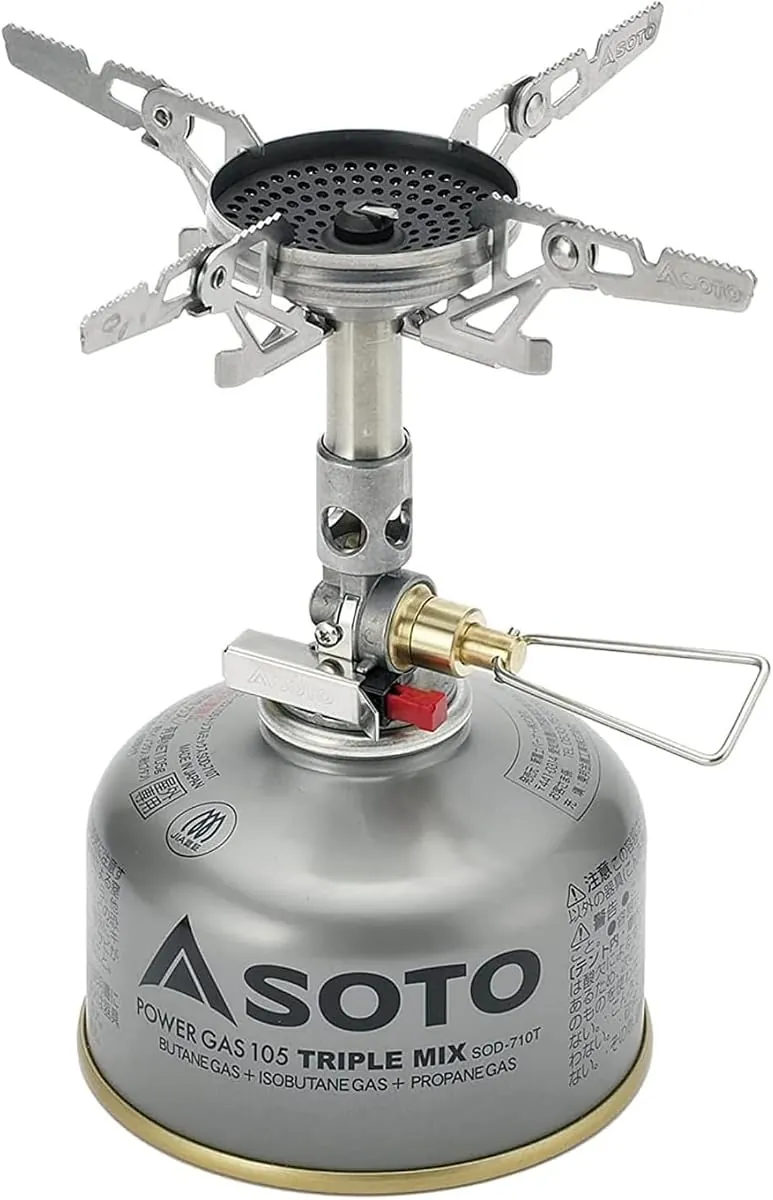
SOTO WindMaster with 4Flex
4.8

SOTO WindMaster with 4Flex

OutdoorGearLab's Editors' Choice and Treeline Review's Best Overall for 2026, and both awards come down to the same thing: the recessed burner head keeps working in wind that reduces a flat burner to a flicker. Add a pressure-regulated valve and 2.3 ounces and there's very little argument left. The 4Flex support swaps in when you want a bigger pot.

Check Price
Simplest Choice
MSR PocketRocket 2
4.8

MSR PocketRocket 2

CleverHiker's Best Overall, and the stove most people should buy first. It's a burner head, three folding arms and a valve, with no regulator and no igniter, which also means there's nothing on it to break. At 2.6 ounces it does the fundamental job as well as anything, and 4,279 ratings say the build is consistent.

Check Price
Cold Mornings
MSR PocketRocket Deluxe
4.8

MSR PocketRocket Deluxe

The PocketRocket 2 with the three things it lacks: a pressure regulator, a piezo igniter, and a broad burner head that spreads the flame instead of concentrating it in a ring. That last one is what lets it actually simmer. Treeline Review clocked it as one of the fastest boilers they tested, and it stays fast as the canister drains.

Check Price
Comparison Table

Every Pick, Side by Side

Compare all 9 picks
Best Overall
Best For
The one stove to buy if you only buy one
Difficulty
Beginner
Price
$$$
Simplest Choice
Best For
A first stove with nothing to learn
Difficulty
Beginner
Price
$$$
Cold Mornings
Best For
Cold mornings and food you actually cook
Difficulty
Intermediate
Price
$$$
Recommended #4
Best For
Boiling water fast with the least fuss
Difficulty
Beginner
Price
$$$
Recommended #5
Best For
Integrated efficiency at close to canister-top weight
Difficulty
Intermediate
Price
$$$
Recommended #6
Best For
The most stove you can get for fifty dollars
Difficulty
Beginner
Price
$$$
Recommended #7
Best For
Cooking when the weather has really turned
Difficulty
Advanced
Price
$$$
Recommended #8
Best For
Deep cold, high altitude and countries without canisters
Difficulty
Advanced
Price
$$$
Recommended #9
Best For
The lightest and cheapest way to boil water
Difficulty
Intermediate
Price
$$$
The Lineup

9 Best Backpacking Stoves, Compared

Detailed picks with verdicts, strengths, tradeoffs, and the situations where each one makes the most sense.

Best Overall
SOTO WindMaster with 4Flex
4.8 (1,703 Amazon ratings)

SOTO WindMaster with 4Flex

Quick verdict: OutdoorGearLab's Editors' Choice and Treeline Review's Best Overall for 2026, and both awards come down to the same thing: the recessed burner head keeps working in wind that reduces a flat burner to a flicker. Add a pressure-regulated valve and 2.3 ounces and there's very little argument left. The 4Flex support swaps in when you want a bigger pot.

Why It Stands Out

  • Concave, recessed burner head, the design that resists wind rather than just claiming to
  • Pressure-regulated valve, so output stays flat as the canister cools or empties
  • 2.3 oz for the stove head, among the lightest with a regulator at all
  • Removable pot support, so you can run the compact TriFlex or the wider 4Flex

Pros

  • Best wind performance of any canister-top stove here
  • Regulated output for cold mornings and end-of-canister use
  • Real simmer control rather than a high setting and a low one
  • Built-in piezo igniter

Cons

  • Costs more than the PocketRocket 2 for the same basic job in still air
  • The pot support detaches, so it's a small part you can lose
  • Still an open flame, so it can't match an integrated system in a gale

Best Situations

Exposed camps, ridgelines and anywhere the wind is part of the forecastShoulder-season trips where the overnight low drops near freezingCooking real food rather than only rehydrating a bag
Difficulty
Beginner
Price Range
$$$
Simplest Choice
MSR PocketRocket 2
4.8 (4,279 Amazon ratings)

MSR PocketRocket 2

Quick verdict: CleverHiker's Best Overall, and the stove most people should buy first. It's a burner head, three folding arms and a valve, with no regulator and no igniter, which also means there's nothing on it to break. At 2.6 ounces it does the fundamental job as well as anything, and 4,279 ratings say the build is consistent.

Why It Stands Out

  • 2.6 oz and packs down to roughly the size of an egg
  • The deepest pool of buyer feedback of any stove on this page
  • Serrated pot supports that grip a pot rather than letting it slide
  • Nothing on it can break, because there is almost nothing on it

Pros

  • Cheapest way into a stove from a brand with real backing
  • Simple enough that there is no learning curve at all
  • Good flame control for an unregulated stove
  • Usually sells below its list price

Cons

  • No pressure regulator, so output sags as the canister cools or empties
  • No igniter, so you carry a lighter, which you should anyway
  • Open burner head, so wind performance is ordinary

Best Situations

Summer and three-season weekends where the weather is reasonableA first stove you want to buy once and not think aboutPairing with a small pot for one or two people
Difficulty
Beginner
Price Range
$$$
Cold Mornings
MSR PocketRocket Deluxe
4.8 (840 Amazon ratings)

MSR PocketRocket Deluxe

Quick verdict: The PocketRocket 2 with the three things it lacks: a pressure regulator, a piezo igniter, and a broad burner head that spreads the flame instead of concentrating it in a ring. That last one is what lets it actually simmer. Treeline Review clocked it as one of the fastest boilers they tested, and it stays fast as the canister drains.

Why It Stands Out

  • Pressure-regulated valve, which is what holds output flat when the morning starts below 40°F
  • Broad burner head spreads heat, so a pot has fewer hot spots to scorch through
  • Built-in piezo igniter
  • 2.9 oz, so the regulator costs almost nothing in weight

Pros

  • Consistent output from a full canister to an empty one
  • Simmers better than anything else that threads onto a canister
  • Noticeably faster to boil than the standard PocketRocket 2
  • Wind performance clearly better than a plain open burner

Cons

  • Costs substantially more than the PocketRocket 2, which is real money for a weekend stove
  • Piezo igniters are the first part of any stove to fail, so carry a lighter
  • Wide burner head makes it bulkier folded than the PocketRocket 2

Best Situations

Shoulder-season and alpine trips where mornings start below freezingCooking rather than boiling: sauces, eggs, anything that can catchLong trips where the last night of a canister still needs full output
Difficulty
Intermediate
Price Range
$$$
Recommended #4
Jetboil Flash 1.0L
4.8 (546 Amazon ratings)

Jetboil Flash 1.0L

Quick verdict: The stove that made integrated systems mainstream, and still the easiest one to use: the pot clips on, one turn of the knob lights it, and the color-change strip on the cozy tells you when it's boiling. Treeline Review called it the easiest to use stove they tested. If dinner is a freeze-dried bag, this is the machine for it.

Why It Stands Out

  • Heat-exchanger fins on the pot base capture heat a bare burner loses
  • Insulating cozy with a color-change indicator, so you don't lift the lid to check
  • One-step ignition: turn the knob and it lights
  • Everything nests, so burner, canister and stabilizer store inside the 1.0L cup

Pros

  • Among the fastest boils you can buy at any price
  • Far better in wind than any open canister-top stove
  • Uses less fuel per liter, so fewer canisters on a long trip
  • Plastic canister stabilizer included rather than sold separately

Cons

  • 13.1 oz, more than five times what the WindMaster weighs
  • No pressure regulator, so cold performance is weaker than the price suggests
  • Tall narrow pot scorches anything thicker than water
  • You're locked into the pot it comes with

Best Situations

Freeze-dried meals, instant coffee and hot drinks at a windy breakTrips where boiling speed and fuel economy matter more than pack weightAnyone who wants a cook system that needs no thought at all
Difficulty
Beginner
Price Range
$$$
Recommended #5
Jetboil Stash
4.7 (494 Amazon ratings)

Jetboil Stash

Quick verdict: The answer to the main objection to integrated systems. The Stash strips the cozy, the igniter and the plastic, uses a titanium burner and an anodized aluminum pot, and lands at 7.1 ounces for the complete kit, roughly half a Flash. You keep the heat exchanger and the fuel savings. You pay near the top of this page for it, and light it with a lighter.

Why It Stands Out

  • 7.1 oz for burner, 0.8L pot and lid together, which no other full system here approaches
  • FluxRing heat exchanger, so it keeps the efficiency that justifies an integrated system
  • Titanium burner and hard-anodized pot rather than steel and plastic
  • The whole system plus a 100g canister nests inside the pot

Pros

  • Integrated efficiency without the integrated weight penalty
  • Wide, low pot shape that's easier to eat and cook from than a tall Jetboil cup
  • Packs smaller than the numbers suggest
  • Works as a standalone burner with other pots

Cons

  • A lot to pay for a burner and a 0.8L pot in a one-person kit
  • No igniter and no cozy, so you carry a lighter and burn your hands on the pot
  • 0.8L is tight for two people
  • No pressure regulator

Best Situations

Ultralight trips where you still want a heat exchanger's fuel savingsLong thru-hike sections where fewer canisters is worth real moneySolo cooking where pack weight is the number you optimize
Difficulty
Intermediate
Price Range
$$$
Recommended #6
SOTO Amicus with Igniter
4.7 (480 Amazon ratings)

SOTO Amicus with Igniter

Quick verdict: OutdoorGearLab's Best Buy, and it earns it by borrowing the WindMaster's thinking for meaningfully less. The burner sits in a recessed cup rather than out in the open, so it handles a breeze better than most stoves at this money, and the four pot supports are wider and more stable than the usual three. What you don't get is the regulator, which is the whole reason the WindMaster costs more.

Why It Stands Out

  • Recessed burner head, so wind performance is well above the norm at this money
  • Four pot supports rather than three, which is steadier under a bigger pot
  • 11,000 BTU output, and the listing rates a 250g canister at roughly 1.5 hours of burn
  • Stealth igniter tucked inside the frame where it can't get knocked out of line

Pros

  • Wind resistance you normally have to pay a good deal more for
  • Wider, more stable pot platform than most stoves this size
  • Igniter effectively included for free
  • 2.9 oz, so nothing is given up on weight

Cons

  • No pressure regulator, so cold-weather output fades
  • Simmer control is coarser than the WindMaster's
  • Less refined build than the pricier stoves ranked above it

Best Situations

A first stove where budget matters but you still want wind performanceSummer and three-season trips with a mid-size potA second stove to keep in a bag you don't want to unpack every trip
Difficulty
Beginner
Price Range
$$$
Recommended #7
MSR WindBurner Personal 1.0L
4.4 (25 Amazon ratings)

MSR WindBurner Personal 1.0L

Quick verdict: The most weatherproof stove on this page, and it isn't close. The WindBurner uses a radiant burner with no visible flame, fully enclosed inside the pot's shroud, so there is nothing for wind to blow out. CleverHiker rates it their most wind-resistant pick. It's 15.3 ounces and sits at the top of this page on price, and in a storm it will make dinner when nothing else here will.

Why It Stands Out

  • Enclosed radiant burner with no exposed flame, so wind has nothing to reach
  • Pressure-regulated valve, so it holds output in the cold as well as the wind
  • Heat exchanger and locking pot, sealed as one combustion system
  • Part of a modular range, so bigger pots and skillets attach to the same burner

Pros

  • Works in conditions that shut down every open-flame stove here
  • Regulated output for mornings that start well below freezing
  • Very good fuel economy per liter
  • Locking pot means it won't tip off the burner

Cons

  • 15.3 oz, the heaviest canister system on this page
  • At the top of the category on price
  • Radiant burner is poor at simmering, so this boils rather than cooks
  • Only 25 Amazon ratings, because MSR moved the listing to a new ASIN

Best Situations

Exposed alpine and coastal camps where wind is the defining problemWinter and shoulder-season trips with a real forecastAnyone who has had a stove blown out and decided never again
Difficulty
Advanced
Price Range
$$$
Recommended #8
MSR WhisperLite Universal
4.5 (16 Amazon ratings)

MSR WhisperLite Universal

Quick verdict: The stove for the trips where canisters stop being the right answer. It burns canister gas, white gas, kerosene and unleaded gas from the same burner, and on liquid fuel it runs off a hand-pumped bottle, so the air temperature never enters into it. OutdoorGearLab keeps it as a Top Pick. It's heavy, fiddly, and the only thing here that works at twenty below.

Why It Stands Out

  • Multi-fuel: isobutane canisters, white gas, kerosene and unleaded from one burner
  • Pump-pressurized liquid fuel, so cold canister pressure is simply not a factor
  • Runs canisters inverted for liquid feed, which fixes cold-weather gas performance
  • Field-maintainable, so it comes apart and can be cleaned on the trail

Pros

  • The only stove here that keeps working in severe cold
  • Fuel available anywhere in the world, not just at outfitters
  • Remote burner sits low and wide, so a big pot is stable
  • Repairable rather than disposable

Cons

  • 11.5 oz for the stove alone, before the pump, bottle and fuel
  • Liquid fuel needs priming, which is messy and takes practice
  • At the top of the category on price, and the fuel bottle is sold separately
  • Only 16 Amazon ratings on this listing

Best Situations

Winter mountaineering and snow melting where canisters quitExpedition travel where threaded canisters can't be boughtGroup cooking that needs a stable base under a large pot
Difficulty
Advanced
Price Range
$$$
Recommended #9
BRS-3000T
4.6 (3,913 Amazon ratings)

BRS-3000T

Quick verdict: 0.9 ounces and a price nothing else comes near, and OutdoorGearLab still lists it as a Best Buy. Thousands of thru-hikers have carried one. What you give up is margin: no regulator, no wind protection, thin titanium supports that don't love a big heavy pot, and more unit-to-unit variation than a stove costing three times as much.

Why It Stands Out

  • 0.9 oz, which undercuts every other stove here by more than an ounce
  • Cheap enough to keep as a spare
  • Titanium construction that folds down to roughly the size of a golf ball
  • 3,913 ratings, so its behavior is well documented by people who own one

Pros

  • Nothing else combines this weight and this price
  • Boils fast for its size when it's out of the wind
  • Packs into almost any mug or pot with room to spare
  • Easy to justify as a backup even if it isn't your main stove

Cons

  • Essentially no wind protection, and a gust can blow it out
  • No pressure regulator, so output fades in cold and near the end of a canister
  • Thin pot supports are reported to soften under a large pot at full output
  • Small support footprint, so a tall pot needs watching

Best Situations

Solo ultralight trips with a small mug and sheltered cookingA backup stove that costs almost nothing to carryA first stove for someone testing whether they'll keep backpacking
Difficulty
Intermediate
Price Range
$$$
Buying Guide

What to Check Before You Buy

Wind, which ruins more meals than anything else on this list

Every published boil time you'll ever read was measured in still air, and almost no one cooks in still air. A breeze strips heat off the side of a pot faster than the burner can put it in, so a stove rated at three and a half minutes can take seven or more on an exposed col, and it burns fuel for every one of those minutes.

Published wind tests put the extra gas burned at a quarter to a half. Only two things really defend against it. The first is burner geometry: a concave, recessed head like the WindMaster's keeps the flame down in a bowl where moving air struggles to reach it, which is why that stove keeps working in conditions that blow a flat burner sideways. The second is an integrated system, where the pot locks onto the burner and a shroud wraps the whole combustion chamber.

That's the WindBurner and, to a lesser extent, the Jetboils. A foil windscreen wrapped around a canister-top stove is not a third option. It works, and it also traps heat against a sealed cylinder of pressurized gas, which is exactly the failure mode manufacturers warn about. If you cook somewhere windy on any kind of regular basis, buy the wind performance into the stove rather than trying to add it later.

The cheap version costs nothing: cook behind a rock, a pack, or in the lee of a tent vestibule with the door open.

Regulated valves, cold canisters, and why output fades

A canister works because the liquid gas inside is under more pressure than the air outside, and that pressure is what pushes fuel to the burner. Cold is the obvious thief. Butane stops vaporizing at about 31°F and isobutane at about 11°F, while propane keeps going far below that, so since the mix is mostly iso/butane with propane as the junior partner, and the propane burns off first, a canister in the cold gets steadily less able to feed the stove until the flame sputters out.

There's still fuel in it when that happens. The other drain is simply emptiness: pressure falls as the canister runs down, so an unregulated stove gets noticeably weaker over the life of one. A pressure regulator fixes both from the stove's side. It's a small valve that delivers gas at a fixed low pressure regardless of what the canister is doing, so output stays flat until the fuel is gone.

On this page the WindMaster, PocketRocket Deluxe and WindBurner all have one; the PocketRocket 2, Amicus and BRS-3000T do not. If your trips are summer weekends, the difference is small and mostly shows up at the end of a canister. If you camp in shoulder season, above treeline, or anywhere the overnight low starts with a 2, it's the single feature worth paying for.

Whichever valve you end up with, sleep with the canister in your bag and stand it in a shallow puddle of water rather than on frozen ground. Both tricks are free.

Canister-top versus integrated system, and what each gives up

A canister-top stove is a burner head that threads straight onto the canister, with folding arms that hold whatever pot you like. It's the lightest, cheapest, most flexible option: two to three ounces, works with a titanium mug or a two-liter pot, and packs into almost nothing. The trade is that it's a bare flame in the open air, so it's the worse of the two in wind, and a tall pot balanced on a small canister is tippy enough that people really do lose dinner that way.

An integrated system flips that. The pot is part of the stove, with heat-exchanger fins ringed around its base to grab heat that would otherwise go past, a shroud to keep wind out, and a plastic foot that stabilizes the canister. They boil faster and use meaningfully less fuel per liter, which matters on a long trip because you carry fewer canisters.

What you give up is weight (13 to 15 ounces rather than 3, though the Jetboil Stash is the exception at 7.1), money, and flexibility: the pot is the pot, most of them are tall and narrow, and the classic complaint is that they scorch anything thicker than water. The honest split is by what you cook. Boiling water to pour into a freeze-dried bag is the job an integrated system was designed around. Anything you'd stand over and stir wants a regulated canister-top stove under your own wide pot.

Fuel math, availability, and the one thing you can't fly with

Fuel is the part people plan worst. The rough working figure for canister stoves is that boiling roughly half a liter costs about 8 to 12 grams of gas, so a standard 8 oz (230 g) canister covers somewhere around 20 to 25 boils, which for one person doing a hot breakfast and a hot dinner is most of a week. Cut that estimate hard for cold, wind, altitude, snow melting, or actually simmering food rather than just boiling it.

Canisters come in 110 g, 230 g and 450 g; two 110s weigh more and cost more than one 230 for the same gas, so size up unless you're counting grams for a single overnight. The maddening part is that you can't tell how much is left without weighing it, which is why the most useful thing you can do to a brand new canister is write its empty weight on the side in marker.

Availability is the other half. Threaded isobutane canisters are stocked in every outfitter and most gas stations near a trailhead in North America, Europe and Japan, which is why canister stoves dominate. They're much harder to find in remote parts of South America, Africa and Central Asia. That, not performance, is the main reason to own a liquid-fuel stove like the WhisperLite Universal, which will burn white gas, kerosene and, in a pinch, unleaded gas.

One rule has no exceptions: you cannot fly with fuel. Not full canisters, not empty ones, not in checked baggage. Buy it at the far end and plan for that.

Your First Stove
Canister-top

Weekend trips, boiling water for dinner and coffee, three seasons. Buy a canister-top stove and a 750ml pot and stop there. The MSR PocketRocket 2 is the safe default, and a little more buys the SOTO WindMaster's regulated valve and much better wind performance. That's the upgrade most people eventually wish they'd made.

Boil Water And Nothing Else
Integrated system

This is the one case where 13 ounces of stove makes sense. If dinner comes out of a foil bag and coffee comes out of a packet, an integrated system boils faster, wastes less gas and shrugs off a breeze. The Jetboil Flash 1.0L is the easy one: click, ignite, walk away. The MSR WindBurner Personal costs more and keeps cooking in weather that would have blown the Flash out.

Cold, Altitude Or Off The Grid
Regulated or liquid fuel

Once mornings start below freezing, a regulated valve stops being a luxury, and the MSR PocketRocket Deluxe is the cheapest way to get one. Past that, the MSR WhisperLite Universal runs on a hand-pumped bottle of white gas or kerosene, so the temperature outside stops being a variable. It's also the answer for countries where threaded canisters simply aren't sold.

Full Catalog

Compare All 9 Backpacking Stoves

Want to browse beyond the ranked picks? Filter and sort the full backpacking stoves listing below.

Best Backpacking Stoves of 2026 — All Products

9 Products
FAQ

Frequently Asked Questions

For practical purposes, yes. Almost every backpacking stove sold in North America and Europe uses the same 7/16 UNEF threaded fitting, standardized as EN 417, so an MSR stove screws onto a Jetboil canister and a SOTO stove screws onto a Coleman one. Buy whichever brand the store near the trailhead stocks. The contents are near-identical too: a mix of isobutane and propane, sometimes with plain butane in cheaper blends, and the ratio is the only meaningful difference.

More propane means better cold-weather performance, so if you're heading somewhere cold it's worth reading the canister. MSR's IsoPro and Jetboil's Jetpower are both iso/propane blends with no straight butane, which is what you want. The exceptions are old and rare: Campingaz's pierceable cartridges and a few vintage bayonet fittings don't thread. If the canister you're holding has a screw thread and a valve that seals when you unscrew the stove, it will fit.

The one swap that doesn't work is the reverse: a liquid-fuel stove wants a refillable bottle, not a canister, unless it's a hybrid like the WhisperLite Universal.

Glossary

The words on this page

Every term this guide leans on has its own page with a plain answer at the top.

Browse the whole glossary →
How We Choose Products

How These Picks Are Chosen

Reader-supported and free of paid placements. Every pick is ranked on published specs and Amazon buyer ratings, not on who pays us.

Spec Research

Each pick is compared on published specs, materials, design, and category fit across the major brands.

Practical Fit

Rankings factor in how well each product matches common hiking, backpacking, and trail running needs, not just popularity.

Amazon Buyer Ratings

Star ratings and review volume from verified Amazon buyers are factored in to reflect real-world satisfaction.

Value

A pick earns its spot by delivering useful performance for the money, whether budget or premium.

STOVE SORTED.
NOW THE WATER.

A stove is only half the camp kitchen. The other half is what you put in the pot. Filters, pads, tents and canisters are all up, and my dad and I add guides as we work through the kit ourselves.

Best Backpacking Water Filters