Skip to content
Best Backpacking Gadgets of 2026 — hiking gear
Backpacking Gadget Buying Guide

Best Backpacking Gadgets of 2026

Ten small pieces of trail hardware, ranked on what each one weighs against how often it earns that weight back. Nothing here is a pack, a tent or a sleeping bag.

View the top picksUpdated 9 August 2026 · Ranked from specs & buyer reviews

If you buy through a link on this page we may earn a commission, at no extra cost to you. It never changes how anything is ranked. Prices were last checked on and move around; the figure on Amazon is the one that counts.

How to Choose

How to Choose What Small Gear Is Worth Carrying

Once the pack, the shelter, the sleeping bag and the pad are settled, what's left is a pile of small objects that each solve exactly one problem. A brick that keeps your phone alive, a bag that makes filtering water bearable. Then there's the spoon that reaches the bottom of a freeze-dried pouch. None of them weighs anything worth arguing about on its own, and that's the trap: ten things at two ounces each is a pound and a quarter you didn't decide to carry, you just accumulated.

Everything on this page is useful, so useful isn't the bar. The bar is whether a thing earns what it weighs on the kind of trip you take.

That's the basis this list is ordered on, and it's worth saying out loud because it isn't the basis Amazon would give you. Each pick is ranked on what it weighs against how often it earns that weight back over a multi-day trip, then on how badly the trip goes if you don't have it.

Review counts had no say in the order, and you can see it in the result: the BigBlue solar charger has the biggest ratings pool on this page at 9,897 and finishes last, while the DirtSaw Deuce has 45 and sits fifth. Popularity on Amazon measures how many units moved through Amazon.

In a mixed category like this one it mostly measures which items also get bought by people who aren't backpacking, which is why a roll of repair tape has collected nearly four times the ratings of a satellite messenger without being anywhere near as important on a trail.

Prices here run from a few dollars to a few hundred, and the top of that range needs a note. Garmin now sells a newer inReach Mini 3 and a Mini 3 Plus, both substantially more expensive. The Mini 2 is here instead because it still does the part that matters: two-way messaging, plus an SOS to Garmin's 24/7 response center from anywhere with a view of the sky.

It does that for a great deal less than the Mini 3. Everything else here sits at or near the top of its own small category, so nothing below is a budget stand-in. This page also skips gear that already has its own guide on the site, so you won't find headlamps, water filters, GPS watches, bear canisters or stoves ranked below, only the things that sit alongside them.

Ratings, review counts and prices came off the listings on August 8, 2026. My dad and I haven't carried all ten of these ourselves; they're ranked from published specs, manufacturer weights, buyer feedback and the testing other people have put in print.

Quick Picks

Top Three at a Glance

Short on time? Start with these top-rated backpacking gadgets picks.

Best Overall
Nitecore NB10000 Gen 2
4.1

Nitecore NB10000 Gen 2

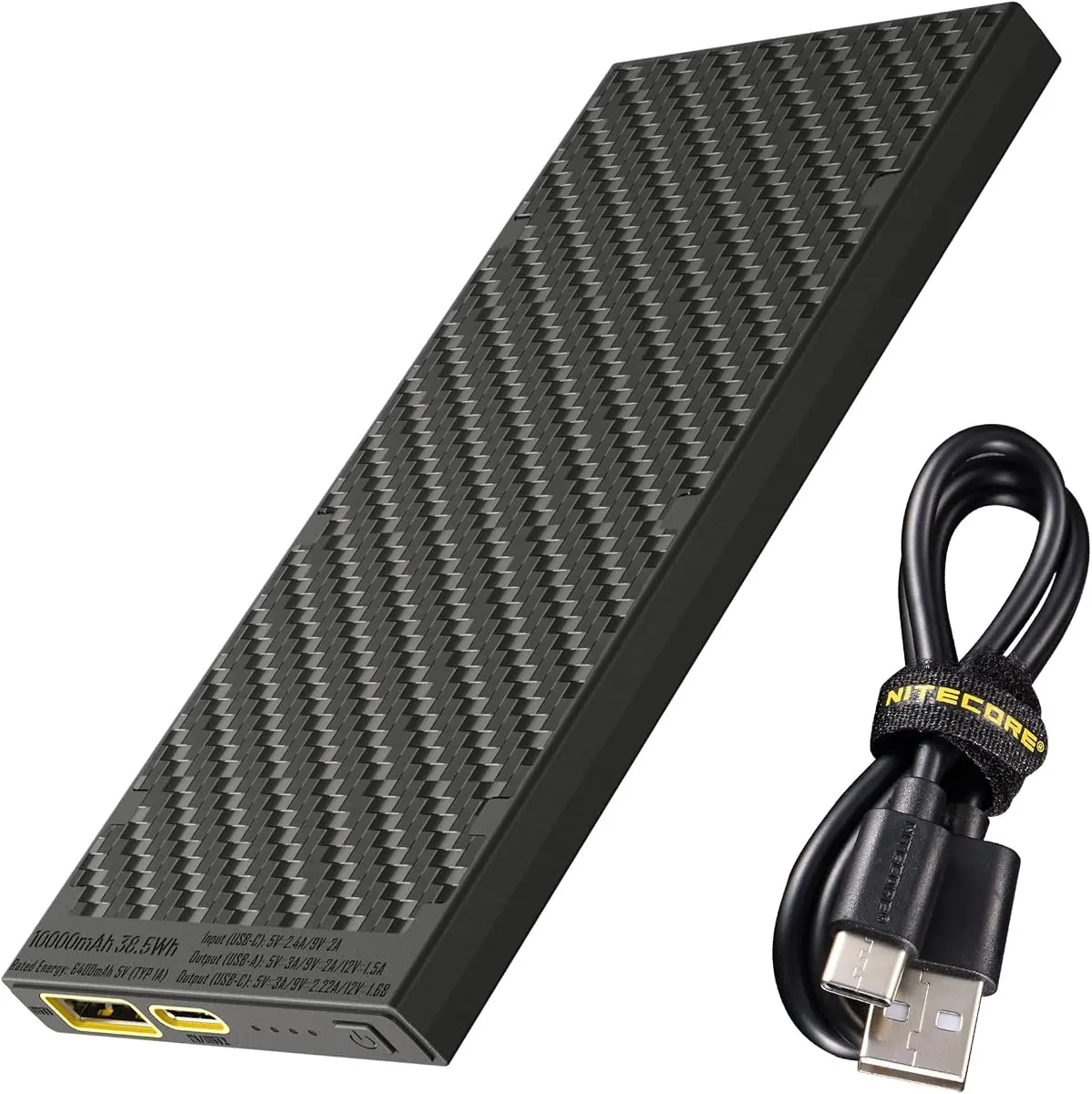
Ten thousand milliamp-hours in 5.29 ounces is about as much power as you can carry per gram, and that ratio is why it's first. Every other electronic item you carry (phone, headlamp, watch, lantern) is downstream of whatever power bank you pick, so getting the lightest one that still holds a useful charge pays off across the whole kit rather than in one place.Worth knowing before you buy: Nitecore has since released a Gen 4 at 143 g that shaves off another quarter-ounce, but it isn't reliably stocked on Amazon yet, so the Gen 2 is the one you can buy today. The weight has a cost too. The carbon-fiber shell is thin and the Amazon rating is the lowest on this page at 4.1, which is a fair reflection of how it handles rough treatment.

Check Price
The Safety Buy
Garmin inReach Mini 2
4.6

Garmin inReach Mini 2

Three and a half ounces that change what happens on the worst possible day, which is the only reason a device this expensive ranks second. The SOS button is what sells it and the two-way texting is what you'll use: describing a problem, asking for a forecast, or calling off a search before anyone has started one. With a mandatory ongoing subscription on top, it's also easily the biggest financial commitment on this page.

Check Price
Best Value
CNOC Vecto 2L
4.8

CNOC Vecto 2L

The single best value on this page. For 2.8 ounces and very little money it does two jobs at once: it's two extra liters of capacity for a dry camp, and it's the dirty-water bag that turns a slow, tiring squeeze filter into something you hang from a branch and ignore while you pitch the tent. The wide opening at the bottom is the part that matters. Scooping from a shallow, silty creek is where the stock bags that ship with most filters fall down.

Check Price
Comparison Table

Every Pick, Side by Side

Compare all 10 picks
Best Overall
Best For
Keeping everything else charged for under six ounces
Difficulty
Beginner
Price
$$$
The Safety Buy
Best For
Hiking alone or well outside cell coverage
Difficulty
Intermediate
Price
$$$
Best Value
Best For
Making a squeeze filter behave like a gravity system
Difficulty
Beginner
Price
$$$
Recommended #4
Best For
Eating out of a freeze-dried pouch without wearing it
Difficulty
Beginner
Price
$$$
Recommended #5
Best For
Digging a legal cathole in ground that fights back
Difficulty
Beginner
Price
$$$
Recommended #6
Best For
Turning a punctured pad or torn tent into a ten-minute fix
Difficulty
Beginner
Price
$$$
Recommended #7
Best For
Scissors, tweezers and a blade in three quarters of an ounce
Difficulty
Beginner
Price
$$$
Recommended #8
Best For
Camp light that never touches your power budget
Difficulty
Beginner
Price
$$$
Recommended #9
Best For
Consolidating the half-empty canisters in your garage
Difficulty
Intermediate
Price
$$$
Recommended #10
Best For
Stretches longer than a power bank can cover
Difficulty
Advanced
Price
$$$
The Lineup

10 Best Backpacking Gadgets, Compared

Detailed picks with verdicts, strengths, tradeoffs, and the situations where each one makes the most sense.

Best Overall
Nitecore NB10000 Gen 2
4.1 (77 Amazon ratings)

Nitecore NB10000 Gen 2

Quick verdict: Ten thousand milliamp-hours in 5.29 ounces is about as much power as you can carry per gram, and that ratio is why it's first. Every other electronic item you carry (phone, headlamp, watch, lantern) is downstream of whatever power bank you pick, so getting the lightest one that still holds a useful charge pays off across the whole kit rather than in one place.

Worth knowing before you buy: Nitecore has since released a Gen 4 at 143 g that shaves off another quarter-ounce, but it isn't reliably stocked on Amazon yet, so the Gen 2 is the one you can buy today. The weight has a cost too. The carbon-fiber shell is thin and the Amazon rating is the lowest on this page at 4.1, which is a fair reflection of how it handles rough treatment.

Why It Stands Out

  • 10,000 mAh (38.5 Wh) at 150 g / 5.29 oz, among the best capacity-to-weight ratios you can buy
  • USB-C and USB-A outputs, so it charges a phone and a headlamp at once without an adapter
  • 38.5 Wh is comfortably under the 100 Wh airline threshold, so it flies carry-on with no approval
  • Nitecore rates real output at 6,400 mAh, not the 10,000 printed on the label

Pros

  • The lightest 10,000 mAh bank most hikers will find
  • The one I'd buy if I were counting every ounce
  • Slim enough to sit flat against a pack panel
  • Dual output ports on a bank this light is unusual

Cons

  • 4.1 stars from just 77 ratings, a small and young pool
  • The thin shell trades durability for weight, so treat it as fragile
  • Costs more than a mainstream bank of the same capacity

Best Situations

Any trip of three days or more with a phone doing navigationShared between two people for a weekend, though it gets thinCharging a rechargeable headlamp and a watch alongside a phone
Difficulty
Beginner
Price Range
$$$
The Safety Buy
Garmin inReach Mini 2
4.6 (2,182 Amazon ratings)

Garmin inReach Mini 2

Quick verdict: Three and a half ounces that change what happens on the worst possible day, which is the only reason a device this expensive ranks second. The SOS button is what sells it and the two-way texting is what you'll use: describing a problem, asking for a forecast, or calling off a search before anyone has started one. With a mandatory ongoing subscription on top, it's also easily the biggest financial commitment on this page.

Why It Stands Out

  • Two-way satellite messaging plus an SOS routed to Garmin's staffed 24/7 response center
  • 100 g / 3.5 oz, small enough to live clipped to a shoulder strap and be forgotten
  • Sells well below its list price, and well below the newer inReach Mini 3
  • Works from anywhere with a clear view of the sky, independent of cell coverage entirely

Pros

  • Two-way messaging, not just a one-way panic button
  • Long battery life relative to a phone doing the same job
  • Pairs to a phone so you can type on a real keyboard
  • A steep discount off list at the moment

Cons

  • Useless without an active satellite subscription, billed separately
  • The most expensive item here by a factor of four
  • Tiny on-device screen makes typing without a phone slow

Best Situations

Solo trips anywhere without reliable cell coverageAny route where being a day overdue wouldn't be noticed quicklyHiking with someone whose medical situation could change fast
Difficulty
Intermediate
Price Range
$$$
Best Value
CNOC Vecto 2L
4.8 (4,118 Amazon ratings)

CNOC Vecto 2L

Quick verdict: The single best value on this page. For 2.8 ounces and very little money it does two jobs at once: it's two extra liters of capacity for a dry camp, and it's the dirty-water bag that turns a slow, tiring squeeze filter into something you hang from a branch and ignore while you pitch the tent. The wide opening at the bottom is the part that matters. Scooping from a shallow, silty creek is where the stock bags that ship with most filters fall down.

Why It Stands Out

  • 28 mm thread fits the Sawyer Squeeze and HydroBlu VersaFlow directly, no adapter
  • Wide slider opening makes filling from a shallow or silty source easy
  • 2.8 oz for 2 liters of extra carrying capacity on dry stretches
  • The listing rates the seams to a 220 lb breaking point, so it can hang full

Pros

  • Doubles as spare capacity and as filter feed bag
  • Far easier to fill and clean than a stock squeeze pouch
  • Tethered cap and slider that don't get lost
  • Cheap enough to be an obvious buy for anyone with a squeeze filter

Cons

  • Only fits 28 mm filter threads, so not universal
  • Soft-sided, so it needs somewhere to hang or lean
  • Adds nothing if you already run a gravity or pump filter

Best Situations

Desert and ridge routes with long gaps between waterDry camping, where you carry the evening's water inAnyone frustrated by how slowly a clogging squeeze filter runs
Difficulty
Beginner
Price Range
$$$
Recommended #4
TOAKS Titanium Long Handle Spoon
4.8 (3,534 Amazon ratings)

TOAKS Titanium Long Handle Spoon

Quick verdict: The least glamorous object here and one of the best-earning. At 0.6 oz it's used three times a day, every day, and the long handle solves the specific, maddening problem of reaching the bottom corner of a tall freeze-dried bag without getting sauce on your knuckles. The polished bowl is easier to wipe clean than a matte one, which matters more than it sounds when you're rinsing with cold water and no soap.

Why It Stands Out

  • 0.6 oz of titanium, which won't bend, corrode or hold flavors
  • The long handle reaches the bottom of a tall meal pouch and a deep pot
  • Polished bowl wipes clean far more easily than a matte finish
  • Costs almost nothing for something that will outlast most of the rest of the pack

Pros

  • One of the few things here you'll never replace
  • Used more often than anything else on this page
  • Cheap enough that there's no reason to improvise
  • Hanging hole for clipping it somewhere findable

Cons

  • Titanium conducts heat, so the bowl gets hot in a boiling pot
  • The long handle is slightly awkward to pack in a small mug
  • A spoon, not a spork, so no help with anything you'd stab

Best Situations

Any trip eating rehydrated meals from their own pouchCooking in a tall, narrow pot where a short spoon can't reachReplacing a plastic spoon that's already cracked once
Difficulty
Beginner
Price Range
$$$
Recommended #5
TheTentLab DirtSaw Deuce #2
4.6 (45 Amazon ratings)

TheTentLab DirtSaw Deuce #2

Quick verdict: 0.6 oz, printed right on the blade, for the one job with no workable substitute. A boot heel doesn't get close to a legal cathole in the kind of ground people camp on, which is the whole reason this exists. What that buys is a serrated edge that saws instead of scrapes, plus DAC aluminum that flexes rather than snapping when you hit a rock. It's a silly-looking object and I'd carry it on every overnight trip.

Why It Stands Out

  • 0.6 oz / 17 g, verified on the product itself rather than a spec sheet
  • Serrated edges cut through the roots that stop a flat trowel dead
  • Aluminum, made for TheTentLab by DAC, so it flexes rather than snapping
  • Reaches the 6-8 inch depth Leave No Trace calls for

Pros

  • No realistic substitute for the weight
  • Doubles as a probe for finding a diggable spot
  • Aluminum won't shatter in cold the way cheap plastic can
  • Used on essentially every overnight trip

Cons

  • Only 45 ratings on this listing, and limited stock
  • A lot to pay for a piece of shaped aluminum
  • Useless where regulations require you to pack waste out

Best Situations

Any overnight trip in an area where catholes are permittedHard, rocky or root-bound ground near established campsitesAnywhere the alternative is a shallow scrape an animal will find
Difficulty
Beginner
Price Range
$$$
Recommended #6
Gear Aid Tenacious Tape
4.3 (8,220 Amazon ratings)

Gear Aid Tenacious Tape

Quick verdict: This is the cheapest insurance in backpacking. A peel-and-stick nylon patch fixes a deflating sleeping pad, a cut tent floor or a jacket leaking down, and each of those is a failure that otherwise ruins or ends a trip. The trick is not to carry the roll. Cut six or eight inches onto a strip of waxed paper before you leave, and the whole repair kit disappears into a pocket.

Why It Stands Out

  • Fixes the three failures that end trips: pad, tent floor, insulated jacket
  • Peel-and-stick, so it works in the cold and dark with no adhesive to cure
  • Cut to size, so the carried weight is a fraction of an ounce rather than the roll
  • The cheapest thing on this page

Pros

  • Solves problems far out of proportion to its cost and weight
  • One roll supplies years of trips
  • Works on nylon, down shells, dry bags and tent floors
  • No skill or tools needed to apply it

Cons

  • 4.3 stars, tied with the solar panel and low for this page
  • Adhesion suffers on wet, dirty or very cold fabric
  • Clear version is visible and permanent on a repair you'd rather hide

Best Situations

Every trip using an inflatable sleeping padShoulder-season trips where a cold night has real consequencesAnywhere a torn shell or tent can't wait until you get home
Difficulty
Beginner
Price Range
$$$
Recommended #7
Victorinox Classic SD
4.8 (2,491 Amazon ratings)

Victorinox Classic SD

Quick verdict: 0.74 oz gets you a small blade, real scissors, a nail file, a screwdriver, tweezers and a toothpick, and it has been living in people's pockets since long before anyone used the word ultralight. It ranks seventh rather than higher because nearly every job on it can be improvised or postponed, which is the point of ranking on consequence instead of on the 4.8-star average that makes it look like the obvious number one.

Why It Stands Out

  • Seven functions at 0.74 oz / 21 g, in a 58 mm body that lives on a keyring
  • The scissors are good enough to use on purpose, which is rare at this size
  • Tweezers handle splinters, spines and ticks better than anything improvised
  • Swiss-made and cheap enough to replace without thinking about it

Pros

  • A consistent 4.8 stars across 2,491 ratings
  • Small enough that you stop noticing it
  • Scissors beat a knife for most trail tasks
  • Cheap for something that lasts decades

Cons

  • The blade is small, and no substitute for a real knife if you need one
  • Nothing it does is truly irreplaceable on a trail
  • The keyring version is easy to leave attached to your house keys

Best Situations

Tick country, cactus country, anywhere with splintersTrimming tape, cord, moleskin and food packagingAs the only cutting tool on a trip where a knife is overkill
Difficulty
Beginner
Price Range
$$$
Recommended #8
LuminAID PackLite Nova USB
4.6 (7,956 Amazon ratings)

LuminAID PackLite Nova USB

Quick verdict: An inflatable cube that packs flat to an inch and throws soft area light nobody has to wear on their head, which is what makes cooking and card games at camp pleasant rather than a series of beams in each other's eyes. It ranks eighth because 5 ounces is a lot for a light. The argument that saves it is solar: charged in the sun on your pack lid, it costs nothing from the power bank everything else is competing for.

Why It Stands Out

  • Solar charging means it never draws from the same 10,000 mAh as your phone
  • Packs flat to 4.75 x 4.75 x 1 inches and inflates to a 4.75-inch cube
  • LuminAID rates it at 3-5 hours on turbo and up to 24 on the low setting
  • Waterproof, and diffuse enough to light a tent without glare

Pros

  • Lights a whole tent evenly instead of one bright spot
  • Solar plus USB, so it recharges either way
  • No glass, no bulb and no rigid housing, so there's nothing in it to break
  • Large, consistent feedback pool at 4.6 stars from 7,956 ratings

Cons

  • 5 oz is heavy for a light, third-heaviest here after the panel and the power bank
  • 75 lumens is area light, not something to walk or navigate by
  • Solar charging takes about 10 hours of good sun for a full cycle

Best Situations

Group camps where a headlamp in the face gets old fastLong trips where charging one more device is a real costCar-camping and cabin trips where the weight doesn't matter
Difficulty
Beginner
Price Range
$$$
Recommended #9
FlipFuel Fuel Transfer Device
4.9 (336 Amazon ratings)

FlipFuel Fuel Transfer Device

Quick verdict: A precisely made little brass-and-aluminum valve that moves isobutane from one canister into another, so three canisters with a quarter left become one you can actually take. It has the highest rating on this page at 4.9, and it is still ninth, because this is a problem you solve at home before a trip rather than on the trail. Carrying its 1.4 ounces past the trailhead buys you nothing.

Why It Stands Out

  • Turns a shelf of unusable partial canisters into one full one
  • 1.4 oz / 39.7 g, with a flow-control valve rather than a crude coupler
  • 4.9 stars, the highest average of anything here
  • Keeps pressurized canisters out of the landfill

Pros

  • Solves a problem every canister-stove owner eventually has
  • Well made, with a real valve and a weighted flow gauge
  • Pays for itself in a handful of uses
  • Lets you weigh and top off to an exact fuel load before a trip

Cons

  • A garage tool more than a trail tool, so leave it at home
  • Only useful once you already own several partial canisters
  • Real money for something you use a few times a year

Best Situations

Before a trip, topping up one canister from several partialsAfter a season, consolidating what's left instead of throwing it outDialing in an exact fuel weight for a long trip
Difficulty
Intermediate
Price Range
$$$
Recommended #10
BigBlue 28W Solar Charger
4.3 (9,897 Amazon ratings)

BigBlue 28W Solar Charger

Quick verdict: Ranked last on purpose, and still the panel to buy if you need one. At roughly 21 ounces it weighs four times what a 10,000 mAh power bank does, so on any trip a bank can cover it's dead weight in your pack. The arithmetic flips somewhere past six days between outlets. That's a narrow set of trips, but if yours is one of them, this is the folding 28W panel the testing outfits keep putting on top.

Why It Stands Out

  • 28W folding panel with two USB-C ports and a USB-A, rated at 25.4% conversion efficiency
  • BigBlue's 28W is the folding panel OutdoorGearLab and Treeline Review both rank at the top; this listing is the current dual-USB-C version
  • Carabiner loops for strapping to a pack lid, though output while walking is poor
  • 9,897 ratings at 4.3 stars, the largest feedback pool on this page

Pros

  • Earns its weight once you're past a week between outlets
  • Big enough to charge a power bank in one sunny afternoon
  • Weather-resistant and built to be folded repeatedly
  • Cheaper than most panels of comparable output

Cons

  • About 21 oz, four times the weight of a 10,000 mAh power bank
  • Rated output assumes the panel is aimed straight at the sun
  • Charging a phone directly stalls every time a cloud passes

Best Situations

Thru-hikes where the towns are a week apartExtended desert or high-latitude trips with long daylightBase camps where the panel can lie flat in the sun all day
Difficulty
Advanced
Price Range
$$$
Buying Guide

What to Check Before You Buy

Weight against use, which is the test this whole page runs on

The useful way to judge a small item is to divide what it weighs by how many times you'll reach for it. A 0.6 oz titanium spoon used three times a day for four days is twelve uses out of six tenths of an ounce, which is why it ranks fourth here despite being the least impressive object on the page.

A 21 oz solar panel that trickles a phone back to half on a sunny afternoon is one use per pound and a third, which is why it ranks last. Everything in between is a judgment about your specific trip. The other half of the test is what happens when the item isn't there. Forgetting a spoon is an inconvenience you can whittle around.

Forgetting a trowel is a Leave No Trace violation you can't improvise your way out of, and a punctured sleeping pad with no patch is a cold night. Items that turn a trip-ending failure into a ten-minute annoyance punch far above their weight, which is how a few dollars of tape ends up ahead of a Swiss Army knife. Run the same arithmetic on your own pack and you'll usually find two or three things that have been riding along for years without earning it.

Power is a budget, and it's worth doing the math before you leave

The honest way to size a power bank is to add up what you'll actually drain rather than guessing. A modern phone holds 4,000 to 5,000 mAh, so a 10,000 mAh bank like the NB10000 Gen 2 is about one and a half full phone charges once conversion losses take their cut. Nitecore rates that bank's real output at 6,400 mAh, so roughly a third of the number on the label never reaches your phone.

A rechargeable headlamp is another 1,000 to 2,000 mAh, a GPS watch a few hundred, a rechargeable lantern somewhere in between. For most people that comes out to a 10,000 mAh bank covering three to five days comfortably, and longer if you're disciplined. A few habits do more for you than a bigger battery. Airplane mode stretches a phone's standby life a long way, and screen brightness is the single largest drain.

Cold weather temporarily hides a chunk of any lithium battery's charge, which is why the bank sleeps in the sleeping bag with you. All of that matters because the alternative to planning is carrying more battery, and battery is heavy: doubling to a 20,000 mAh bank costs you another five ounces or so. Figuring out your real daily draw for one trip costs nothing, and it's usually the difference between needing the bigger bank and not.

The failures small gear is insuring against

Some of the picks here exist because a specific piece of expensive gear fails in a specific way. Inflatable sleeping pads develop pinhole leaks, usually from grit under the groundsheet or a hip pressing a stone through the fabric, and an uninsulated night on cold ground gets dangerous fast in shoulder season. That's what a strip of repair tape is for, and it's why the tape ranks where it does.

Squeeze water filters clog and run slow, and the fix that helps most isn't a better filter. It's a bag that lets you fill once and let gravity do the work while you set up camp, which is the case for the Vecto. Fuel canisters strand you with a quarter left in each of three of them, which is what the FlipFuel is for, though that one is a garage problem more than a trail problem.

So the useful question to ask of your own kit is which item would end the trip if it broke, and then whether a two-ounce answer to it exists. Usually it does.

Subscriptions, batteries and the fine print that isn't on the price tag

Start with the satellite messenger, because it's a service and not just a device. The inReach Mini 2 does nothing at all without an active Garmin satellite plan, billed monthly or annually on top of the hardware, and there's no version of it that works unsubscribed. Budget for the plan before you decide the device is affordable, and note that plans can usually be suspended for the months you aren't using it.

Then there's flying. Lithium power banks are carry-on only on every airline, never checked, and the ones over 100 Wh need airline approval; a 10,000 mAh bank at 38.5 Wh is comfortably under that line, but the rule is worth knowing before a bag gets pulled. Fuel canisters can't fly at all, full or empty, in any bag, which is the constraint that decides how you plan a trip you're flying to.

The last one is the easiest to miss: everything rechargeable on this list has to be charged from something, and that something is usually the same power bank you already sized. A rechargeable lantern competes with your phone for the same 10,000 mAh, which is a real argument for a solar-charged light that never touches the budget at all.

The Weekend Kit
About $100

Two or three nights within reach of a trailhead. A 10,000 mAh power bank, a titanium spoon, a trowel and six inches of repair tape cut off the roll cover nearly everything that goes wrong at this scale. That's about six and a half ounces all in. Nothing else on this page earns a place in a pack going out Friday and back Sunday.

Out Of Signal, Solo
About $250 + plan

The moment nobody would notice you were overdue for a day or more, the inReach Mini 2 stops being a luxury. Two-way texting means you can report a sprained ankle without triggering a helicopter. That's the part most people underestimate before they own one. The subscription is a separate bill that never stops, so price the thing at more than its sticker.

Long Carries And Long Gaps
About $85

Desert stretches and dry camps are where the 2L Vecto earns its 2.8 ounces twice over, once as extra capacity and once as the dirty bag that makes a squeeze filter into a gravity system. Add solar only if you'll go more than five or six days without an outlet; below that, a second power bank is lighter and far more reliable.

Full Catalog

Compare All 10 Backpacking Gadgets

Want to browse beyond the ranked picks? Filter and sort the full backpacking gadgets listing below.

Best Backpacking Gadgets of 2026 — All Products

10 Products
FAQ

Frequently Asked Questions

It depends entirely on whether anyone would come looking for you, and how soon. On a busy front-country trail on a Saturday, with a charged phone and intermittent bars from a ridge, a messenger is optional. The case gets strong fast if you hike alone, or somewhere with no cell coverage at all for a full day or more. It gets stronger again if you hike with anyone whose medical situation could change quickly.

The feature people misunderstand is the SOS button. It gives you one enormous, irreversible option, and knowing that pressing it launches a helicopter is exactly what makes people hesitate when they should be asking for help. Two-way messaging is the part that gets used. It lets you describe a rolled ankle, get a weather forecast, tell someone you're taking the alternate route, or say you're a day late and fine, and that last message is what prevents most unnecessary searches.

Garmin's SOS goes to a staffed response center that coordinates with local search and rescue, so you aren't relying on a passing satellite and hope. Against that, it's a serious outlay plus an ongoing subscription and 3.5 ounces. If you hike mostly in cell coverage with other people, spend the money on something else.

Glossary

The words on this page

Every term this guide leans on has its own page with a plain answer at the top.

Browse the whole glossary →
How We Choose Products

How These Picks Are Chosen

Reader-supported and free of paid placements. Every pick is ranked on published specs and Amazon buyer ratings, not on who pays us.

Spec Research

Each pick is compared on published specs, materials, design, and category fit across the major brands.

Practical Fit

Rankings factor in how well each product matches common hiking, backpacking, and trail running needs, not just popularity.

Amazon Buyer Ratings

Star ratings and review volume from verified Amazon buyers are factored in to reflect real-world satisfaction.

Value

A pick earns its spot by delivering useful performance for the money, whether budget or premium.

THE SMALL STUFF,
SORTED.

Gadgets are what you add once the big four are handled. If they aren't yet, the stove is the one that changes camp the most, and my dad and I have ranked those too.

Best Backpacking Stoves