Skip to content
Best Trail Running Shorts of 2026 — hiking gear
Trail Running Shorts Buying Guide

Best Trail Running Shorts of 2026

Eight pairs, ranked on where the weight sits when you load a waistband and on whether the liner lasts past hour two. Three are linerless on purpose.

View the top picksUpdated 29 August 2026 · Ranked from specs & buyer reviews

If you buy through a link on this page we may earn a commission, at no extra cost to you. It never changes how anything is ranked. Prices were last checked on and move around; the figure on Amazon is the one that counts.

How to Choose

How to Choose Trail Running Shorts

A road running short has one job and does it in about four ounces: stay out of the way. Trail asks for more. You are further from the car, the weather turns over on you, and you need water, food and a phone on your body for two hours or five. Most runners answer that with a vest and stop thinking about it.

But the shorts decide whether you reach for the vest at all on a short day, and a pair with a real cargo waistband will carry a flask, a few gels and a phone with nothing over your shoulders. That is the actual difference between a short that happens to get worn on trail and one built for it.

So pockets come first here, and specifically where the weight sits rather than how many pockets the label counts. Anything heavy low in a leg pocket swings through every stride and keeps swinging; the same weight held flat against the small of your back stays put. Then the liner, because the liner is the part that ends runs early. A brief that's fine for forty minutes can rub you raw by hour three, and the fix is either a better liner or none at all plus one you picked yourself.

Then inseam, which is a coverage-against-stride trade and more personal than anyone selling shorts admits. Then fabric, which you stop noticing until the day you go through a creek and have to keep running afterwards.

Amazon review count sets none of that order, and here it would wreck it. The two pairs with the deepest rating pools have more ratings between them than the other six put together, and they finish seventh and eighth; the pair I'd hand somebody first has about thirty. Review volume measures how many units a listing has moved, which tracks price and listing age more than quality.

Two absences are worth explaining instead of glossing. The short nearly every reviewer names first is Patagonia's Strider Pro, around $80 direct, and it isn't here because Patagonia does not sell through Amazon and pursues the third-party sellers who list it, so every Strider Pro listing I found was unauthorized and priced far above what Patagonia charges. Buy that one from Patagonia. Janji, Path Projects and rabbit sell direct only, and their modular short-plus-liner systems run past $110 once you buy both halves.

Then the caveat that matters. My dad and I haven't run in any of these shorts and I am not going to dress that up. The order comes from published specs, the makers' own material data, what other reviewers have put in print, and Amazon buyer reviews. Every rating and price was read on August 29, 2026 off one specific listing, and since shorts sell as size-and-color combinations with a separate listing for each, your size may land somewhere else on the scale.

Quick Picks

Top Three at a Glance

Short on time? Start with these top-rated trail running shorts picks.

Best Overall
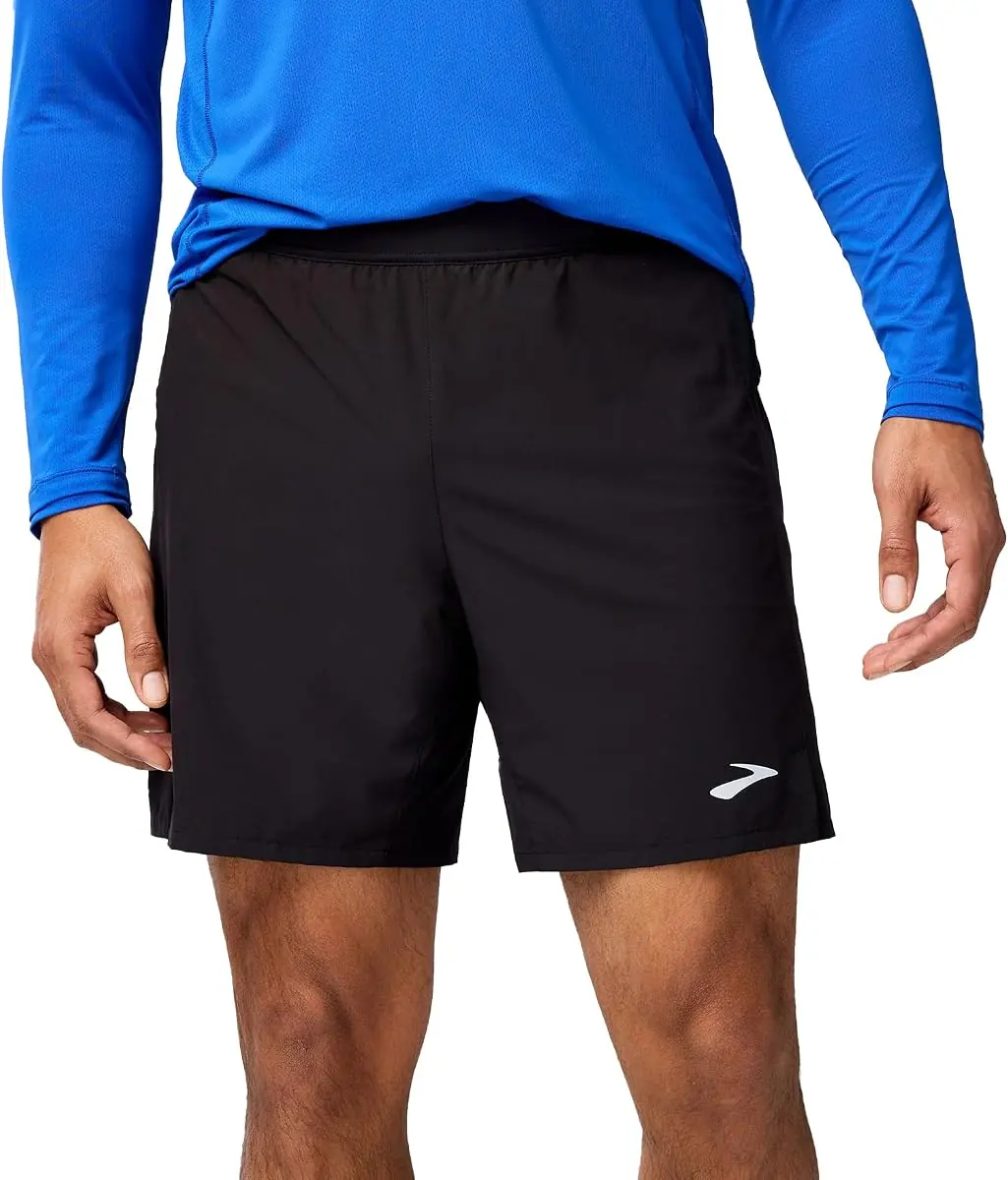
Brooks Men's Journey 7" 2-in-1 Short
4.4

Brooks Men's Journey 7" 2-in-1 Short

The most complete short here, and the successor to the Sherpa that Brooks has now discontinued. A 2-in-1 from a company that makes running kit and nothing else, with a seven-inch shell over an anchored boxer liner, which is the detail that decides whether hour three is comfortable.

Check Price
Best Fast and Light
Arc'teryx Norvan Short 5" Men's
3.8

Arc'teryx Norvan Short 5" Men's

The best-made shell on this page and the current linerless Norvan, after Arc'teryx discontinued the seven-inch version. Deliberately half a system: buy it if you already know which layer you want underneath.

Check Price
Comparison Table

Every Pick, Side by Side

Compare all 8 picks
Best Overall
Best For
One pair to cover most trail running
Difficulty
Beginner
Price
$$$
Best Fast and Light
Best For
Fast and light days, if you supply the liner
Difficulty
Intermediate
Price
$$$
Best Value
Best For
The cheapest short here worth taking up a mountain
Difficulty
Intermediate
Price
$$$
Recommended #4
Best For
Long efforts where chafing is the limiting factor
Difficulty
Intermediate
Price
$$$
Recommended #5
Best For
Maximum coverage at minimum weight
Difficulty
Intermediate
Price
$$$
Recommended #6
Best For
Multi-day trips and back-to-back runs
Difficulty
Beginner
Price
$$$
Recommended #7
Best For
A road short that works on trail
Difficulty
Beginner
Price
$$$
Recommended #8
Best For
The most usable pockets for the least money
Difficulty
Beginner
Price
$$$
The Lineup

8 Best Trail Running Shorts, Compared

Detailed picks with verdicts, strengths, tradeoffs, and the situations where each one makes the most sense.

Best Overall
Brooks Men's Journey 7" 2-in-1 Short
4.4 (30 Amazon ratings)

Brooks Men's Journey 7" 2-in-1 Short

Quick verdict: The most complete short here, and the successor to the Sherpa that Brooks has now discontinued. A 2-in-1 from a company that makes running kit and nothing else, with a seven-inch shell over an anchored boxer liner, which is the detail that decides whether hour three is comfortable.

Why It Stands Out

  • A genuine 2-in-1 with a boxer liner: the inner short is joined to the shell, so it can't ride up mid-run, which is the failure that makes a loose sewn-in brief stop protecting you halfway round.
  • A boxer-length liner rather than a brief, so it reaches the inner thigh where skin actually rubs skin on a long effort.
  • Seven inches of shell covers that same area without adding enough fabric to flap on a descent.
  • Brooks lists it with secure storage and an adjustable waist, which is what lets a short carry anything without sliding under the load.

Pros

  • Inner short anchored to the shell, so no riding up
  • Boxer-length liner, not a brief
  • Seven-inch coverage where chafing starts
  • No separate liner to buy

Cons

  • Heavier and warmer than a linerless shell in real heat
  • A shallow rating pool, since it is a recent replacement for the Sherpa
  • Costs more than the cheaper linerless picks before you even add their liner

Best Situations

Long runs where chafing is the thing that ends the dayAnyone who wants one pair and no decisionsTrail runs of two hours and up
Difficulty
Beginner
Price Range
$$$
Best Fast and Light
Arc'teryx Norvan Short 5" Men's
3.8 (4 Amazon ratings)

Arc'teryx Norvan Short 5" Men's

Quick verdict: The best-made shell on this page and the current linerless Norvan, after Arc'teryx discontinued the seven-inch version. Deliberately half a system: buy it if you already know which layer you want underneath.

Why It Stands Out

  • Linerless by design, not by cost-cutting. Arc'teryx sells a lined Norvan alongside it, so this shell is meant to be paired with a layer you choose and replace on its own schedule.
  • A five-inch inseam, which is the modern trail default and the length most trail-specific shorts are cut to.
  • Arc'teryx lists it as ultra-lightweight with a zippered pocket, which is the minimum closed storage a shell needs for a key.
  • Arc'teryx construction, which is the reason this short sits at the top of the page on price.

Pros

  • Best-built shell here
  • Linerless, so the liner is yours to choose and replace
  • A zippered pocket rather than open hand pockets alone
  • Five-inch cut moves freely on steep ground

Cons

  • You still have to buy a liner, so the real cost is above the tile price
  • Only four Amazon ratings, and they average below the rest of this page
  • Tied for the most expensive short here
  • Shorter coverage than the seven-inch model it replaces

Best Situations

Runners who already own a compression short or running brief they likeFast days and short racesAnyone replacing a worn liner rather than a worn shell
Difficulty
Intermediate
Price Range
$$$
Best Value
adidas Mens Terrex Multi Light Trail Running Shorts
4.5 (29 Amazon ratings)

adidas Mens Terrex Multi Light Trail Running Shorts

Quick verdict: A purpose-built trail short at a price that looks like a mistake. Terrex is adidas' mountain line rather than its gym line, and this is the pick that proves the budget end of this category is genuinely good.

Why It Stands Out

  • Built for trail, not adapted to it: adidas describes it for fast hikes and trail runs, with front pockets sized for gels and keys.
  • A drawcord-adjustable elastic waist, which is what lets a light short carry anything at all without sliding down under the load.
  • Linerless, confirmed by adidas' own listing and by Advnture's review of the line, so budget for a layer underneath.
  • Offered in several inseam lengths across the family, so the same short can be a shorter or longer cut depending on the listing you pick.

Pros

  • A real trail short from a mountain line, at the cheap end of this page
  • Pockets sized for gels, not for a wallet
  • Adjustable waist, which matters once the pockets are loaded
  • Several inseam options across the family

Cons

  • Linerless, so the real cost includes a liner you have to buy
  • Inseam varies by listing, so check the one you're actually buying
  • A modest rating pool compared with the mass-market shorts here

Best Situations

Runners who already wear a compression short underneathA second pair so the first can go in the washFast hikes and hike-run days
Difficulty
Intermediate
Price Range
$$$
Recommended #4
CW-X Men's Stabilyx Ventilator Joint Support Compression Shorts
4.4 (231 Amazon ratings)

CW-X Men's Stabilyx Ventilator Joint Support Compression Shorts

Quick verdict: The specialist answer, and the only thing here that's not really a short at all. A compression garment with a patented support web, which removes the chafing question by removing the shell that causes it.

Why It Stands Out

  • A patented EXO-WEB support panel contoured over the hip and thigh, which is what CW-X sells, not fabric alone.
  • With no outer shell there is no shell-against-liner movement, so the usual mechanism of long-run chafing is simply absent.
  • Mesh panels placed for airflow, which is the difference between this and a plain pair of compression shorts.
  • The largest rating pool of the premium picks here, which says the quality is consistent even though it doesn't decide the ranking.

Pros

  • Removes the main cause of long-run chafing outright
  • Genuine joint support rather than plain compression
  • Ventilation panels rather than a solid knit
  • Well-reviewed across a real number of ratings

Cons

  • Almost no carrying capacity, which is this page's first ranking axis
  • A compression fit is not what everyone wants to run in
  • CW-X does not publish an inseam for it
  • Tied for the most expensive short here

Best Situations

Ultra distances and all-day effortsAnyone who chafes no matter which liner they tryWorn under a linerless shell as the layer underneath
Difficulty
Intermediate
Price Range
$$$
Recommended #5
Haimont APEX Men's 8" Linerless Trail Running Shorts
4.7 (8 Amazon ratings)

Haimont APEX Men's 8" Linerless Trail Running Shorts

Quick verdict: The longest linerless shell here and the lightest thing on the page that publishes a weight at all. An unusual pairing, and a useful one if brush and sun are your problem rather than heat. It is also the one pick with no independent testing behind it anywhere.

Why It Stands Out

  • An eight-inch inseam, the longest on this page, which covers the inner thigh fully and protects against brush and scree on overgrown trail.
  • Listed under six ounces, so the extra length costs almost nothing in weight. Read that figure carefully though: the lightest number Haimont quotes is for the smallest size, and the listing carries a heavier one elsewhere, so treat it as a range and expect your own size to sit above the headline.
  • Linerless, so the length works with whatever layer you already run in rather than forcing a liner cut you didn't choose.
  • Well rated so far, though from a rating pool small enough that the average isn't yet meaningful.

Pros

  • Longest coverage here without a weight penalty
  • Light for its length
  • Linerless, so the liner is your choice
  • The only eight-inch option on this page

Cons

  • Only eight ratings, so there is very little information behind that average
  • No independent testing anywhere: not OutdoorGearLab, Treeline, iRunFar or Believe in the Run
  • Eight inches is more short than some runners want on a hot climb
  • A recent listing from an Amazon-native brand with no retail presence to check it against

Best Situations

Overgrown trail, brush and screeSun protection on exposed runningRunners who already own a liner they trust
Difficulty
Intermediate
Price Range
$$$
Recommended #6
Smartwool Men's Active Lined 7" Short
5 (1 Amazon ratings)

Smartwool Men's Active Lined 7" Short

Quick verdict: The one here with merino against the skin. The liner is a merino and lyocell blend, not a plain synthetic mesh, which is what makes this the pick for trips where the same shorts go back on tomorrow.

Why It Stands Out

  • A liner blended from merino wool and lyocell, which is the combination that stays tolerable after a day when a synthetic mesh has gone sour.
  • A mostly polyester shell with elastane for stretch, so the outside still behaves like a running short, not like wool.
  • A seven-inch inseam, which is the length that covers the inner thigh properly on long efforts.
  • Smartwool has built its business on next-to-skin merino, and the liner is where that experience actually lands.

Pros

  • Merino-blend liner, the best odor performance here
  • Synthetic shell, so it still dries like a running short
  • Seven-inch coverage
  • Sold in a linerless version too if you prefer to choose your own

Cons

  • One Amazon rating, which is effectively no rating pool at all
  • Merino liners wear out faster than synthetic ones
  • Near the top of this page on price

Best Situations

Hut trips and multi-day runningAnyone who runs several days in a row between washesWarm weather where synthetic liners start to smell
Difficulty
Beginner
Price Range
$$$
Recommended #7
Under Armour Launch Stretch Woven 7'' Shorts
4.5 (1,782 Amazon ratings)

Under Armour Launch Stretch Woven 7'' Shorts

Quick verdict: The most-reviewed short on this page, and a good one, but it's a road short with a phone pocket, not a trail short. It finishes seventh here because carrying is what this page ranks on.

Why It Stands Out

  • An internal mesh brief liner and an encased elastic waistband with an internal drawcord, per Under Armour's own description.
  • An internal powermesh phone pocket on the right side, which is more than most road shorts offer and less than a cargo waistband gives you.
  • Mesh side panels and four-way stretch in a light woven, so it drains and dries properly after a creek.
  • A seven-inch inseam, the length that covers the inner thigh on longer efforts.

Pros

  • Genuinely good short, widely available in many sizes and colors
  • A real phone pocket, not a token one
  • Light woven that drains rather than holding water
  • Usually listed below its list price

Cons

  • Hand pockets rather than a cargo waistband, so a loaded pocket swings
  • Designed for road running, with no trail-specific features
  • Under Armour has renamed this line twice since the listing was written, so the name on the tile is no longer the name in their catalog
  • Its rating pool is why people buy it, not why it ranks where it does here

Best Situations

Runs under about ninety minutes where a vest carries the restRunners who split their mileage between road and trailA first pair before committing to a trail-specific short
Difficulty
Beginner
Price Range
$$$
Recommended #8
baleaf Men's 5" Running Athletic Shorts with Liner
4.5 (1,288 Amazon ratings)

baleaf Men's 5" Running Athletic Shorts with Liner

Quick verdict: The cheapest thing here, and the spec sheet reads better than the price suggests it should. Five inches, three pockets including a zipped one, and a lined build, which is more storage than anything else at this end of the page.

Why It Stands Out

  • Two side pockets plus a zipped pocket, which is genuinely more than some shorts costing three times as much.
  • A five-inch inseam, the modern default for trail running and the length most trail-specific shorts are cut to.
  • A lined build with an elastic waist and an inner drawcord, so there is no separate liner to buy.
  • More than a thousand ratings at a consistent average, which is the one thing a large pool genuinely tells you.

Pros

  • Cheapest short here
  • Three pockets including a zipped one
  • Lined, so nothing else to buy
  • Large, consistent rating pool

Cons

  • Hand pockets rather than a waistband storage system, so loaded pockets swing
  • Marketed for the gym as much as for running, and the fabric is not a trail woven
  • The parent listing also sells a linerless version under the same name, so check which variant you are adding to the basket
  • Its huge rating pool reflects sales volume, not how it ranks here

Best Situations

A first pair, or a spare while the good pair driesShorter runs where carrying is not the problemAnyone who wants to try a five-inch inseam before spending more
Difficulty
Beginner
Price Range
$$$
Buying Guide

What to Check Before You Buy

Can the pockets actually carry a run's worth of fuel without bouncing?

Yes, but only when the pockets sit in the waistband instead of down the legs. A wide stretch waistband with drop-in pockets carries a flask, a few gels, a phone and a key without bouncing, while the same load in a leg pocket swings on every stride because it hangs off a moving limb. Weight held flat and high against the small of your back barely moves, because that part of you is doing the least traveling.

This is why a wide waistband with pockets built into it beats a short with two deep hand pockets, however roomy the hand pockets look on a hanger. What to look for, in order. First, a waistband deep enough to hold something, roughly three to four fingers wide, cut from a stretch mesh or a stretch woven instead of a folded-over casing with a drawcord threaded through it.

Second, whether the openings face upward and inward, so a flask stays put when you bend to scramble instead of gaping outward where a stride will work it loose. Third, at least one closed pocket, zipped or deep and snug, for a car key and a phone. The phone is the awkward one: heavy, rigid, the item you least want to lose, and a short that swallows a modern phone without slapping your thigh is doing something difficult.

A drop-in waistband pocket usually beats a zip pocket for a flask, because you want to pull it out and put it back one-handed while moving, and a zip needs two hands and a stop. The short that made this a category is the Ultimate Direction Hydro Short, which builds a storage belt into its waistband and ships with two soft flasks.

It isn't ranked here because it has no Amazon rating pool at all, but it's the shape the good ones are converging on, and it's worth looking at direct if carrying is the only thing you care about.

Should you buy a lined short, a 2-in-1, or go linerless?

Buy a brief liner for runs under an hour, a boxer-brief liner or a 2-in-1 once runs get long, and go linerless only if you already own the layer you want underneath. There are four builds, and run length and how much you chafe are what decide between them. A brief liner is the traditional answer: a light mesh brief sewn into the shell, minimal fabric, dries fast, and completely fine if your runs are under about an hour and you don't have a chafing problem.

A boxer-brief liner extends down the inner thigh, which is exactly where skin rubs skin on a long effort, and it's the most useful upgrade for most people once runs get long. A 2-in-1 goes further: a genuine compression short bonded or sewn inside the shell, so the inner layer holds your thigh, not merely covering it, and crucially it doesn't ride up, because it's anchored to the shell instead of floating free.

That anchoring is the whole point, and it is why a 2-in-1 usually beats a shell with a loose boxer liner tacked in at one seam. Then linerless, which sounds like the cheap option and isn't. A linerless shell lets you choose your own next-to-skin layer and replace it on its own schedule, since the liner always wears out long before the shell does. This is the modular idea Path Projects built a company on.

The catch is that you have to actually buy the liner, so budget for a compression short or a purpose-made running brief underneath, and don't run in cotton underwear, which holds water and will chafe you badly. Three of the picks here are linerless on purpose and are priced as shells, so read them as half a system rather than a bargain.

What inseam should you run trail in?

Between five and seven inches covers most trail running, and the honest answer is that this is more personal than any spec on the page. What the number controls is the trade between stride freedom and coverage. A short inseam moves out of the way of a high knee and vents well, which is why mountain racers wear them; a long one protects your thighs from brush, sun and a fall onto scree, and gives a liner more room to do its job.

Here is the useful way to think about the range. Three inches is a racing length and largely a road habit, and it exposes a lot of thigh. Five inches is the modern default: enough coverage for most terrain, no interference with a big step up, and the length most trail-specific shorts are cut to. Seven inches is where the long-run crowd sits, because it covers the inner thigh properly, which is the part that chafes, and it stops the hem riding into your groin on a steep climb.

Nine inches and up starts behaving like a hiking short, which is fine if you hike-run but adds fabric that flaps on a descent. One detail matters more than the number: a split hem or a side vent lets a shorter-feeling short have a longer inseam, because the leg opening flares as your knee comes through. That is how a seven-inch short can move like a five.

If you are between lengths and your runs are getting longer, size up in inseam rather than down, since chafing is a much worse problem than a slightly warm thigh.

What should trail running shorts be made of?

A light stretch woven for the shell and a knit for the liner, and never cotton anywhere in the system. Most good trail shorts use a nylon or polyester stretch woven face fabric, usually with a few percent elastane, because a woven resists abrasion from brush and rock far better than a knit while still moving with you. That abrasion resistance is the real reason trail shorts differ from road shorts on fabric: the failure mode on trail is a snag or a slide, not wear from washing.

Denier is the shorthand for yarn weight, so a higher number means a tougher and heavier cloth, and trail shorts sit at the low end because nobody wants to carry the extra. What you actually want to test for is drainage. Go through a creek in a knit short and you carry the water for the next twenty minutes; a light woven sheds most of it in a few strides and is merely damp.

That difference is unpleasant to learn the hard way on a cold day. A DWR finish helps and is worth having, though understand what it is: a surface treatment with no membrane involved, good for spray, wet grass and light drizzle, and done once the face fabric wets out. How well it sheds is measured by the AATCC 22 spray test, which scores a fabric from 0 to 100 after water is sprayed at it, so a maker quoting a spray rating is quoting that.

It wears off, and it can be renewed with a wash-in treatment. Do not buy shorts hoping they will keep you dry in rain, because a fabric that genuinely stops water doesn't breathe enough to run in. Two smaller things worth checking: flat seams, not raised ones anywhere the liner touches skin, and a gusset in the liner. Both cost the maker very little and decide whether hour four is comfortable.

If you're buying one pair
$50-$85

Buy a 2-in-1 with a real waistband and stop thinking about shorts. The Brooks Journey is the best-rounded pair here: the inner short is anchored rather than floating, so it doesn't ride up, and the seven-inch shell covers the inner thigh where chafing starts. If you want the same idea lighter and are happy to supply your own liner, the Arc'teryx Norvan is the better-built shell on this page.

If you run past two hours
$85-$100

Long efforts turn small annoyances into the reason you stop, so this is where paying more buys something you can point at. The CW-X Stabilyx Ventilator is the specialist answer: a genuine compression short with support panels and no shell to flap, which removes the chafing question entirely at the cost of carrying capacity. The Smartwool Active Lined is the other route, with merino next to the skin, which is the fiber that stays tolerable when a synthetic liner has gone sour.

If you want to spend the least
$25-$35

The budget end of this category is good, which isn't true of every category on this site. The adidas Terrex Multi Light is a purpose-built trail short with pockets sized for gels, and it's the cheapest thing here I'd take up a mountain. The baleaf undercuts even that, with more usable pockets than shorts costing three times as much. Neither is a compromise so much as a reminder that a short is a simple garment.

Full Catalog

Compare All 8 Trail Running Shorts

Want to browse beyond the ranked picks? Filter and sort the full trail running shorts listing below.

FAQ

Frequently Asked Questions

Five inches suits most trail running, and seven is the better choice if your runs are long or you chafe. The inseam controls a straightforward trade: a shorter one frees up a high knee and vents heat, a longer one protects your inner thigh, which is where skin rubs skin over hours. Three inches is a racing length borrowed from the road and leaves a lot of leg exposed to brush and sun.

Five is the modern default and what most trail-specific shorts are cut to. Seven is where people who run long tend to end up, because the coverage keeps the hem out of your groin on a steep climb and gives a liner room to work. Nine and above starts behaving like a hiking short, which is reasonable if you hike as much as you run but adds fabric that flaps on descents.

One thing worth knowing: a split hem or a side vent makes a longer inseam move like a shorter one, because the leg opening flares as the knee comes through, so do not judge a seven-inch short by the number alone. If you're between two lengths and your distances are creeping up, take the longer one. A slightly warm thigh is a much smaller problem than raw skin at hour three.

Glossary

The words on this page

Every term this guide leans on has its own page with a plain answer at the top.

Browse the whole glossary →
How We Choose Products

How These Picks Are Chosen

Reader-supported and free of paid placements. Every pick is ranked on published specs and Amazon buyer ratings, not on who pays us.

Spec Research

Each pick is compared on published specs, materials, design, and category fit across the major brands.

Practical Fit

Rankings factor in how well each product matches common hiking, backpacking, and trail running needs, not just popularity.

Amazon Buyer Ratings

Star ratings and review volume from verified Amazon buyers are factored in to reflect real-world satisfaction.

Value

A pick earns its spot by delivering useful performance for the money, whether budget or premium.

SHORTS SORTED.
A WAISTBAND ONLY HOLDS SO MUCH.

A loaded waistband covers a lot of ordinary running, right up until it doesn't. Two flasks, four hours of food and a shell have to go on your torso, and a chest flask is the only water you can drink without stopping. That's the other half of the kit, ranked separately.

Best Hydration Vests