Skip to content
Best Satellite Messengers and Beacons of 2026 — hiking gear
Backcountry Safety Buying Guide

Best Satellite Messengers and Beacons of 2026

Eight satellite messengers, trackers and emergency beacons. Six stop working the day you stop paying. The two that don't can't send you a word back.

View the top picksUpdated 24 August 2026 · Ranked from specs & buyer reviews

If you buy through a link on this page we may earn a commission, at no extra cost to you. It never changes how anything is ranked. Prices were last checked on and move around; the figure on Amazon is the one that counts.

How to Choose

How to Choose a Satellite Messenger

Before you pick a device, settle which kind of device you want. A satellite messenger sends texts both ways over a commercial satellite network, so you can tell your family you're running late and, if it goes badly, hold an actual conversation with the people coming to get you. A personal locator beacon does one thing: press the button and a 406 MHz distress signal goes to a government search and rescue system, free forever, with no way to say what's wrong or hear anything back.

Both are on this page because the right answer depends on whether you want to be reachable or only rescuable.

The order below runs on four things: whether rescuers can message you back, which satellite network the device talks to and where that network actually reaches, how long it runs between charges, and what the plan costs once you add up the years. Amazon review count is deliberately not one of them, and this category would mislead you badly if it were. The ZOLEO carries 3,159 ratings, more than any other device here, and it finishes fourth.

The inReach Messenger Plus has 62 and finishes third. A big ratings pool tells you a device is consistent, which is worth knowing. It doesn't tell you that its network covers the ground you're walking into.

This page runs the full span of the category rather than stopping at the affordable end. The floor is the SPOT Gen 4 and the ceiling is the ACR ResQLink View, with Garmin's current flagship in between, so the expensive end is ranked here rather than described from a distance. Four of the eight are Garmin, which is what happens when you rank two-way Iridium messaging on the merits.

Prices, ratings and availability were read off the Amazon listings on August 24, 2026. Weights, battery figures and network details are the manufacturers' published specifications. My dad and I haven't pressed the SOS button on any of these, and I'm not going to pretend otherwise. The ranking comes from published specs, buyer feedback and AI-assisted research.

Quick Picks

Top Three at a Glance

Short on time? Start with these top-rated satellite messengers picks.

Best Overall
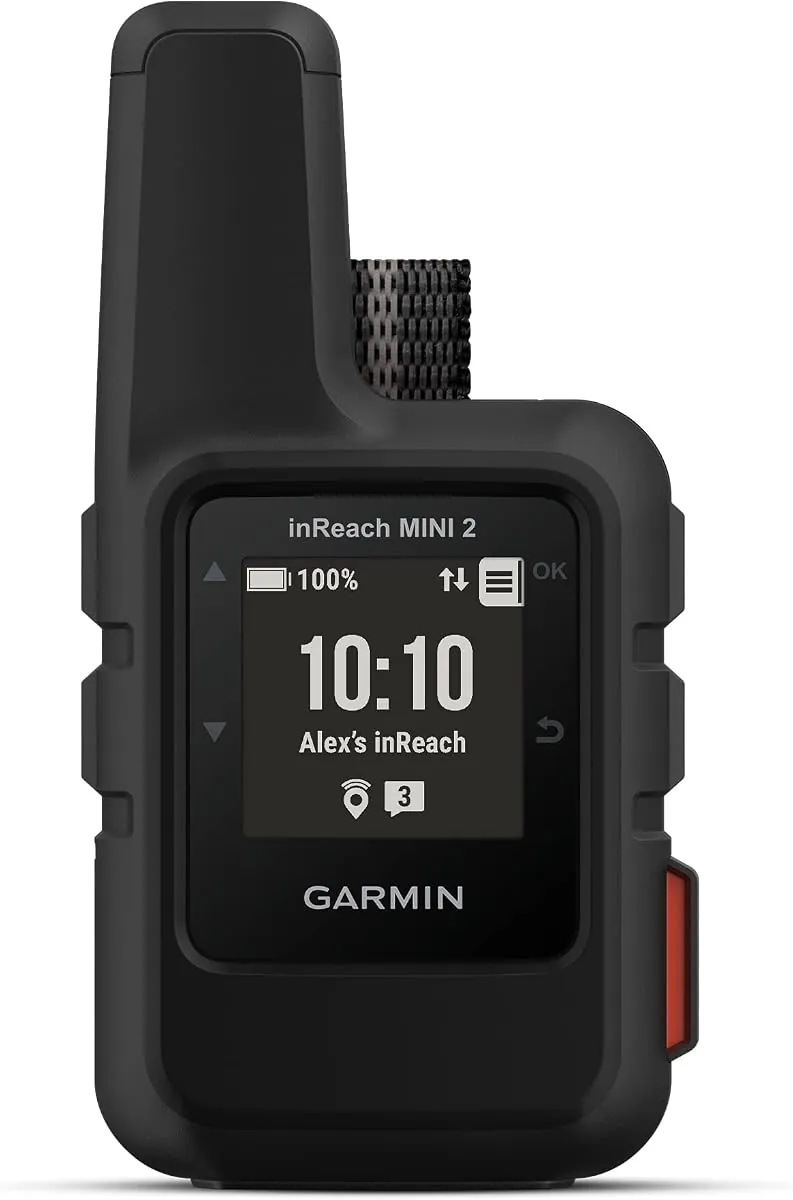
Garmin inReach Mini 2
4.6

Garmin inReach Mini 2

The default recommendation in this category, and the pick I'd hand to almost anybody. It runs on Iridium, so the coverage is global rather than merely wide, and it has its own screen and buttons, so preset messages, replies and the SOS all work with your phone switched off or dead. Garmin rates it at up to 14 days at the default 10-minute tracking interval. At 100 grams it's the lightest thing here that does the whole job.

Check Price
Most Capable
Garmin inReach Mini 3 Plus
4.6

Garmin inReach Mini 3 Plus

The most capable device on this page, and the one to buy if the budget is open. It does everything the Mini 2 does and adds a color screen plus photo, text and voice messaging, so it collapses the Mini 2 and the Messenger Plus into one unit. Garmin's manual lists an IP67 rating, an 1,800 mAh cell and an operating range of -20 to 60 degrees Celsius. It sits second rather than first only because the extra money buys convenience rather than a better outcome in an emergency.

Check Price
Best for Photos and Voice
Garmin inReach Messenger Plus
4.6

Garmin inReach Messenger Plus

The best pure communication device here, and the cheapest way to send a photo over satellite. Paired with the Garmin Messenger app it sends texts of up to 1,600 characters, photos, and 30-second voice messages, which is a different thing from the 160-character world satellite messaging normally lives in. Preset check-in phrases don't count against the monthly message allowance. It ranks below the Mini 2 because it's built to talk rather than navigate.

Check Price
Comparison Table

Every Pick, Side by Side

Compare all 8 picks
Best Overall
Best For
Solo hikers who want everything that matters and nothing that doesn't
Difficulty
Beginner
Price
$$$
Most Capable
Best For
People who want the flagship and aren't counting the money
Difficulty
Intermediate
Price
$$$
Best for Photos and Voice
Best For
Sending photos and voice notes from places with no signal
Difficulty
Beginner
Price
$$$
Recommended #4
Best For
Keeping family updated without teaching anyone to use an app
Difficulty
Beginner
Price
$$$
Recommended #5
Best For
Emergency beacon: calls for help, never bills you, says nothing
Difficulty
Intermediate
Price
$$$
Recommended #6
Best For
The cheapest way onto Iridium with real two-way messaging
Difficulty
Beginner
Price
$$$
Recommended #7
Best For
Emergency beacon: the lightest way to carry a rescue call
Difficulty
Intermediate
Price
$$$
Recommended #8
Best For
One-way tracker: the cheapest way to be followed, with real limits
Difficulty
Beginner
Price
$$$
The Lineup

8 Best Satellite Messengers, Compared

Detailed picks with verdicts, strengths, tradeoffs, and the situations where each one makes the most sense.

Best Overall
Garmin inReach Mini 2
4.6 (2,188 Amazon ratings)

Garmin inReach Mini 2

Quick verdict: The default recommendation in this category, and the pick I'd hand to almost anybody. It runs on Iridium, so the coverage is global rather than merely wide, and it has its own screen and buttons, so preset messages, replies and the SOS all work with your phone switched off or dead. Garmin rates it at up to 14 days at the default 10-minute tracking interval. At 100 grams it's the lightest thing here that does the whole job.

Why It Stands Out

  • Iridium network, so it reaches a satellite anywhere on Earth including the poles
  • Interactive SOS to Garmin Response, a 24/7-staffed coordination center
  • Own screen and buttons, so it works without a phone
  • 4.6 stars across 2,188 ratings, the deepest pool of any Garmin here

Pros

  • Usually sells well under its list price
  • About 100 grams, so it barely registers against base weight
  • TracBack routing and a digital compass for getting back out
  • IPX7 water rating under IEC 60529

Cons

  • Subscription required, and the device is inert without one
  • Monochrome screen and no photo or voice messaging
  • Typing on the device itself is slow without the paired app
  • The orange colorway is often listed without a buy box

Best Situations

Solo overnights and multi-day trips outside cell coverageAnywhere you might need to describe an injury rather than just flag oneTrips where the phone is a camera and nothing more
Difficulty
Beginner
Price Range
$$$
Most Capable
Garmin inReach Mini 3 Plus
4.6 (123 Amazon ratings)

Garmin inReach Mini 3 Plus

Quick verdict: The most capable device on this page, and the one to buy if the budget is open. It does everything the Mini 2 does and adds a color screen plus photo, text and voice messaging, so it collapses the Mini 2 and the Messenger Plus into one unit. Garmin's manual lists an IP67 rating, an 1,800 mAh cell and an operating range of -20 to 60 degrees Celsius. It sits second rather than first only because the extra money buys convenience rather than a better outcome in an emergency.

Why It Stands Out

  • Exchanges photos, texts and voice messages as well as running standalone
  • Color display, a real step up from the Mini 2's monochrome screen
  • Interactive SOS to Garmin Response over Iridium
  • Usually discounted below its list price

Pros

  • The only device here that both navigates and sends photos and voice
  • IP67 rated and specified down to -20 degrees Celsius
  • 1,800 mAh rechargeable cell
  • 4.6 stars, matching every inReach here except the plain Messenger

Cons

  • Nearly twice the price of the Mini 2 for the same emergency capability
  • Only 123 ratings so far, a much shallower pool than the Mini 2's
  • Sending photos still requires pairing with the Garmin Messenger app
  • Subscription required on top of the highest hardware price in the Garmin line

Best Situations

Expedition trips where one device has to do navigation and communicationWinter expeditions, where an operating range down to -20 Celsius stops being a footnoteBuyers replacing both a messenger and a handheld GPS
Difficulty
Intermediate
Price Range
$$$
Best for Photos and Voice
Garmin inReach Messenger Plus
4.6 (62 Amazon ratings)

Garmin inReach Messenger Plus

Quick verdict: The best pure communication device here, and the cheapest way to send a photo over satellite. Paired with the Garmin Messenger app it sends texts of up to 1,600 characters, photos, and 30-second voice messages, which is a different thing from the 160-character world satellite messaging normally lives in. Preset check-in phrases don't count against the monthly message allowance. It ranks below the Mini 2 because it's built to talk rather than navigate.

Why It Stands Out

  • Text, photo and 30-second voice messaging over the Iridium network
  • Messages up to 1,600 characters, far past the usual satellite limit
  • Preset check-ins don't count against the monthly allotment
  • Interactive SOS to Garmin Response, the same 24/7 center as the Mini line

Pros

  • Usually discounted well below its list price
  • Voice notes carry tone, which matters more than it sounds when things go wrong
  • Shares to several contacts at once through the app
  • 4.6 stars, the same average as both Minis

Cons

  • Only 62 ratings, the smallest pool on this page
  • Photos and full typing need a paired smartphone
  • No TracBack routing or compass, so it doesn't replace a navigation device
  • Subscription required, and photo messages consume the allowance quickly

Best Situations

Long trips where the people at home want more than a location pingGroups splitting up who need to send more than a coordinateAnyone who already carries a watch or GPS for navigation
Difficulty
Beginner
Price Range
$$$
Recommended #4
ZOLEO Satellite Communicator
4.4 (3,159 Amazon ratings)

ZOLEO Satellite Communicator

Quick verdict: The value pick, and the easiest of these for the people back home. ZOLEO gives the device its own SMS number and email address, so friends text you the way they text anyone else, with nothing to install and nothing to explain. It moves between cellular, Wi-Fi and Iridium on its own, using the cheapest network it can reach. It's the cheapest real two-way satellite messenger here, and it's rated IP68 with over 200 hours of battery when checking messages roughly every 12 minutes.

Why It Stands Out

  • Dedicated SMS number and email address, so contacts need no app
  • Switches automatically between cellular, Wi-Fi and Iridium
  • The lowest price on this page for two-way satellite messaging
  • IP68 rated with MIL-STD-810G shock resistance

Pros

  • Over 200 hours of battery at a 12-minute message check interval
  • SOS goes to a 24/7 monitoring center, with a Medical Assist option
  • 4.4 stars across 3,159 ratings, the biggest pool on this page
  • Optional Global Rescue field membership for evacuation cover

Cons

  • Needs a paired phone to type free-form messages
  • No screen beyond status lights, so you can't read a message on the device
  • No navigation features at all
  • Subscription required, like every two-way device here

Best Situations

Family trips where several people want to reach you directlyBuyers who want Iridium coverage without Garmin pricingTrips where the phone is reliably charged and dry
Difficulty
Beginner
Price Range
$$$
Recommended #5
ACR ResQLink View PLB-425
4.6 (394 Amazon ratings)

ACR ResQLink View PLB-425

Quick verdict: The strongest no-subscription option here, and the beacon to buy if you want confirmation your signal left the building. It transmits on 406 MHz to the government Cospas-Sarsat network with 121.5 MHz homing for the final approach, fixes position on both GPS and Galileo, floats without a pouch, and carries a digital display that confirms the distress message actually went out. ACR rates it at 28 hours of transmission with a five-year battery replacement interval. It can't send or receive a single word.

Why It Stands Out

  • No subscription, ever, on any part of the service
  • 406 MHz to Cospas-Sarsat plus 121.5 MHz homing for the final approach
  • Digital display confirms the distress signal was transmitted
  • Buoyant without an added flotation pouch

Pros

  • 4.6 stars across 394 ratings, nearly four times the feedback behind the other beacon here
  • GPS and Galileo positioning rather than GPS alone
  • 28 hours of transmission once activated, on a battery you never charge
  • Government rescue network, with no commercial service to lapse

Cons

  • The highest price on this page
  • One-way only: no messaging, no confirmation that help is moving
  • 148 grams, half again the weight of the inReach Mini 2
  • Battery replacement every five years, and it isn't a job you can do yourself

Best Situations

Remote trips where a subscription would lapse between usesBoating and aviation as well as hiking, on one deviceBuyers who want the rescue call and nothing else
Difficulty
Intermediate
Price Range
$$$
Recommended #6
Garmin inReach Messenger
4.4 (433 Amazon ratings)

Garmin inReach Messenger

Quick verdict: The budget entry to Garmin's ecosystem, and a sensible one. It's the plain Messenger without the Plus model's photo and voice features, which leaves two-way texting, location sharing and the same interactive SOS to Garmin Response over the same Iridium network. It undercuts every other Garmin here. It sits sixth because the ZOLEO does the same core job for less and hands your contacts a normal phone number.

Why It Stands Out

  • Two-way messaging over Iridium at the lowest Garmin price here
  • Interactive SOS to Garmin Response, identical to the pricier models
  • The cheapest way into Garmin's ecosystem here
  • 4.4 stars across 433 ratings

Pros

  • Full Garmin SOS handling without the flagship price
  • Works with the Garmin Messenger app and Garmin's wider ecosystem
  • Simple enough to hand to someone who'll never read a manual
  • Cheaper than the Messenger Plus by a hundred dollars

Cons

  • No photo or voice messaging, unlike the Plus
  • No navigation features, unlike the Mini line
  • Depends on a paired phone for free-form typing
  • The ZOLEO costs less and adds a dedicated phone number

Best Situations

First satellite device for someone already inside the Garmin ecosystemWeekend trips where check-ins matter more than photosBuyers who want Garmin's SOS handling at the lowest entry price
Difficulty
Beginner
Price Range
$$$
Recommended #7
Ocean Signal rescueME PLB1
4.6 (105 Amazon ratings)

Ocean Signal rescueME PLB1

Quick verdict: The smallest and lightest beacon here at 116 grams, and the one that disappears into a hipbelt pocket instead of living on the outside of the pack. Like every personal locator beacon it transmits on 406 MHz to Cospas-Sarsat with 121.5 MHz homing, needs no subscription, and says nothing back. Ocean Signal quotes seven years of battery life, which is the longest replacement interval on this page, and more than 24 hours of transmission at -20 degrees Celsius.

Why It Stands Out

  • 116 grams, a full 32 grams under the other beacon here
  • Seven-year battery life, two years longer than the ACR's interval
  • Nothing to subscribe to, now or later
  • Over 24 hours of transmission at -20 degrees Celsius

Pros

  • Cheaper than the ACR ResQLink View
  • Small enough that carrying it is never a decision
  • The same 406 MHz Cospas-Sarsat call as the ACR, in a smaller body
  • 4.6 stars across 105 ratings

Cons

  • One-way only, with no way to describe the emergency
  • No display, so nothing confirms the signal went out
  • Only 105 ratings, a shallow pool for a safety purchase
  • Still a serious outlay for a device you hope never to switch on

Best Situations

Ultralight trips where every gram is argued overCarrying a beacon on your person rather than in the packCold-weather use, where the -20 degree figure is published rather than assumed
Difficulty
Intermediate
Price Range
$$$
Recommended #8
SPOT Gen 4
4.4 (399 Amazon ratings)

SPOT Gen 4

Quick verdict: The cheapest device here, and the one whose compromises need saying out loud. It's the only Globalstar device on the page, so its coverage map has holes in it that no Iridium device has. It's also one-way: it sends preset check-ins, tracking points and an SOS, and it can't receive a thing, so you never learn whether your message arrived. It takes four AAA lithium cells rather than a rechargeable pack, which some people prefer on long trips. It finishes last on capability, not on price.

Why It Stands Out

  • The lowest price on this page, undercutting even the cheapest Iridium device
  • Runs on four AAA lithium cells, rated for around 1,250 messages
  • Sends tracking points while moving and when stopped
  • IP68 dust and water rating

Pros

  • Half the price of the cheapest Garmin here
  • Swappable AAA cells rather than a battery you have to recharge
  • 4.4 stars across 399 ratings
  • Simple enough that there's nothing to learn

Cons

  • One-way only, so nothing ever confirms your message was received
  • Globalstar coverage has real gaps at high latitudes
  • Subscription still required despite the low hardware price
  • About 142 grams, heavier than the inReach Mini 2

Best Situations

Letting family follow a trip in country Globalstar covers wellA second tracker for a group that already carries a two-way deviceBuyers who want the lowest possible entry cost and understand the tradeoff
Difficulty
Beginner
Price Range
$$$
Buying Guide

What to Check Before You Buy

Do you need two-way messaging, or just an SOS button?

Two-way messaging lets rescuers ask what's wrong and tell you what's coming. A beacon only tells them where you are, and that difference decides most of this page. With a two-way messenger the SOS reaches a staffed coordination center and you trade texts with it from there, so the responders know whether they're collecting a turned ankle or a cardiac event, and can send a ground team instead of a helicopter.

A beacon broadcasts your position and then goes quiet. It's simpler and there's nothing to renew, but it can't tell anyone a thing. If you hike alone in country where a bad fall and a twisted knee would get very different responses, buy the messaging.

Which satellite network does it use, and does that matter where you hike?

It matters, and mostly at high latitudes. Three networks are in play here: Iridium reaches every point on Earth, poles included; Globalstar covers most of the populated world and leaves real gaps in the far north; and Cospas-Sarsat is the government system every 406 MHz beacon transmits to. Five of the eight devices below run on Iridium, and that's the reason to prefer them if you hike far north or a long way from a road.

The SPOT Gen 4 is the one Globalstar device here, which is part of why it finishes last despite being the cheapest thing on the page. Whichever network you land on, every one of these needs open sky overhead to work at all.

What does the subscription actually cost over five years?

A messenger is a subscription product, and over five years the plan usually costs more than the hardware did. Every two-way device on this page is inert without an active one. Plans bill monthly, and an annual commitment costs less per month while the flexible version costs more and lets you suspend service over the winter. Figure out the yearly number for the months you actually hike, add it to the sticker price, and compare that instead.

A personal locator beacon works the other way around: buy it once, register it free with the national authority, replace the battery every five to seven years, and pay nothing in between.

Does it still work if your phone is dead?

Only some of these can send a message without a working phone, and it's worth checking before you buy. The inReach Mini 2 and Mini 3 Plus carry their own screens and buttons, so you can fire off a check-in, read what came back and hold down the SOS with the phone switched off or drowned. The ZOLEO and both inReach Messengers need a paired phone to type anything free-form, though their SOS buttons work on their own.

Beacons need no phone at all. Phones die, get wet and get dropped down rock cracks, so a device that keeps working without one earns its place.

If you hike solo in cell dead zones
About $250

The inReach Mini 2 has been the default answer for years, and nothing on this page has taken the spot off it. Iridium coverage means it reaches a satellite anywhere, and its own screen and buttons mean a flat phone battery doesn't take the messenger down with it. It's about the least you can spend on something that still works when your phone doesn't.

If you only want the rescue button
$400-$470

Buy a beacon and you stop paying anybody, permanently. The Ocean Signal rescueME PLB1 weighs 116 grams and sits on a seven-year battery; the ACR ResQLink View adds a small screen that tells you the call went out. Neither one can send a text or take one. They'll still raise a rescue seven years from now, on the battery you bought them with.

If you mostly want to keep people at home updated
About $150

Nobody at home wants to install an app to hear from you. The ZOLEO gets around that by carrying its own phone number and its own email address, so a message to you looks like a message to anybody else. It's also the cheapest way onto Iridium here, and it routes each message over cellular, Wi-Fi or satellite, whichever one it can reach most cheaply.

Full Catalog

Compare All 8 Satellite Messengers

Want to browse beyond the ranked picks? Filter and sort the full satellite messengers listing below.

Best Satellite Messengers and Beacons of 2026 — All Products

8 Products
FAQ

Frequently Asked Questions

Anywhere with a clear view of the sky, which is not the same as everywhere. What stops a message is almost always something over your head rather than how far you are from a road. An Iridium device on an open ridge in the middle of nowhere sends in seconds; the same device in a narrow canyon or under dense conifer can take many minutes or fail outright.

So when a message won't go, walk to the most open ground you can get to, set the device down with its antenna pointing at the sky, and leave it there instead of standing over it.

Glossary

The words on this page

Every term this guide leans on has its own page with a plain answer at the top.

Browse the whole glossary →
How We Choose Products

How These Picks Are Chosen

Reader-supported and free of paid placements. Every pick is ranked on published specs and Amazon buyer ratings, not on who pays us.

Spec Research

Each pick is compared on published specs, materials, design, and category fit across the major brands.

Practical Fit

Rankings factor in how well each product matches common hiking, backpacking, and trail running needs, not just popularity.

Amazon Buyer Ratings

Star ratings and review volume from verified Amazon buyers are factored in to reflect real-world satisfaction.

Value

A pick earns its spot by delivering useful performance for the money, whether budget or premium.

SIGNAL SORTED.
NOW THE NAVIGATION.

A messenger tells people where you are. It doesn't tell you where you're going. We ranked the navigation watches separately, on rated GPS-mode battery hours and whether you get real onboard topo maps or just a breadcrumb trail pointing back the way you came.

Best GPS Hiking Watches