Best GPS Hiking Watches of 2026 — hiking gear
GPS Watch Buying Guide

Best GPS Hiking Watches of 2026

Eight watches, ranked on two questions: how many hours does it really record with the GPS on, and does the topo map live on the watch or back on your phone?

View Top PicksUpdated 3 August 2026 · Ranked from specs & buyer reviews

If you buy through a link on this page we may earn a commission, at no extra cost to you. It never changes how anything is ranked.

How to Choose

How to Choose a GPS Hiking Watch

A GPS watch does two separate jobs, and product listings blur them together. The first is recording: it tracks where you went, how far, how much you climbed, and hands you a file at the end. Every watch on this page is good at that, including the cheapest one. The second job is navigation, meaning it tells you where you are and where the trail goes while you're standing on it in the rain with a dead phone. That's where these watches split, and the dividing line is whether the map lives on the watch. A watch with real onboard topographic maps shows contours, trails and the terrain on either side of your route. A breadcrumb watch shows a bare line, the track you loaded plus a dot for you, with nothing around it. Both will keep you on a well-marked trail. Only one helps when you're trying to figure out whether the drainage on your left goes anywhere.

Battery is the other axis, and it's the number most often quoted misleadingly. "Up to 36 days" is smartwatch mode: the watch on your wrist counting steps and buzzing at texts, GPS off. The figure that decides a trip is hours in the GPS mode you'll actually record in, and it's a small fraction of the headline. Garmin rates the fenix 8 Solar at 149 hours of GPS with solar charging; the AMOLED fenix 8 at 47 hours; the Instinct 3 Solar at 40, or 130 with real sun on it. Switch on multi-band GNSS for accuracy in a canyon and every one of those numbers drops, often by a third, and cold weather takes another bite. Figure out how many hours of recording your trip needs, double it, and buy above that. A watch that quits on day four of a five-day trip leaves you walking the last day off memory.

The eight below are ordered on those two things first, then on whether you can build or load a route without a phone in the loop, and last on how the screen reads in direct sun. They are deliberately not ordered on review count. An Amazon review count mostly measures how long a listing has been up and how many units it moves, which is why the Amazfit here carries 2,491 ratings and the COROS APEX 4 carries 126, and why that gap says almost nothing about which one navigates better. Nothing was left off the page for costing too much. Garmin's fenix 8 is where this category tops out, and it's here in both its forms: the Solar 51mm at $1,199.99, which trades the bright screen for the longest battery on the page, and the AMOLED 47mm at $1,085.99, which does the opposite. Everything is ranked from published specs, Amazon buyer feedback and the testing other people have put in print. My dad and I have not worn all eight of these for a season, and I'm not going to pretend we have. Ratings, review counts and prices were read off the listings on August 3, 2026.

Quick Picks

Top Three at a Glance

Short on time? Start with these top-rated gps hiking watches picks.

Best Overall
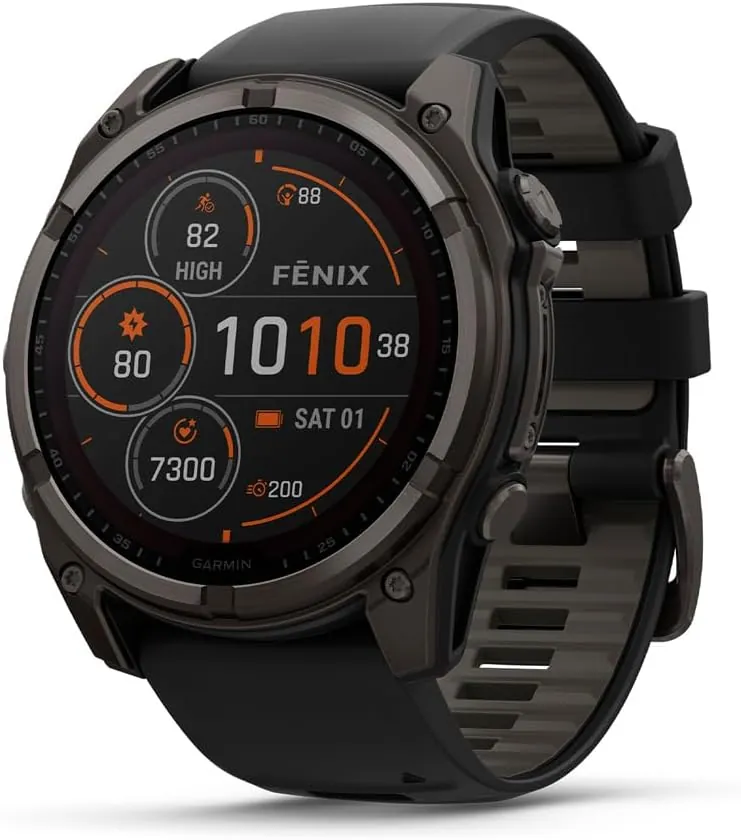
Garmin fenix 8 Solar (51mm)
4.7

Garmin fenix 8 Solar (51mm)

The reason this one is first is narrow and specific: Garmin rates it at 149 hours of GPS with solar charging, and it still carries full preloaded topographic maps and on-watch round-trip routing. Nothing else here comes close on that combination. It gets there by taking the fenix 8's feature set and swapping the AMOLED screen for a power-sipping MIP panel under a solar lens, which is also why it reads best in exactly the midday glare that washes an AMOLED out. At 64 grams for the titanium version it's lighter than the 51mm epix Pro too. It costs $1,199.99, and it earns that only if your trips are long enough that battery is a planning problem rather than a footnote.

Check Price
Best Value
Garmin epix Pro Gen 2 (51mm)
4.6

Garmin epix Pro Gen 2 (51mm)

This is the value pick of the expensive end, and only because of the price it's currently sitting at. It lists at $1,099.99 and was $614.63 on the day of writing, a 44% cut, which puts Garmin's full mapping stack, round-trip routing, an AMOLED screen and a rated 82 hours of GPS below the price of watches with half the capability. It's a 2023 generation rather than the newest, so it misses the fenix 8's speaker, mic and dive rating. For hiking, none of those three matter. Check the price before you decide, because discounts like this move: it dropped another $25 in the hours it took to write this page.

Check Price
Best Under $500
COROS APEX 4 (46mm)
4.1

COROS APEX 4 (46mm)

The most sensible watch here for most people who need actual navigation. $479 buys global topographic maps with turn-by-turn directions, a rated 53 hours in all-systems GPS mode, and a case that comes in around 50 grams on a nylon band, among the lightest on this page with maps on board. COROS's interface is also the quickest of the three brands to learn, which matters more than spec sheets suggest when you're cold and trying to do something on a small screen. The 4.1 average across 126 ratings is the softest score here, and it's a recent release, so read that as a young pool rather than a verdict.

Check Price
Comparison Table

Every Pick, Side by Side

Best Overall
Best For
Weeks out between charges
Difficulty
Advanced
Price
$$$
Best Value
Best For
Flagship mapping without flagship money
Difficulty
Advanced
Price
$$$
Best Under $500
Best For
Real maps for under $500
Difficulty
Intermediate
Price
$$$
Recommended #4
Best For
One watch that does absolutely everything
Difficulty
Advanced
Price
$$$
Recommended #5
Best For
The cheapest route to onboard topo maps
Difficulty
Intermediate
Price
$$$
Recommended #6
Best For
Turn-by-turn maps at the low end
Difficulty
Beginner
Price
$$$
Recommended #7
Best For
Never thinking about the charger
Difficulty
Beginner
Price
$$$
Recommended #8
Best For
A first GPS watch on a real budget
Difficulty
Beginner
Price
$$$
The Lineup

8 Best GPS Hiking Watches, Compared

Detailed picks with verdicts, strengths, tradeoffs, and the situations where each one makes the most sense.

Best Overall
Garmin fenix 8 Solar (51mm)
4.7 (237 Amazon ratings)

Garmin fenix 8 Solar (51mm)

Quick verdict: The reason this one is first is narrow and specific: Garmin rates it at 149 hours of GPS with solar charging, and it still carries full preloaded topographic maps and on-watch round-trip routing. Nothing else here comes close on that combination. It gets there by taking the fenix 8's feature set and swapping the AMOLED screen for a power-sipping MIP panel under a solar lens, which is also why it reads best in exactly the midday glare that washes an AMOLED out. At 64 grams for the titanium version it's lighter than the 51mm epix Pro too. It costs $1,199.99, and it earns that only if your trips are long enough that battery is a planning problem rather than a footnote.

Why It Stands Out

  • Garmin rates it at 149 hours of GPS with solar, the longest on this page by a wide margin
  • Preloaded topographic maps, not a breadcrumb line
  • Round-trip routing builds a loop of the distance you ask for, from where you're standing
  • 64 grams in titanium, lighter than the 51mm epix Pro despite the same case size

Pros

  • The one watch here where a week-long trip needs no charging plan at all
  • MIP screen is at its most readable in the midday sun that defeats AMOLED
  • Sapphire lens, titanium bezel, flashlight, speaker and mic, and a 40 metre dive rating

Cons

  • $1,199.99, the most expensive watch on this page
  • MIP screen looks dull and dated next to an AMOLED indoors
  • 237 ratings is a modest review base next to the epix Pro's 1,431

Best Situations

Thru-hikes and long traversesExpedition tripsAnywhere off-grid for days
Difficulty
Advanced
Price Range
$$$
Best Value
Garmin epix Pro Gen 2 (51mm)
4.6 (1,431 Amazon ratings)

Garmin epix Pro Gen 2 (51mm)

Quick verdict: This is the value pick of the expensive end, and only because of the price it's currently sitting at. It lists at $1,099.99 and was $614.63 on the day of writing, a 44% cut, which puts Garmin's full mapping stack, round-trip routing, an AMOLED screen and a rated 82 hours of GPS below the price of watches with half the capability. It's a 2023 generation rather than the newest, so it misses the fenix 8's speaker, mic and dive rating. For hiking, none of those three matter. Check the price before you decide, because discounts like this move: it dropped another $25 in the hours it took to write this page.

Why It Stands Out

  • Garmin rates it at 82 hours of GPS-only tracking, second only to the fenix 8 Solar here
  • Full multi-continent TopoActive maps with the same routing engine as the fenix line
  • 44% off its list price at the time of writing, at $614.63 against $1,099.99
  • 1,431 ratings averaging 4.6, the deepest feedback pool of any Garmin on this page

Pros

  • Bright AMOLED display that makes a map easy to read at a glance
  • Full Garmin ecosystem: apps, maps, routing, the largest user community
  • 51mm case gives the biggest map view on the page

Cons

  • About 88 grams, the heaviest watch here, and a 51mm case swamps a slim wrist
  • Previous generation, so it won't get new features as long as the fenix 8 will
  • The discount is the whole argument. At list price the math stops working

Best Situations

Multi-day backcountryMap-heavy off-trail travelOne-watch-for-everything buyers
Difficulty
Advanced
Price Range
$$$
Best Under $500
COROS APEX 4 (46mm)
4.1 (126 Amazon ratings)

COROS APEX 4 (46mm)

Quick verdict: The most sensible watch here for most people who need actual navigation. $479 buys global topographic maps with turn-by-turn directions, a rated 53 hours in all-systems GPS mode, and a case that comes in around 50 grams on a nylon band, among the lightest on this page with maps on board. COROS's interface is also the quickest of the three brands to learn, which matters more than spec sheets suggest when you're cold and trying to do something on a small screen. The 4.1 average across 126 ratings is the softest score here, and it's a recent release, so read that as a young pool rather than a verdict.

Why It Stands Out

  • Global onboard maps with turn-by-turn navigation at well under flagship money
  • COROS rates the 46mm at 53 hours in all-systems GPS mode
  • About 50 grams with the nylon band, among the lightest mapping watches on this page
  • MIP display, which is the right screen for a full-sun ridge

Pros

  • Simplest interface of the three big brands, with a digital dial that works in gloves
  • Adds a speaker and mic, so calls and voice notes work from the wrist
  • One of the lightest watches you can buy with real maps on it

Cons

  • 4.1 stars is the lowest average on this page, from a young pool of 126 ratings
  • COROS's app ecosystem is much smaller than Garmin's
  • No round-trip routing, so you plan routes rather than improvise them

Best Situations

Multi-day backpackingFast hiking and trail runningBuyers who want maps without $900
Difficulty
Intermediate
Price Range
$$$
Recommended #4
Garmin fenix 8 AMOLED (47mm)
4.5 (405 Amazon ratings)

Garmin fenix 8 AMOLED (47mm)

Quick verdict: The same flagship as the watch at the top of this page, with the trade reversed: this one keeps the AMOLED screen and gives up the battery. It has everything else too, including round-trip routing, a speaker and mic, a sapphire lens and a dive rating to 40 meters. For hiking specifically, though, Garmin rates it at 47 hours of GPS against the Solar version's 149, it weighs around 80 grams, and it costs $1,085.99. On the two things this guide ranks by, it loses to cheaper watches. Buy it if you want a single watch for hiking, diving, training and daily wear, and the screen matters more to you than the charging interval.

Why It Stands Out

  • Full TopoActive mapping plus Garmin's best-in-class round-trip routing
  • Bright 1.4-inch AMOLED under a sapphire lens, the best screen here
  • Speaker and mic for calls, plus a dive rating to 40 meters
  • Newest generation, so it gets Garmin's new features first and longest

Pros

  • The widest feature set of any watch on this page
  • Sapphire lens and titanium bezel are as durable as this category gets
  • Excellent for anyone who wants one watch for hiking and everything else

Cons

  • $1,085.99, second only to its own Solar sibling on price
  • 47 rated GPS hours, behind four cheaper watches on this page
  • Around 80 grams, and the speaker, mic and dive rating do nothing on a trail

Best Situations

Multi-sport athletesDaily wear plus backcountryBuyers who want the flagship
Difficulty
Advanced
Price Range
$$$
Recommended #5
Suunto Vertical
4.3 (52 Amazon ratings)

Suunto Vertical

Quick verdict: The value story of the page. Suunto's free offline topographic maps, dual-band GNSS and a rated 60 hours of GPS in the steel version, at $348.98 against a $499 list. That is real mapping capability for roughly a third of what the flagships cost. The caveats are honest ones: the app and ecosystem are thinner than Garmin's, and 52 ratings is easily the smallest feedback pool here, so there's less collective experience to lean on. Note also that the 85-hour figure quoted around this watch belongs to the solar and titanium versions, not the steel one.

Why It Stands Out

  • Free offline topographic maps downloaded straight to the watch, no subscription
  • Dual-band GNSS, which is the setting that helps in canyons and thick timber
  • Suunto rates the steel version at 60 hours of GPS on the most accurate setting
  • 30% off list at $348.98, which puts real topographic maps under $350

Pros

  • Map handling is excellent and costs nothing extra
  • Considerably cheaper than any Garmin with comparable mapping
  • Solar and titanium versions push rated GPS time to 85 hours if you spend more

Cons

  • 52 ratings is the thinnest review base on this page
  • Smaller app ecosystem and fewer third-party integrations than Garmin
  • Steel version is about 86 grams, and a lot of the specs you'll read online are for the lighter titanium one

Best Situations

Multi-day backcountry on a budgetMap-first buyersAnyone avoiding Garmin's prices
Difficulty
Intermediate
Price Range
$$$
Recommended #6
COROS Nomad
4.4 (258 Amazon ratings)

COROS Nomad

Quick verdict: A slightly odd product with a very good navigation package hiding inside it. COROS aimed the Nomad at anglers and the Amazon listing leads with tide tables and catch logging, none of which does a thing for a hiker. Underneath that, it's $349 for the same global maps and turn-by-turn navigation as the APEX line, a MIP screen and a 22-day daily-use battery. If you can ignore the fishing framing, it's one of the cheapest ways to get proper on-watch maps. If the marketing bothers you, the Suunto Vertical is a similar price and squarely aimed at your sport.

Why It Stands Out

  • Global onboard maps with turn-by-turn navigation, the same system as the APEX watches
  • $349 puts it at the bottom of the real-mapping price band
  • COROS's 22-day daily-use rating means charging is rarely on your mind
  • MIP screen, which stays readable in the brightest conditions

Pros

  • Proper maps and routing for well under $400
  • COROS's simple interface, which is easy to operate with cold hands
  • Rugged case aimed at outdoor use rather than the gym

Cons

  • Marketed as a fishing watch, so a chunk of the feature set is dead weight on a trail
  • Shorter GPS runtime than the APEX 4 despite the similar look
  • Reviews are pooled across the Nomad colorways, so read 258 ratings as one signal

Best Situations

Budget multi-day tripsFirst mapping watchAnglers who also hike
Difficulty
Beginner
Price Range
$$$
Recommended #7
Garmin Instinct 3 Solar (50mm)
4.5 (61 Amazon ratings)

Garmin Instinct 3 Solar (50mm)

Quick verdict: One of the most popular hiking watches going, and seventh here purely because it has no maps. What it has instead is a hard-wearing polymer case, Garmin's ecosystem, and solar charging that takes a rated 40 GPS hours up to about 130 with real sun on it. If you hike marked trails and carry a phone for the map, this is arguably the smartest buy on the page. The listing linked here is the Supernova limited-edition colourway, which is the same watch as the standard Instinct 3 Solar in a different case and band; it carries its own smaller pool of 61 ratings rather than the many hundreds the charcoal version has collected. If you want to see contours on your wrist, this simply doesn't do that, and no firmware update will change it.

Why It Stands Out

  • Solar charging stretches a rated 40 GPS hours to about 130 in good sun
  • Metal-reinforced polymer case built to Garmin's toughest outdoor standard
  • Effectively unlimited smartwatch-mode runtime if you are outdoors most days
  • $399.99 against a $449.99 list, and it includes a built-in flashlight

Pros

  • May never need charging between trips if you hike in open sun
  • Very tough, and lighter than the metal flagships at about 53 grams
  • Garmin's ecosystem and app support at a mid-range price

Cons

  • Breadcrumb navigation only. No topographic maps at all, and that's by design
  • MIP screen is low-resolution next to the AMOLED watches here
  • $399.99 buys onboard maps elsewhere on this page

Best Situations

Marked-trail day hikingLong trips where charging is hardRough handling and cold weather
Difficulty
Beginner
Price Range
$$$
Recommended #8
Amazfit T-Rex 3
4.5 (2,491 Amazon ratings)

Amazfit T-Rex 3

Quick verdict: The cheapest way onto this page and, surprisingly, one that doesn't skip the important feature: it downloads free offline topographic maps with turn-by-turn navigation, which nothing else near $255 does. Amazfit rates it at 42 hours in accurate GPS mode and up to 114 in its battery-saver mode. The catch is everything around the navigation. GPS accuracy under canopy is the weakest here, and the software and support are a step below the three specialist brands. Its 2,491 ratings make it by far the most-reviewed watch on the page, which reflects sales volume rather than superiority, and is exactly why it's ranked last rather than first.

Why It Stands Out

  • Free downloadable offline contour maps with turn-by-turn navigation at $254.90
  • Amazfit rates it at 42 hours in accurate GPS mode, 114 in battery-saver
  • 1.5-inch AMOLED screen that is brighter than the MIP watches costing twice as much
  • 27-day typical daily-use battery and a 100-meter water rating

Pros

  • Onboard maps for a quarter of what the flagships cost
  • Bright, sharp AMOLED display
  • The largest review pool here at 2,491 ratings averaging 4.5

Cons

  • GPS accuracy under tree cover is the weakest of the eight
  • Software and long-term support lag Garmin, COROS and Suunto
  • 48mm case at about 67 grams is a lot of watch on a smaller wrist

Best Situations

First GPS watchBudget day hikingBuyers who want maps cheaply
Difficulty
Beginner
Price Range
$$$
Buying Guide

What to Check Before You Buy

Onboard maps or a breadcrumb line

This is the biggest functional difference between two watches that look identical on a shelf. Full onboard maps mean the watch stores actual topographic map tiles: contour lines, named trails, water, and the terrain on either side of wherever you are. Seven of the eight here do that. The Garmin Instinct 3 Solar doesn't, and Garmin left it out on purpose. It shows a breadcrumb, which is the route line you loaded plus your position on it, along with distance and bearing to the waypoints you set. On a signed trail that's enough. It stops being enough the moment you want to improvise, or take a bail-out the loaded route knows nothing about. Free maps matter here too. Garmin and Suunto both hand you topo maps at no extra cost, COROS ships global maps on the watch, and Amazfit lets you download free contour maps. Nobody in this lineup charges a map subscription, which wasn't true of this category a few years ago.

Read the GPS-hours figure, not the days figure

Every brand leads with its longest number, and the longest number is always smartwatch mode with the GPS radio off. It's useful for knowing how often you'll charge at home and useless for planning a trip. The number to compare is rated hours in the standard GPS or all-systems mode, because that is what recording a hike costs. Across this page that runs from 40 hours on the Instinct 3 Solar to 149 on the fenix 8 Solar, close to a fourfold spread hidden behind headline figures that are all quoted in weeks. Then start subtracting. Multi-band GNSS, which is what you want in a slot canyon or thick timber, can cost a third of the runtime, and an always-on AMOLED screen costs more again. Sub-freezing nights shorten it further. Solar helps, but only outdoors in real sun, which is why solar figures always come with a stated assumption of a few hours a day at a given brightness.

Whether a route loads without your phone

The reason to own a navigation watch is not needing to take the phone out, so it matters how a route gets onto the watch in the first place. The good answer is Wi-Fi sync: you build a route in the app or on a mapping site at home, and the watch pulls it over your home network without a phone involved. Garmin, COROS and Suunto all do this. Fewer watches can create a route on the watch itself. Garmin's round-trip routing on the fenix 8 and epix Pro will take a distance you want to cover and build a loop from where you're standing, then rebuild it if you go a different way. That's the difference between a watch that plays back a route and one that can hand you a new one at four in the afternoon when the weather turns. Worth checking before you buy: whether your watch can search for a point of interest, and whether it will route you back to the trailhead from wherever you are without any preparation.

Screen type, weight and the ABC sensors

There are two screen technologies and the trade is straightforward. MIP screens, used by the COROS APEX 4 and Nomad and by the Instinct line, are dim indoors and get brighter and more legible the harder the sun hits them, and they sip power. AMOLED screens, on the fenix 8, epix Pro and T-Rex 3, are gorgeous everywhere and cost battery, especially left always-on. For hiking specifically MIP has the edge, because full midday sun on a ridge is exactly the condition it's best in. Weight is worth a thought too, since this thing is on your wrist for fourteen hours a day: the published figures run from about 50 grams on the lightest watches here, the COROS Nomad and the APEX 4, up to about 88 on the 51mm epix Pro. And check for a barometric altimeter rather than GPS-derived elevation. All eight here have the full altimeter, barometer and compass set, which is what gives you honest climb totals and a pressure trend that hints at weather before the sky does.

Day Hikes And Marked Trails
$255-$400

You're out for a day at a time on trails with signs, and you carry a phone. Buy for battery and durability rather than mapping. The Amazfit T-Rex 3 or the Instinct 3 Solar both do this well, and the Instinct's solar charging means you may never think about the charger at all.

Multi-Day Backcountry
$350-$650

Three to five nights out, off the phone, sometimes off the trail. This is where onboard maps stop being a luxury. The COROS APEX 4 and Suunto Vertical both give you real topo maps and 50-plus GPS hours for well under the flagship price, and the discounted epix Pro adds Garmin's routing on top.

Thru-Hiking And Long Traverses
$615-$1,200

Weeks between charges, and navigation you're relying on rather than double-checking against a phone. The fenix 8 Solar's 149 GPS hours with sun on the glass are the reason that version exists, and the discounted epix Pro gets you the same maps and routing for around half the money if you can live with charging more often.

Full Catalog

Compare All 8 GPS Hiking Watches

Want to browse beyond the ranked picks? Filter and sort the full gps hiking watches listing below.

Best GPS Hiking Watches of 2026 — All Products

8 Products
FAQ

Frequently Asked Questions

Honestly, for day hikes on marked trails, no. A phone with a downloaded offline map in something like Gaia or CalTopo is a better map than any watch, on a far bigger screen, and it costs you nothing extra. The case for a watch is about the things a phone is bad at: it's on your wrist so you glance rather than stop and dig, it runs for days rather than hours, it works with wet or gloved hands, and it doesn't mind the cold or the rain. The most common real-world setup is both, with the phone as the map you consult when you need detail and the watch as the thing that quietly records and keeps you honest about direction and distance. If you only ever hike marked day trails and your phone lasts the day, save the money.

How We Choose Products

How These Picks Are Chosen

Reader-supported and free of paid placements. Every pick is ranked on published specs and Amazon buyer ratings, not on who pays us.

Spec Research

Each pick is compared on published specs, materials, design, and category fit across the major brands.

Practical Fit

Rankings factor in how well each product matches common hiking, backpacking, and trail running needs, not just popularity.

Amazon Buyer Ratings

Star ratings and review volume from verified Amazon buyers are factored in to reflect real-world satisfaction.

Value

A pick earns its spot by delivering useful performance for the money, whether budget or premium.

NAVIGATION SORTED.
NOW THE REST.

Packs, boots, trekking poles and bear canisters are all up now, and my dad and I are working through the rest of the kit the same way. New guides go live as we finish them.

Browse All Guides
See Top Picks