Skip to content
Best Power Banks for Backpacking of 2026 — hiking gear
Backpacking Power Bank Buying Guide

Best Power Banks for Backpacking of 2026

How much battery a trip actually needs, why the number on the box overstates it, and which of these eight is worth its weight in your pack.

View the top picksUpdated 30 September 2026 · Ranked from specs & buyer reviews
How to Choose

How to Choose a Power Bank for Backpacking

Your phone does a lot of jobs on a backpacking trip. It's the map, the camera, the GPS track, sometimes the headlamp charger and, on a clear ridge, the only way to text home. A dead phone on day three is an inconvenience at best. That's why a power bank is one of the most common gadgets on a multi-day trip.

The trouble is that many power banks are sold to commuters. The listings brag about how fast they top up a laptop, and few of them tell you what you care about on a trail: how many phone charges you get per ounce, and whether the thing survives a rainstorm in a hipbelt pocket.

The eight below are ranked on those two things first: usable energy for the weight, and how much rain and knocking around each one takes. Ports and recharge speed come after that. My dad and I haven't bench-tested them. The order comes from each maker's specs, CleverHiker's power bank roundup, and what Amazon buyers report in their ratings and reviews.

One note on scope. Beyond a certain size a power bank turns into a laptop battery or a camp power station, which weighs pounds and rarely belongs on a trail. The Goal Zero here is about as far up that ladder as a backpacker should go.

Quick Picks

Top Three at a Glance

Short on time? Start with these top-rated power banks for backpacking picks.

Best Overall
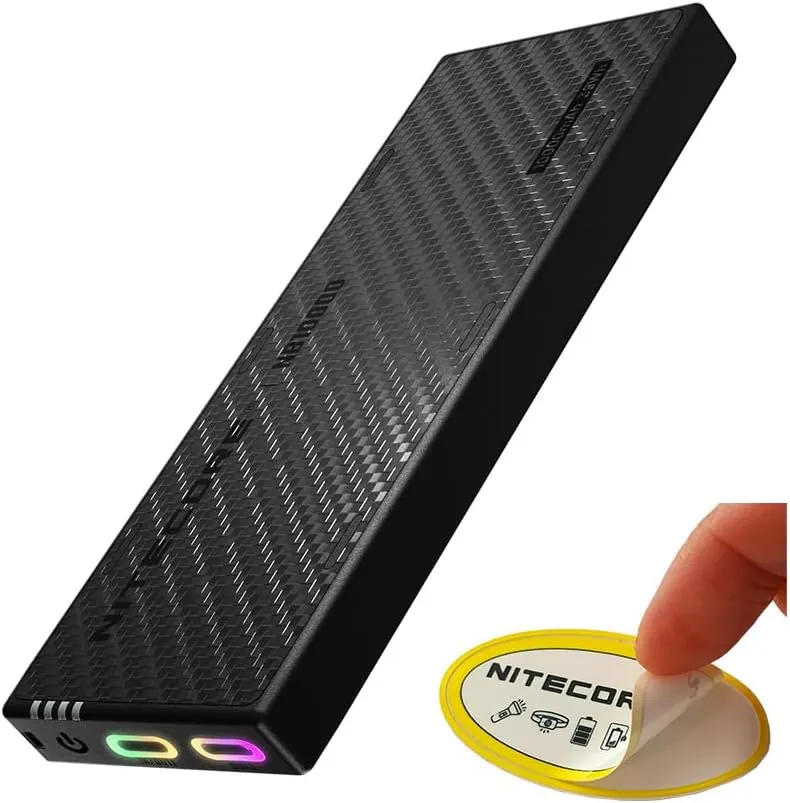
Nitecore NB10000 Gen 4 Power Bank
4.1

Nitecore NB10000 Gen 4 Power Bank

The benchmark ultralight power bank here, and CleverHiker's best overall pick. Ten thousand mAh in a 4.94 ounce carbon-fiber slab is among the best charge per ounce in this guide. The Gen 4 adds an IPX7 rating, so a rainstorm or a dunk in a creek is no longer a worry.It's expensive for a 10,000 mAh bank, and the review pool on this new generation is still small. That second part worries me less than it would on a new brand, since the Gen 4 refines a line backpackers have carried for years.

Check Price
Best Value Ultralight
Flextail Zero Power Bank 10000C
4.1

Flextail Zero Power Bank 10000C

The closest rival to the Nitecore, and a clear step cheaper. At 5.1 ounces and 0.39 inches thin, it matches the NB10000 almost ounce for ounce, with a carbon-fiber shell and 22.5W output. CleverHiker named it their best ultralight pick.The trade is weather protection: IPX4 means splashes only, so it wants a zip bag in real rain. Flextail's extended-range mode trades charge speed for extra delivered capacity, which suits slow overnight charging in a tent.

Check Price
Best for Long Trips
Nitecore NB20000 Gen 3 Power Bank
4.1

Nitecore NB20000 Gen 3 Power Bank

Twice the NB10000's capacity for roughly twice the weight, which is exactly the deal you want at this size. At 10.26 ounces it's light for 20,000 mAh, and Nitecore rates it for about four phone charges.It carries an IPX5 rating and two USB-C ports with pass-through charging. It's the right bank for long stretches, and overkill for a weekend.

Check Price
Comparison Table

Every Pick, Side by Side

Compare all 8 picks
Best Overall
Best For
Most backpackers who want one power bank for every trip
Difficulty
Beginner
Price
$$$
Best Value Ultralight
Best For
Ultralight backpackers who want Nitecore-class weight for less
Difficulty
Beginner
Price
$$$
Best for Long Trips
Best For
A week or more between outlets, or charging several devices
Difficulty
Intermediate
Price
$$$
Recommended #4
Best For
Hikers who want a proven bank with a cable that can't be forgotten
Difficulty
Beginner
Price
$$$
Recommended #5
Best For
Overnights, fastpacking and running vests
Difficulty
Intermediate
Price
$$$
Recommended #6
Best For
Car camping, paddling and trips where the bank gets knocked around
Difficulty
Beginner
Price
$$$
Recommended #7
Best For
Groups, photographers and trips that charge more than a phone
Difficulty
Advanced
Price
$$$
Recommended #8
Best For
A cheap backup bank for occasional trips
Difficulty
Beginner
Price
$$$
The Lineup

8 Best Power Banks for Backpacking, Compared

Detailed picks with verdicts, strengths, tradeoffs, and the situations where each one makes the most sense.

Best Overall
Nitecore NB10000 Gen 4 Power Bank
4.1 (37 Amazon ratings)

Nitecore NB10000 Gen 4 Power Bank

Quick verdict: The benchmark ultralight power bank here, and CleverHiker's best overall pick. Ten thousand mAh in a 4.94 ounce carbon-fiber slab is among the best charge per ounce in this guide. The Gen 4 adds an IPX7 rating, so a rainstorm or a dunk in a creek is no longer a worry.

It's expensive for a 10,000 mAh bank, and the review pool on this new generation is still small. That second part worries me less than it would on a new brand, since the Gen 4 refines a line backpackers have carried for years.

Why It Stands Out

  • 4.94 ounces for 10,000 mAh, the best weight-to-capacity ratio in its size here
  • IPX7 rated, so it survives submersion, not just rain
  • Two USB-C ports at 22.5W, with pass-through charging
  • The lanyard doubles as a USB-C cable, so there's one less thing to pack

Pros

  • Lightest 10,000 mAh bank here that publishes its weight
  • Waterproof to IPX7
  • Charges two devices at once over USB-C
  • Pass-through charging on town stops

Cons

  • The priciest 10,000 mAh bank on this page
  • Only a few dozen Amazon ratings on this generation so far
  • No USB-A port, so older cables need an adapter

Best Situations

Two- to four-night backpacking tripsThru-hike sections between resuppliesWet-weather trips where the bank rides in an outside pocket
Difficulty
Beginner
Price Range
$$$
Best Value Ultralight
Flextail Zero Power Bank 10000C
4.1 (130 Amazon ratings)

Flextail Zero Power Bank 10000C

Quick verdict: The closest rival to the Nitecore, and a clear step cheaper. At 5.1 ounces and 0.39 inches thin, it matches the NB10000 almost ounce for ounce, with a carbon-fiber shell and 22.5W output. CleverHiker named it their best ultralight pick.

The trade is weather protection: IPX4 means splashes only, so it wants a zip bag in real rain. Flextail's extended-range mode trades charge speed for extra delivered capacity, which suits slow overnight charging in a tent.

Why It Stands Out

  • 5.1 ounces for 10,000 mAh
  • Carbon-fiber shell that's thinner than most phones
  • A slower charging mode Flextail says delivers about 20 percent more usable charge

Pros

  • Almost as light as the Nitecore for noticeably less money
  • Very slim, so it slides into a hipbelt pocket
  • 22.5W fast charging

Cons

  • Only IPX4, splash resistance rather than waterproofing
  • A 4.1-star rating from a modest pool of Amazon reviews
  • The extended-range mode is a maker claim nobody here has verified

Best Situations

Ultralight weekend and multi-night tripsHikers counting ounces on a budgetDry-climate trips in the desert Southwest
Difficulty
Beginner
Price Range
$$$
Best for Long Trips
Nitecore NB20000 Gen 3 Power Bank
4.1 (116 Amazon ratings)

Nitecore NB20000 Gen 3 Power Bank

Quick verdict: Twice the NB10000's capacity for roughly twice the weight, which is exactly the deal you want at this size. At 10.26 ounces it's light for 20,000 mAh, and Nitecore rates it for about four phone charges.

It carries an IPX5 rating and two USB-C ports with pass-through charging. It's the right bank for long stretches, and overkill for a weekend.

Why It Stands Out

  • 20,000 mAh at 10.26 ounces
  • IPX5 rated against rain and water jets
  • Two USB-C ports and pass-through charging, plus a USB-C to USB-A adapter in the box

Pros

  • Nitecore rates it for about four phone charges
  • Light for its capacity
  • Charges two devices at once

Cons

  • Heavy for a weekend trip
  • The priciest Nitecore on this page
  • Rain-resistant, not submersible

Best Situations

Week-long trips with no town stopsTrips that also charge a camera or satellite messengerTwo hikers sharing one bank
Difficulty
Intermediate
Price Range
$$$
Recommended #4
Anker Nano Power Bank 10K 30W
4.4 (10,260 Amazon ratings)

Anker Nano Power Bank 10K 30W

Quick verdict: Anker's pocket bank with a USB-C cable built into the case, which fixes the dumbest way to end up with a useless power bank on a trip: leaving the cable at home. It charges at 30W in both directions, so an hour at a cafe outlet puts a lot back in.

At about 215 grams, or roughly 7.6 ounces, it's heavier than the two ultralight banks above for the same capacity, and it has no water rating. What you get in return is a track record: over ten thousand Amazon ratings at 4.4 stars.

Why It Stands Out

  • Built-in USB-C cable doubles as its charging lead
  • 30W input and output for fast top-ups on resupply
  • A USB-A port alongside the built-in USB-C cable

Pros

  • No separate cable to lose
  • Fast to recharge in town
  • A very large and consistent Amazon review record

Cons

  • About two and a half ounces heavier than the Nitecore
  • No water resistance rating
  • A built-in cable is one more thing that can wear out

Best Situations

Hikers who travel to trailheads by planeSection hikes with frequent town stopsA bank that doubles for everyday carry
Difficulty
Beginner
Price Range
$$$
Recommended #5
Nitecore Carbon Battery 6K
4.4 (93 Amazon ratings)

Nitecore Carbon Battery 6K

Quick verdict: A three-ounce carbon tube that holds enough to take a phone from flat to roughly full once. It's rated IP68, the toughest water rating here, and it doubles as an extended battery for several Nitecore headlamps.

The catch is speed. Its single USB-C port puts out 10W, so it's a slow overnight charger rather than a quick top-up, and Nitecore's own spec rates it at 3,700 mAh at the 5 volt output.

Why It Stands Out

  • 88 grams, about 3.1 ounces
  • IP68 rated and submersible to two meters per Nitecore
  • Extends runtime on several Nitecore headlamps

Pros

  • Lightest bank on this page, by nearly two ounces
  • Toughest water rating here
  • Fits in a running vest's front pocket

Cons

  • Only one charge's worth for most phones
  • Slow 10W output
  • A single port

Best Situations

One-night trips and fastpacksTrail runs where a phone is the backup navigationHikers already carrying a Nitecore headlamp
Difficulty
Intermediate
Price Range
$$$
Recommended #6
NESTOUT 15000mAh Rugged Power Bank
4.5 (1,931 Amazon ratings)

NESTOUT 15000mAh Rugged Power Bank

Quick verdict: Built like a small fuel bottle, with screw caps over its ports, an IP67 rating and a shock-resistant shell. It's the one here to throw in a canoe or a truck bed. Three ports at up to 32W charge three devices at once.

It weighs about 0.8 pounds for 15,000 mAh, which puts it well behind the Nitecores on charge per ounce. For backpacking, you'd carry it because it's tough. You wouldn't carry it to save weight.

Why It Stands Out

  • IP67 dust and water rating, with sealed port caps
  • Shock-resistant hard shell
  • One USB-C and two USB-A ports, up to 32W

Pros

  • The most rugged build on this page
  • Charges three devices at once
  • 4.5 stars from nearly two thousand Amazon ratings

Cons

  • Heavy for its capacity
  • Bulky, rounded shape doesn't slip into a thin pocket
  • Screw caps are slower to open than an open port

Best Situations

River trips and paddlingBase camps and car campingHard use where the bank rides outside the pack
Difficulty
Beginner
Price Range
$$$
Recommended #7
Goal Zero Venture 75 Power Bank
4.5 (160 Amazon ratings)

Goal Zero Venture 75 Power Bank

Quick verdict: The big one. It holds 19,200 mAh, or 71 watt-hours, with a 60W USB-C port that recharges the whole bank in about an hour and a half. It's IP67 rated and has a built-in flashlight.

At 577 grams, about 1.3 pounds, it's more than most solo backpackers should carry. It earns its place charging cameras, a tablet or a group's phones on a base-camp trip, and it's still well under the FAA's 100 watt-hour carry-on line.

Why It Stands Out

  • 71 watt-hours, about the same energy as the NB20000
  • 60W USB-C Power Delivery, recharges in about 1.5 hours
  • IP67 rated, with a built-in flashlight

Pros

  • The most powerful charging port on this page, at 60W
  • Enough capacity to share between phones
  • Waterproof and rugged

Cons

  • Over a pound, the heaviest bank here
  • The most expensive product on this page
  • USB-A ports are limited to 15W

Best Situations

Group trips sharing one bankPhotography trips charging camera batteriesBase camps and long desert trips
Difficulty
Advanced
Price Range
$$$
Recommended #8
INIU 10000mAh 45W Power Bank
4.4 (87,256 Amazon ratings)

INIU 10000mAh 45W Power Bank

Quick verdict: A small, cheap 10,000 mAh bank with 45W charging and a detachable USB-C cable, and the most-reviewed product on this page by a long way. INIU says its cells make it 36 percent lighter than a conventional bank of the same capacity.

It has no water rating, and it's built for everyday carry. Still, it's a sensible backup or a first bank for occasional overnights, as long as it rides in a zip bag.

Why It Stands Out

  • 45W output, fast for its size
  • Detachable USB-C cable included
  • The cheapest bank here, with a huge Amazon review record

Pros

  • Very little money for a 10,000 mAh bank
  • Fast charging
  • Tens of thousands of Amazon ratings at 4.4 stars

Cons

  • No water resistance rating
  • Built for everyday carry rather than the outdoors
  • INIU's weight savings are against its own baseline, not the Nitecore

Best Situations

A first power bank for occasional overnightsA backup bank for a partnerTrips where the bank stays inside the pack
Difficulty
Beginner
Price Range
$$$
Buying Guide

What to Check Before You Buy

How many mAh do you need for backpacking?

For most trips of two to four nights, a 10,000 mAh power bank is the right size. It recharges a modern phone roughly one and a half to two times, which covers a phone used for maps and photos with airplane mode on. Go down to 5,000 or 6,000 mAh for a single night or a fastpack, and up to 20,000 mAh for a week or more between towns.

A simple way to size it: count the nights, guess how much of your phone's battery a day on trail uses, and carry one full phone charge for every two or three days. Then add a margin for a satellite messenger or headlamp.

Why doesn't a 10,000 mAh power bank give you 10,000 mAh?

A power bank delivers less than its rated mAh because the number on the box is measured at the cell's own voltage, around 3.6 to 3.7 volts, and your phone charges at 5 volts or more. Converting up loses energy as heat. Expect roughly 60 to 70 percent of the rated figure to reach your phone.

Nitecore publishes both numbers for the Carbon Battery 6K: 6,000 mAh at the cell, but a rated 3,700 mAh at the 5 volt output. The fairer number to compare is watt-hours, which is voltage times capacity and doesn't hide the conversion. It's also why a lighter bank that converts efficiently can beat a heavier one with a bigger number printed on it.

What matters most, weight or capacity?

Weight per phone charge. On this page a 10,000 mAh bank runs from about five ounces for the Nitecore NB10000 and the Flextail to about seven and a half for the Anker Nano, for the same nominal capacity. Over a season of trips you'll notice that, especially if you count your base weight.

Capacity scales weight almost in a straight line. The NB20000 carries twice the NB10000's capacity for roughly twice the weight, and the Goal Zero Venture 75 weighs over a pound. Buy the size your trips need, not the biggest one that looks like good value.

Do ports, charge speed and water resistance matter?

Yes, both. USB-C with Power Delivery is the one port worth insisting on, because it recharges the bank quickly during a resupply. An hour at a cafe outlet puts far more back into a 20W to 60W bank than into an old 10W one. Two ports let you charge a phone and a headlamp at once.

Water resistance is measured by an IP rating under IEC 60529. IPX4 shrugs off splashes, IPX5 handles rain and water jets, and IPX7 or IP67 survives a dunk in a creek. Four banks here are rated IPX7 or better; the Anker and the INIU carry no rating and want a zip bag.

Most trips: a 10,000 mAh bank
10,000 mAh

If you're only going to own one power bank, make it one of these. The Nitecore NB10000 and the Flextail both weigh about five ounces, both have two USB-C ports, and either one covers two to four nights of a phone doing navigation and photos.

Overnights and fastpacking: go smaller
5,000-6,000 mAh

One night, a fast two-day push or a running vest where every ounce shows. The Nitecore Carbon Battery 6K weighs about three ounces, is rated IP68 and gets a phone from flat to roughly full once.

A week or more between towns
20,000 mAh

The Nitecore NB20000 doubles the capacity for about ten ounces, which is what you want when there's no outlet for a week or the bank also has to feed a camera or a satellite messenger. Need something sturdier or faster? The Goal Zero Venture 75 stores about the same energy and refills at 60W.

Full Catalog

Compare All 8 Power Banks for Backpacking

Want to browse beyond the ranked picks? Filter and sort the full power banks for backpacking listing below.

Best Power Banks for Backpacking of 2026 — All Products

8 Products
FAQ

Frequently Asked Questions

Roughly one and a half to two full charges for most current phones. A phone battery holds around 13 to 19 watt-hours, and a 10,000 mAh bank stores about 36 to 37. After roughly a third is lost converting up to charging voltage, that leaves enough for about two charges on a small phone and closer to one and a half on a big one.

Glossary

The words on this page

Every term this guide leans on has its own page with a plain answer at the top.

Browse the whole glossary →
How We Choose Products

How These Picks Are Chosen

Reader-supported and free of paid placements. Every pick is ranked on published specs and Amazon buyer ratings, not on who pays us.

Spec Research

Each pick is compared on published specs, materials, design, and category fit across the major brands.

Practical Fit

Rankings factor in how well each product matches common hiking, backpacking, and trail running needs, not just popularity.

Amazon Buyer Ratings

Star ratings and review volume from verified Amazon buyers are factored in to reflect real-world satisfaction.

Value

A pick earns its spot by delivering useful performance for the money, whether budget or premium.

KEEP THE PHONE ALIVE.
NOW PLAN FOR NO SIGNAL.

A power bank keeps your phone and headlamp going. The satellite messenger guide ranks the devices that still reach help when there's no signal at all.

See Satellite Messengers