Best Running Headlamps of 2026 — hiking gear
Running Headlamp Buying Guide

Best Running Headlamps of 2026

Nine rechargeable headlamps from $46 to $150, ranked on what you notice at 5am: whether it bounces, and where the beam falls in front of your feet. Then how long it lasts on the setting you actually run with, which isn't the one on the box.

View Top PicksUpdated 4 August 2026 · Ranked from specs & buyer reviews

If you buy through a link on this page we may earn a commission, at no extra cost to you. It never changes how anything is ranked.

How to Choose

How to Choose a Running Headlamp

A headlamp for running has a harder job than a headlamp for camping, and most of the lamps sold are built for camping. Standing still at a picnic table, anything works. Running, you're covering ground at five or six miles an hour, your head is moving up and down with every stride, and the piece of ground you need lit isn't the one directly under your feet. It's the two or three strides ahead, where your next foot is going to land. A lamp that throws a hard bright circle twenty feet out leaves everything closer than that in shadow, and you end up running slightly blind in the gap.

Which is why lumens, the one number every listing shouts, is close to useless on its own. Lumens measure total light leaving the lamp, not where any of it lands. Two lamps rated at 500 can be completely different tools: one a narrow spot for picking out a trail marker across a meadow, the other a wide flood that lights the whole width of the trail at your feet. Most listings also quote a burst figure the lamp holds for a few minutes before it steps down to protect the battery, so the brightness on the box is rarely the brightness you run in. What decides whether you like a headlamp is the shape of the beam and whether the thing stays still on your head. After that it's how long it lasts on the setting you use most, which for most people is the middle one rather than the maximum.

One note on where this page sits in the market. Everything below tops out at $150, which covers essentially every runner. Above that there is a real tier: lamps around $200 like Petzl's NAO RL and Black Diamond's Distance 1500, which pair very high output with reactive sensors and bigger batteries, and are aimed at people running through an entire night in a 100-mile race. If that's you, they're worth the money. If your longest dark stretch is two hours before sunrise, the extra spend buys capacity you'll never draw on.

The ordering here comes from published specs, the design decisions each brand made, and what Amazon buyers report after living with these lamps through winters. I haven't run a thousand night miles in all nine, and I'm not going to pretend otherwise. Where a lamp's reputation rests on something I couldn't verify, I've said so rather than filled the gap. Every star rating, review count and price was read off the listing on August 4, 2026 and every lamp was in stock that day. Lighting gets discounted constantly, so check the current price before you buy.

The Anatomy

What You're Actually Buying

A running headlamp comes down to six parts, and the marketing talks almost exclusively about one of them. Here is what each piece does and which ones decide whether you enjoy using it.

The lamp head and its optics

Essential

The lens and reflector in front of the LED, which decide the shape of the light. A flood lens spreads a wide even wash over the ground close in; a spot lens concentrates output into a narrow column that reaches further. Good running lamps do both at once, either with separate LEDs or with a lens designed to blend the two. This is the part that matters most and the part no spec sheet describes well.

The headband and top strap

Essential

A band around the head holds a light lamp fine. Anything heavier needs a second strap over the crown to stop the whole thing rocking forwards on each footfall. Look for a band wide enough not to dig in, some grip or silicone on the inside so it doesn't creep on a sweaty forehead, and reflective material in the weave, which costs nothing and makes you visible from the side.

The battery and where it lives

Essential

Either built into the lamp head, which is simple and keeps all the weight at the front, or in a separate housing at the back of the band, which balances the load and lets the lamp carry more capacity without nodding. Rear housings often double as the mount for a red safety light. A few lamps are hybrid, taking either a rechargeable pack or a carrier of AAA cells, which is what you want if you might be out longer than one charge lasts.

The modes and the interface

Essential

Two or three brightness levels, usually a red mode, sometimes a strobe. What you care about is whether you can cycle to the one you want with cold or gloved hands without stepping through every other setting first, and whether the lamp remembers where you left it. A lock mode is worth checking for specifically: without one, the button presses itself against the inside of a pack and you arrive at the trailhead with a flat battery.

The weather rating

Nice to Have

Printed as IPX4, IP67 or similar. For running, IPX4 is the one that matters, because it handles rain from any angle and that covers nearly every night you will be out. Higher is not automatically better here. It usually means more sealing and a bit more weight for protection you'll never call on, which is worth paying for only if your lamp lives in the bottom of a wet pack between runs.

The rear red light

Nice to Have

A small red LED on the back of the band or battery housing, steady or blinking. Irrelevant if you only run remote trail, close to essential if any of your route shares space with cars. It is the cheapest safety feature on any lamp and the one runners most often discover they wanted after a near miss.

The Formats

Which Style of Lamp Suits You

Running headlamps come in three broad shapes. The choice is mostly about how long you will be out and how much weight you are willing to carry on your head to get there.

Ultralight all-in-one

$45-$70Short dark stretches and road miles

Everything in one small unit on a thin band, usually well under 60 grams. Nothing to bounce because there is barely anything there, and it disappears into a vest pocket when the sun comes up. The trade is capacity: a small internal battery means a couple of hours at a useful brightness, and output that tops out around 400 lumens. For an hour before work, or as the backup lamp you carry and hope not to need, this is the sensible buy.

Rear-battery balanced

$60-$110Most trail runners, most of the time

Lamp at the front, battery in a housing at the back, weight balanced across your head. That balance is what lets these carry a bigger cell and a brighter LED without nodding on every stride, so you get real output and real runtime in something you can still wear for hours. Many put a red safety light on the rear housing. If you're only ever going to own one headlamp for night trail running, this is the shape to get.

Band-integrated slim

$70-$150Runners who hate anything on their forehead

The electronics are built into the band itself so the front profile is almost flat against your head, with the battery counterweighted at the back. Nothing protrudes, so there's no lump to catch the brim of a cap and very little for a stride to shake. They tend to cost more for a given brightness, and the band is the lamp, so a worn-out strap is a worn-out headlamp rather than a spare part.

Quick Picks

Top Three at a Glance

Short on time? Start with these top-rated running headlamps picks.

Best Overall
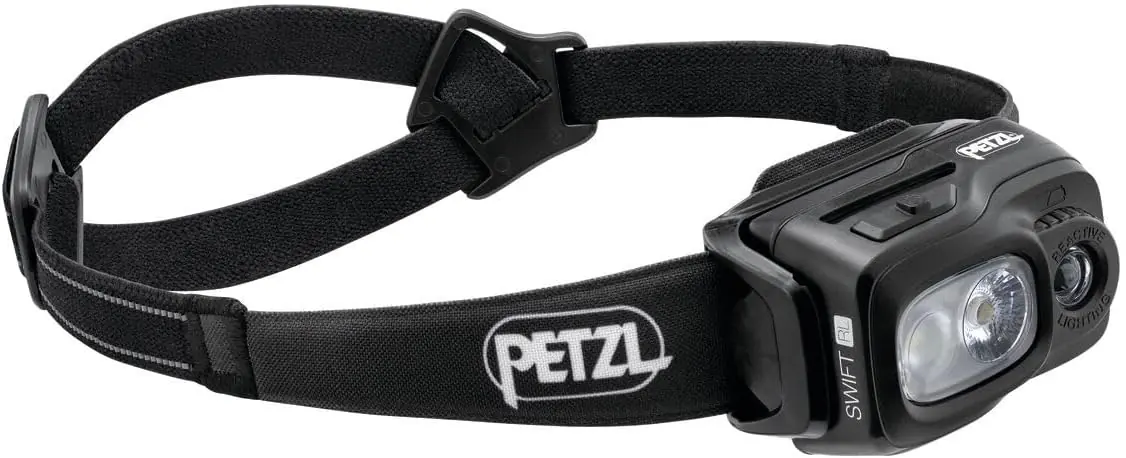
Petzl Swift RL
4.5

Petzl Swift RL

The all-rounder, and the one I'd buy without much agonizing. Petzl's listing rates it at 1,200 lumens with Reactive Lighting, the sensor system that reads how much light is coming back and adjusts output as you go, which is mostly a way of making a battery last a lot longer than its size suggests. It has a deep record behind it at 1,224 ratings, and at $94.90 against a $134.95 list it is well below where this lamp normally sits.

Check Price
Best for Long Runs
Petzl IKO CORE
4.4

Petzl IKO CORE

The comfort pick, and an unusual design. Instead of a fabric band with a lump on the front, the IKO uses a rigid wire headband that spreads the load around your skull and puts the battery at the back, and Petzl publishes 79 grams for the whole thing. 500 lumens is modest next to the brighter lamps here, but the output you get is well shaped, and on a four-hour night run the thing you remember is whether your forehead hurts.

Check Price
Best Value
Nitecore NU43
4.6

Nitecore NU43

The value pick of the page. 1,400 lumens published, a rear battery housing that balances the front unit, USB-C charging and a red mode, for under sixty dollars. That specification costs a lot more from the bigger outdoor brands. 486 ratings at 4.6 stars is a solid record. It's a flashlight company's headlamp rather than a running company's, so the fit is good rather than exceptional, but at this price that's an easy trade.

Check Price
Comparison Table

Every Pick, Side by Side

Best Overall
Best For
One lamp that handles everything from dawn miles to a night race
Difficulty
Intermediate
Price
$$$
Best for Long Runs
Best For
Long hours where you stop noticing it is on your head
Difficulty
Intermediate
Price
$$$
Best Value
Best For
The most usable light per dollar
Difficulty
Beginner
Price
$$$
Recommended #4
Best For
One lamp for running, hiking and everything else
Difficulty
Beginner
Price
$$$
Recommended #5
Best For
Maximum output on genuinely technical ground
Difficulty
Advanced
Price
$$$
Recommended #6
Best For
Foul weather and gear that gets dropped
Difficulty
Beginner
Price
$$$
Recommended #7
Best For
Runners who cannot stand weight on their forehead
Difficulty
Intermediate
Price
$$$
Recommended #8
Best For
Road running where being seen matters more than seeing
Difficulty
Beginner
Price
$$$
Recommended #9
Best For
A backup lamp, or a short hour before sunrise
Difficulty
Beginner
Price
$$$
The Lineup

9 Best Running Headlamps, Compared

Detailed picks with verdicts, strengths, tradeoffs, and the situations where each one makes the most sense.

Best Overall
Petzl Swift RL
4.5 (1,224 Amazon ratings)

Petzl Swift RL

Quick verdict: The all-rounder, and the one I'd buy without much agonizing. Petzl's listing rates it at 1,200 lumens with Reactive Lighting, the sensor system that reads how much light is coming back and adjusts output as you go, which is mostly a way of making a battery last a lot longer than its size suggests. It has a deep record behind it at 1,224 ratings, and at $94.90 against a $134.95 list it is well below where this lamp normally sits.

Why It Stands Out

  • Reactive Lighting adjusts output continuously, so the battery is spent where the terrain needs it
  • 1,224 Amazon ratings at 4.5 stars, the second-deepest record in this guide
  • Balanced fit with a top strap over the crown, which is what keeps a 100-gram lamp still
  • USB-C charging and a five-level battery gauge you can check before leaving the house

Pros

  • Beam blends a wide near-field flood with enough throw to read a junction ahead
  • Reactive mode can be switched off if the dipping annoys you
  • Discounted 30% off list at the price checked

Cons

  • IPX4 only, so it handles rain but is not a lamp to drop in a creek
  • No AAA fallback, so when the internal cell is flat the lamp is done

Best Situations

Night trail runningUltra racingDawn patrolAll-round use
Difficulty
Intermediate
Price Range
$$$
Best for Long Runs
Petzl IKO CORE
4.4 (1,107 Amazon ratings)

Petzl IKO CORE

Quick verdict: The comfort pick, and an unusual design. Instead of a fabric band with a lump on the front, the IKO uses a rigid wire headband that spreads the load around your skull and puts the battery at the back, and Petzl publishes 79 grams for the whole thing. 500 lumens is modest next to the brighter lamps here, but the output you get is well shaped, and on a four-hour night run the thing you remember is whether your forehead hurts.

Why It Stands Out

  • Rigid AIRFIT headband distributes weight around the head instead of pressing on the forehead
  • 79 grams published, light for a lamp with a rear battery and this much output
  • Hybrid power: the CORE rechargeable pack or three AAA cells as a backup
  • 1,107 ratings at 4.4 stars, a deep record for a design this unconventional

Pros

  • Weight sits on the top and back of your head instead of pressing into your brow
  • Converts into a small lantern by collapsing the band, which is handy at a campsite
  • AAA fallback matters on trips longer than one charge

Cons

  • 500 lumens ties for the lowest maximum among the trail-focused picks here
  • The rigid band is a fixed shape, and it fits most heads well and a few badly
  • Does not fold flat, so it takes more room in a vest pocket than a soft-band lamp

Best Situations

Long night runsUltra racingSensitive foreheadsCamp use
Difficulty
Intermediate
Price Range
$$$
Best Value
Nitecore NU43
4.6 (486 Amazon ratings)

Nitecore NU43

Quick verdict: The value pick of the page. 1,400 lumens published, a rear battery housing that balances the front unit, USB-C charging and a red mode, for under sixty dollars. That specification costs a lot more from the bigger outdoor brands. 486 ratings at 4.6 stars is a solid record. It's a flashlight company's headlamp rather than a running company's, so the fit is good rather than exceptional, but at this price that's an easy trade.

Why It Stands Out

  • 1,400 lumens published, the second-highest maximum in this guide
  • Rear battery housing balances the load front to back instead of hanging it off your forehead
  • 4.6 stars across 486 ratings, the same average as the $104.95 Fenix
  • Spotlight, floodlight and red modes in one unit, with USB-C charging

Pros

  • Costs $90 less than the most expensive lamp here, with a higher published maximum
  • Balanced two-piece design rather than an all-in-one front lump
  • Nitecore's headlamps have a long track record among ultralight hikers

Cons

  • Headband is functional rather than plush, and there is no top strap
  • As with every lamp here, 1,400 lumens is a burst figure, not a running setting

Best Situations

Night trail runningValue buyersBackpackingGeneral outdoor use
Difficulty
Beginner
Price Range
$$$
Recommended #4
Petzl Actik Core
4.5 (2,393 Amazon ratings)

Petzl Actik Core

Quick verdict: The most-reviewed lamp on this page at 2,393 ratings, and the sensible answer if you want one headlamp rather than a running-specific one. 650 lumens published, and crucially it is a hybrid: it ships with Petzl's CORE rechargeable pack but takes three AAA cells when that runs out, which is the feature that makes it the pick for multi-day trips where charging is uncertain. It bounces slightly more than the balanced designs here because the weight is all at the front.

Why It Stands Out

  • 2,393 Amazon ratings at 4.5 stars, the largest sample in this guide
  • HYBRID CONCEPT: runs on the CORE rechargeable pack or on three AAA cells
  • 650 lumens published, with a red mode that preserves night vision
  • Petzl's standard mounting means it works with the brand's accessories and helmets

Pros

  • The AAA fallback removes the 'what if it dies' problem on long trips
  • Just as good for camping or working under a car as it is for running
  • Simple interface that is easy to operate in gloves

Cons

  • All the weight is at the front, so it nods more than the rear-battery lamps here
  • Single band with no top strap, which you notice at pace
  • IPX4 sealing only, so it shrugs off rain but is not a lamp for a downpour

Best Situations

Running and hikingMulti-day tripsFirst headlampCamp chores
Difficulty
Beginner
Price Range
$$$
Recommended #5
Fenix HM65R-T V2.0
4.6 (240 Amazon ratings)

Fenix HM65R-T V2.0

Quick verdict: The brightest lamp here at a published 1,600 lumens, with separate spot and flood LEDs you can run independently. That dual-beam arrangement is why it's on a running page rather than a work-light one. It runs on a removable 18650 cell, which is both its strength and its cost: you can carry a spare, but Fenix publishes 140 grams with the cell and band, which puts it among the heavier lamps here.

Why It Stands Out

  • 1,600 lumens published, the highest maximum on this page
  • Separate spotlight and floodlight LEDs that can be run together or apart
  • Removable 18650 battery, so a spare cell extends the night indefinitely
  • IP68 rated, the most weather-sealed lamp in this guide

Pros

  • Floods the ground at your feet and throws a spot down the descent at the same time
  • Magnesium alloy body rather than plastic
  • 4.6 stars from 240 ratings, strong for a lamp aimed at a narrow use case

Cons

  • 140 grams published, among the heaviest here, and it sits at the front of the band
  • A flashlight-company interface with more modes than a runner needs
  • The 18650 cell is a format you have to keep track of and charge separately

Best Situations

Technical night trailSearch and rescueWinter runningBad weather
Difficulty
Advanced
Price Range
$$$
Recommended #6
Black Diamond Storm 500-R
4.5 (739 Amazon ratings)

Black Diamond Storm 500-R

Quick verdict: The durability pick. IP67 sealing means dust-tight and good for brief submersion, which is a long way past what running demands and exactly what you want if your lamp lives in the bottom of a pack with wet kit. 500 lumens ties the IKO CORE for the lowest maximum among the trail-focused picks here, and the beam is a good general-purpose blend rather than a running-specific one. At $61.91 against $89.95 list it's roughly $28 off, which makes it easy to own alongside a lighter running-specific lamp.

Why It Stands Out

  • IP67 rating: dust-tight and rated for brief submersion, not just rain
  • 739 Amazon ratings at 4.5 stars, a deep record for the price
  • Red, green and blue night-vision modes alongside the white output
  • Brightness memory returns to the setting you were last using

Pros

  • The most weatherproof pick here short of the Fenix
  • Discounted well below list at the price checked
  • Black Diamond's warranty and parts pipeline behind it

Cons

  • A hiking and climbing lamp adapted to running rather than designed for it
  • All the weight is at the front with no top strap
  • No rear light, so it does nothing for you on a road route

Best Situations

Wet weatherWinter runningBackpackingRough handling
Difficulty
Beginner
Price Range
$$$
Recommended #7
BioLite HeadLamp 800 Pro
4.3 (118 Amazon ratings)

BioLite HeadLamp 800 Pro

Quick verdict: The flattest-fitting lamp here. BioLite builds the electronics into the band itself, a construction they call 3D SlimFit, so the front sits almost flush against your head with the battery counterweighted at the back, and there is very little for a stride to shake. 800 lumens published, a rear red safety light, and pass-through charging so it runs off a power bank while you wear it. It's the most expensive listing on this page, and 118 ratings is a thin record to be spending $150 against, which is why it sits here rather than higher.

Why It Stands Out

  • 3D SlimFit band construction puts almost nothing proud of your forehead
  • Rear red safety light built into the battery housing for road sections
  • Pass-through charging runs the lamp from a power bank without stopping
  • 800 lumens published, with a run time BioLite lists at 7 hours on high

Pros

  • Almost nothing sits proud of your forehead, which is the fix if front-heavy lamps give you a headache
  • Front-and-rear lighting in a single unit
  • Moisture-wicking band designed to be worn for hours

Cons

  • $149.95 is the highest price on this page
  • 118 ratings at 4.3 stars, so there is less buyer history here than on most of this page
  • No replaceable strap, because the band houses the electronics

Best Situations

Long night runsRoad and trail mixedBounce-sensitive runnersUltras
Difficulty
Intermediate
Price Range
$$$
Recommended #8
BioLite Dash 450
3.8 (63 Amazon ratings)

BioLite Dash 450

Quick verdict: Built for pavement rather than trail, and honest about it. 450 lumens is plenty when there is street lighting doing half the work, and what you are really buying is the combination of a slim front unit and a rear light so drivers coming up behind you see something. Treeline Review's testers made it their road-running pick. The caveat is the Amazon record: 3.8 stars across 63 ratings is the weakest on this page, so treat it as a newer product with a shorter track record.

Why It Stands Out

  • Front and rear lights in one unit, which is the whole point on a road route
  • 450 lumens, appropriate for lit pavement where more output just causes glare
  • Slim band-integrated build with the battery counterweighted at the rear
  • USB-C charging, with a low setting BioLite lists at around 60 hours

Pros

  • Solves the being-seen half of night running that most headlamps ignore
  • Light and low-profile enough to forget you're wearing it
  • Reflective detailing on the band adds side visibility

Cons

  • 3.8 stars from 63 ratings, the lowest score and smallest sample in this guide
  • 450 lumens is not enough for technical trail in full darkness
  • Priced close to lamps here with twice the output

Best Situations

Road runningCommutingLit pathsEarly morning miles
Difficulty
Beginner
Price Range
$$$
Recommended #9
Nitecore NU25 UL
4.7 (223 Amazon ratings)

Nitecore NU25 UL

Quick verdict: The ultralight pick and the highest-rated lamp on this page at 4.7 stars. Nitecore publishes 45 grams for the UL version, which uses a thin cord headband instead of a woven strap, and at that weight a stride has nothing to work with. 400 lumens won't light a technical descent, but it's plenty for pavement or a trail you know, and it's the obvious answer to the one rule of night running: always carry a second light.

Why It Stands Out

  • 45 grams published for the UL version, the lightest lamp in this guide
  • 4.7 stars from 223 ratings, the highest average on this page
  • White, high-CRI and red outputs in a unit smaller than a matchbox
  • USB-C charging, so it shares a cable with everything else you own

Pros

  • Light enough to carry as a spare without thinking about it
  • Cord headband packs down to almost nothing in a vest pocket
  • The cheapest listing on this page, about $14 under the next one

Cons

  • 400 lumens and a small battery limit it to short outings or backup duty
  • The thin cord band is less comfortable than a woven strap over several hours
  • No rear light and no top strap

Best Situations

Backup lampDawn patrolFastpackingUltralight setups
Difficulty
Beginner
Price Range
$$$
Buying Guide

What to Check Before You Buy

Beam shape matters more than the lumen number

What you want on a trail is a wide, even flood that lights the ground from just past your toes out to about twenty feet, with enough of a center spot to pick out a turn or a marker further on. That combination is why a well-designed 500-lumen lamp routinely beats a cheap 1,000-lumen one: the cheap lamp puts all its output into a tight hot circle, your eyes adjust to that bright spot, and everything around it goes darker than it would have with no lamp at all. On pavement you can get away with far less light and a narrower beam, because the surface is predictable and there is usually some street lighting doing half the work.

Where the weight sits decides whether it bounces

Every gram on the front of your forehead is a gram that wants to nod on each footfall, and once a lamp starts bouncing the beam swings and you get motion sick or headachy on a long run. Three designs solve it. The lightest lamps just weigh so little that there's nothing to bounce. Others move the battery to a housing at the back of your head, so the load balances front to rear. A third approach spreads the electronics along the band itself, so nothing sits proud of your forehead at all. Any of the three works fine. Trouble starts with a heavy front unit on a thin single strap, and if a lamp is over about 100 grams you want a top strap over the crown as well as the band around it.

Burn time on the setting you'll actually use

Manufacturers quote runtime at the lowest setting, where a lamp can run for days, and brightness at the highest, where it often lasts under two hours. Neither is the number you want. Figure out roughly how long you'll be out in the dark, add an hour, and check the lamp holds your normal running brightness for that long. Also look for whether the output is regulated: a regulated lamp holds steady and then drops off near the end, while an unregulated one dims slowly the whole time, and you won't notice it happening because your eyes adapt as it fades. A battery meter you can check before you leave the house is worth more than it sounds.

Getting seen from behind

If any part of your run is on a road or a shared path, a lamp that only points forward has solved half the problem. Drivers coming up behind you see nothing. A rear red light on the battery housing or the band, a reflective strip on the strap, or a lamp with a dedicated visibility mode all fix that, and on a road-heavy route it matters more than the front output does. Red light also has a second use on the trail: it preserves your night vision and doesn't blind whoever you're running with, which is the polite way to read a map or dig through a pack at an aid station.

Dawn Patrol & Road Miles
$45-$65

An hour before sunrise on pavement or a trail you know by heart. Around 400 lumens is plenty here, and low weight matters more than power. If you're anywhere near traffic, a rear light does more for your safety than any amount of front output.

Technical Night Trail
$65-$105

Roots, rock and real descents in full darkness. This is where beam quality earns its money: 500 to 800 lumens with a real flood, and a fit that doesn't move once you're at pace. Budget enough runtime for three hours out.

Ultras & All-Nighters
$105-$150

Whole nights out, where the lamp has to keep working when you're too tired to problem-solve. You want long regulated runtime and power you can swap or back up with AAA cells. The brightest lamp on this page, the Fenix, lives in this band. Above it sits the $200 reactive tier built for 100-mile races.

Getting Started

Your First Run In The Dark

Running at night is a different sport from running the same route in daylight, and the first time out is where people discover that. A little setup and a conservative route choice covers almost all of it.

  1. 1

    Charge it, then check it the night before

    Not on the way out the door. Plug the lamp in, then actually switch it on and cycle the modes once it's full, because a charging port that has quietly stopped working looks identical to a charged lamp until you're standing in the dark. If it has a lock mode, learn where it is now. That's what stops the button firing in your pack.

  2. 2

    Fit it low and tighten it more than feels necessary

    Sit the lamp just above your eyebrows rather than high on your forehead, which shortens the lever it has to bounce on. Tighten until it feels slightly too snug standing still; it will loosen as you warm up and sweat. If you run in a cap, decide now whether the lamp goes over or under the brim, because a brim in the top of the beam throws a shadow across everything.

  3. 3

    Pick a route you already know, and run it out and back

    Familiar ground in the dark is disorienting enough on its own. An out-and-back on a route you've run in daylight means you always know how far you are from the car, and you get to see the whole thing from both directions, which is when you find out how different a trail looks with the light behind you.

  4. 4

    Start on the middle setting and leave it there

    The instinct is to run everything on maximum. That flattens the battery, and it washes out the shadows that tell you where the rocks are. It also cooks the LED into a step-down you didn't ask for. Run the middle setting, save the top one for descents and confusing junctions, and you'll both see better and last longer.

  5. 5

    Carry a second light

    A phone counts in a pinch, a small spare lamp is better. This is the one non-negotiable of running in the dark: a headlamp that dies two miles out turns a routine hour into a slow, careful walk. Most people learn this once and then never leave without a backup again.

  6. 6

    Slow down and shorten your stride

    Everyone runs their first night miles too fast. Depth perception is poor under a single light source, and shadows move as your head moves. Roots you'd have stepped over automatically in daylight are suddenly hard to read. Take it as a comfortable effort rather than a pace, and expect it to feel harder than the same route in the sun.

The Jargon

Headlamp Terms In Plain English

Lumens
Total light leaving the lamp, in every direction it goes. It says nothing about where that light lands, which is why a well-designed 500-lumen lamp can be far more useful than a badly designed 1,000-lumen one.
Beam distance (throw)
How far the lamp usefully reaches, usually quoted in meters. Manufacturers measure it to the point where the light has faded to roughly moonlight, so the real working distance is a good deal shorter than the number.
Flood vs spot
Flood is a wide even wash for lighting the ground around your feet; spot is a narrow column for seeing something far away. Running wants mostly flood with a little spot in the middle.
Regulated output
The lamp holds a constant brightness until the battery is nearly gone, then drops sharply. Unregulated lamps fade continuously from the moment you switch on, and because your eyes adapt as it happens, you often don't notice until it's very dim.
Step-down
The automatic drop from maximum to a lower level after a few minutes, to stop the LED overheating. It's why headline lumen figures are a burst rating rather than something you run in.
Reactive lighting
A front sensor that reads reflected light and adjusts output as you go: dimmer when you look at a map, brighter down a dark descent. Petzl's term for it; other brands call it adaptive. Mainly a battery-saving feature.
IPX4 / IP67
Weather sealing ratings. The first digit is dust, the second water, and an X means untested for that one. IPX4 survives rain from any direction and covers all normal running; IP67 is dust-tight and handles brief submersion.
Lock mode
A button combination that disables the switch so the lamp cannot turn itself on inside a pack. The difference between a full battery at the trailhead and a dead one.
Avoid These

Five Mistakes People Make Buying Their First Running Headlamp

  • Shopping on the lumen number alone. It is the one figure every listing leads with and the one that tells you least about how the lamp performs on a trail. Beam shape, fit and usable runtime all matter more, and none of them appear in the headline.
  • Buying a camping headlamp and expecting it to run. A heavy front unit on a single thin strap nods on every footfall, and a narrow spot beam leaves the ground at your feet dark. Both are fine standing at a tent and miserable at running pace.
  • Ignoring the rear light on a road route. Front output does nothing for the driver coming up behind you. If any part of your run shares space with traffic, being visible from behind is the more important half of the problem.
  • Planning around the quoted runtime. Those hundreds of hours are at the lowest setting, which is a reading light. Figure out how long you'll be in the dark, add an hour, and check the lamp holds your normal brightness that long.
  • Running without a backup. A dead headlamp miles from the car turns a run into a long careful walk, and it's the one failure with no workaround once you're out there. A cheap second lamp in the vest fixes it permanently.
Explore Individual Gear

Once you know which setup fits your situation, dig into the full guide library for in-depth picks and buying advice:

Full Catalog

Compare All 9 Running Headlamps

Want to browse beyond the ranked picks? Filter and sort the full running headlamps listing below.

Best Running Headlamps of 2026 — All Products

9 Products
FAQ

Frequently Asked Questions

For pavement and familiar paths, 200 to 400 is plenty, and more can be counterproductive because it lights up the reflective surfaces around you. For unfamiliar or technical trail in full darkness, most runners settle around 400 to 600 in normal use, with the ability to spike higher for a confusing junction or a fast descent. Very few people need to run at 1,000-plus for any length of time, and no lamp here will hold its headline figure for more than a few minutes anyway. Buying a brighter lamp than you need mostly costs you weight and battery.

How We Choose Products

How These Picks Are Chosen

Reader-supported and free of paid placements. Every pick is ranked on published specs and Amazon buyer ratings, not on who pays us.

Spec Research

Each pick is compared on published specs, materials, design, and category fit across the major brands.

Practical Fit

Rankings factor in how well each product matches common hiking, backpacking, and trail running needs, not just popularity.

Amazon Buyer Ratings

Star ratings and review volume from verified Amazon buyers are factored in to reflect real-world satisfaction.

Value

A pick earns its spot by delivering useful performance for the money, whether budget or premium.

LIGHT SORTED.
WHAT'S NEXT?

Boots, day packs and trekking poles are already up, and more guides go live as I finish them.

Browse All Guides
See Top Picks