Eight compasses ranked on how well they work with a paper map. Adjustable declination comes first, then sighting accuracy, map tools, needle type and weight.
A compass is the one navigation tool in your pack with no battery, no screen and no signal to lose. Most of us follow a track on a phone or a watch now, and that works until the cold drains the battery or the screen cracks on a rock. The compass is what's left, and a paper map is what makes it useful.
So this page ranks compasses on how well they work with a map. Adjustable declination comes first, because it removes the one piece of arithmetic people get backwards when they're tired. After that it's how precisely the compass takes a bearing, then the map tools on the plate, the needle type and the weight.
The order comes from each maker's published features, independent roundups from Outdoor Life and GearJunkie, and Amazon buyer ratings. We haven't field-tested these eight ourselves. Ratings back up the order but don't set it: the compass with the most reviews here sits last, because it can't take a bearing off a map.
Compasses are cheap as gear goes. Most of the compasses here cost well under $100, and Suunto's MC-2, which Outdoor Life named best overall, is the first pick. Spending more mostly buys a global needle or tritium lighting, and both are on this page too.
Quick Picks
Top Three at a Glance
Short on time? Start with these top-rated hiking compasses picks.
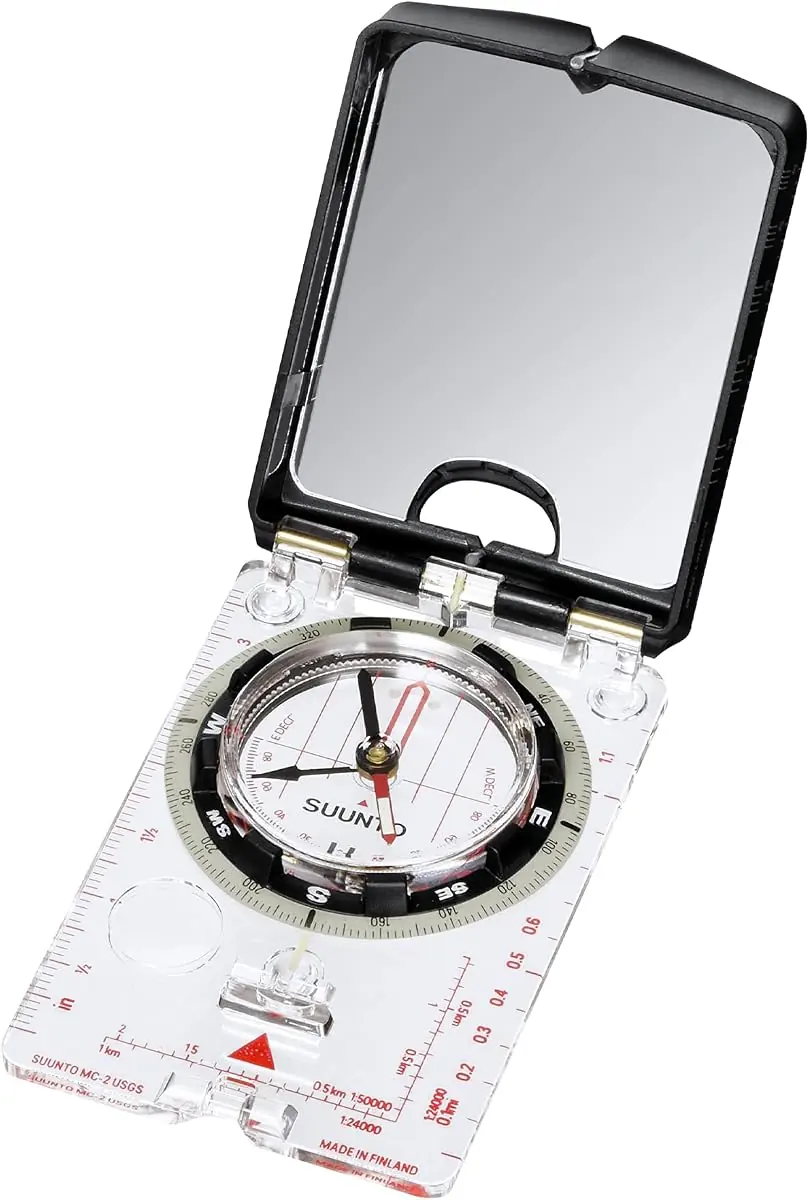
The MC-2 is the pick if you only want to buy one compass. It has everything the buying advice above asks for in a single 74-gram instrument: adjustable declination, a mirror with a sighting hole and notch, a built-in clinometer, a magnifier and luminous markings.This variant has a Northern Hemisphere needle and USGS scales, which match the 1:24,000 topo maps used in the US. Outdoor Life named it best overall in 2026 and noted that it can feel like a lot of tool for a beginner. If you travel south of the equator, Suunto sells a global-needle MC-2 G for more.
The Ranger 2.0 is the mirror compass to buy if you want what the MC-2 does and would rather spend less. It has a built-in declination adjuster, a mirror with a sighting hole, a magnifier and luminous markings that Silva says stay readable for up to four hours after a charge of light.Silva adds two things the MC-2 lacks: a rubber DryFlex grip on the bezel, and a lanyard printed with four map scales so you can lay it along a winding trail and read off the distance. Outdoor Life picked it as the best compass for hiking and noted it's a little heavier than the MC-2, with slope work done on a separate card.
The M-3 G is the baseplate compass I'd pick for anyone who doesn't need a mirror. At 48 grams it weighs about two-thirds of what the MC-2 does, and it keeps the features that matter most with a map: adjustable declination, a magnifier, luminous markings and scales in both metric and imperial.The G stands for global. The needle is balanced to work in both hemispheres, so the same compass goes to the Alps, the Andes or New Zealand. Suunto also builds a clinometer into this version. GearJunkie's top overall pick is the Northern Hemisphere M-3, its sibling with a single-zone needle.
Quick verdict: The MC-2 is the pick if you only want to buy one compass. It has everything the buying advice above asks for in a single 74-gram instrument: adjustable declination, a mirror with a sighting hole and notch, a built-in clinometer, a magnifier and luminous markings.
This variant has a Northern Hemisphere needle and USGS scales, which match the 1:24,000 topo maps used in the US. Outdoor Life named it best overall in 2026 and noted that it can feel like a lot of tool for a beginner. If you travel south of the equator, Suunto sells a global-needle MC-2 G for more.
Why It Stands Out
Adjustable declination set once with the included key
Mirror with sighting hole and notch for precise bearings
Built-in clinometer for slope angle
USGS scales that match 1:24,000 topo maps
Pros
Every tool a map-and-compass user needs in one unit
Made in Finland
Luminous markings for use in low light
Cons
Heavier and bulkier than any baseplate compass here
Northern Hemisphere needle only on this variant
More features than a casual trail hiker will use
Best Situations
Off-trail travel where you sight on a distant landmarkWinter trips where slope angle mattersLearning to navigate by map and compass
Quick verdict: The Ranger 2.0 is the mirror compass to buy if you want what the MC-2 does and would rather spend less. It has a built-in declination adjuster, a mirror with a sighting hole, a magnifier and luminous markings that Silva says stay readable for up to four hours after a charge of light.
Silva adds two things the MC-2 lacks: a rubber DryFlex grip on the bezel, and a lanyard printed with four map scales so you can lay it along a winding trail and read off the distance. Outdoor Life picked it as the best compass for hiking and noted it's a little heavier than the MC-2, with slope work done on a separate card.
Why It Stands Out
Built-in declination adjuster
Mirror sighting with a sighting hole
Scale lanyard measures distance along a curving trail
Rubber bezel grip for wet or cold hands
Pros
Costs less than the Suunto MC-2
Lanyard carries 1:24k, 1:25k, 1:50k and 1:62.5k scales
Slope card included for avalanche terrain
Cons
Slope card is a separate piece to keep track of
A little heavier than the MC-2, per Outdoor Life
Balanced for the northern magnetic zone only
Best Situations
Hikers who want a mirror compass on a tighter budgetMeasuring trail distance on a paper mapCold-weather trips with gloved hands
Quick verdict: The M-3 G is the baseplate compass I'd pick for anyone who doesn't need a mirror. At 48 grams it weighs about two-thirds of what the MC-2 does, and it keeps the features that matter most with a map: adjustable declination, a magnifier, luminous markings and scales in both metric and imperial.
The G stands for global. The needle is balanced to work in both hemispheres, so the same compass goes to the Alps, the Andes or New Zealand. Suunto also builds a clinometer into this version. GearJunkie's top overall pick is the Northern Hemisphere M-3, its sibling with a single-zone needle.
Why It Stands Out
Global needle works in both hemispheres
Adjustable declination on a 48-gram baseplate
Built-in clinometer
Magnifier and luminous markings for map work at dusk
Pros
Lighter than both mirror compasses
One compass for travel anywhere
Made in Finland
Cons
No mirror, so sighted bearings are less precise
No lid to protect the capsule in a pack
Costs more than simpler baseplate compasses
Best Situations
On-trail hiking with a paper mapInternational trekking in either hemisphereBackpackers counting grams
Quick verdict: The Explorer Pro is Silva's answer to the M-3: a clear baseplate compass with a built-in declination adjuster, a magnifier and luminous markings. It comes with the same extras as the Ranger 2.0, a slope card and a soft lanyard printed with four map scales for measuring distance along a route.
What it gives up against the Suunto is the global needle, so it's a compass for the northern magnetic zone. The rubber DryFlex bezel is meant to be easier to grip with wet or cold fingers than a bare plastic ring, and that's the main reason to choose it over the M-3 if you only hike in North America.
Why It Stands Out
Built-in declination adjuster
Rubber DryFlex grip on the bezel
Scale lanyard and slope card included
Luminous markings rated for up to four hours
Pros
Rubber grip for cold or wet hands
Lanyard measures distance on four map scales
Magnifier for fine map detail
Cons
Not a global needle
No mirror for sighting
Slope card is a loose piece
Best Situations
Day hikes and backpacking trips in North AmericaRainy or cold conditionsHikers who measure distances on paper maps
Quick verdict: The A-10 is the least expensive compass here that I'd call a real navigation tool. It's a liquid-filled baseplate compass with inch and centimeter scales, and it weighs 30 grams. Like the MC-2, it's made in Finland.
What you give up is convenience. The declination scale is fixed, so you add or subtract the local figure yourself on every bearing, and Suunto lists no magnifier or luminous markings on this model. Outdoor Life's tester also needed multiple tries with it. As a backup in the lid pocket for a hiker who navigates by GPS, it's the one to get.
Why It Stands Out
Weighs 30 grams
Liquid-filled baseplate compass
Inch and centimeter scales for map work
The cheapest map-capable compass on this page
Pros
Light enough to carry on every hike
Simple to learn on
Made in Finland
Cons
Fixed declination scale means doing the math yourself
No magnifier or luminous markings listed
No mirror or clinometer
Best Situations
A backup to a phone or GPS watchScouts and beginners learning the basicsMarked trails where you only orient the map
Quick verdict: The TruArc 5 is a plain baseplate compass with two features that usually cost more. Its global needle works in both hemispheres, and its declination adjusts by hand with no key or screwdriver to lose. It has a magnifier, a two-degree bezel and inch and millimeter scales, weighs about 45 grams, and is made in Riverton, Wyoming.
It sits below the Suunto and Silva baseplates because of the needle. Outdoor Life named it the best budget compass but reported that the needle sometimes sticks. Brunton doesn't list luminous markings either, so it's weaker at dusk.
Why It Stands Out
Global needle for both hemispheres
Declination adjusts without a tool
Two-degree bezel resolution
Made in the USA
Pros
No adjustment key to lose
Works anywhere in the world
Costs less than the Suunto M-3 G
Cons
Needle can stick, per Outdoor Life
No luminous markings listed
No clinometer or slope card
Best Situations
Travel to the Southern Hemisphere on a budgetHikers who want adjustable declination without a keyA second compass for a partner
Quick verdict: The 3H is a military-style lensatic compass, and it's built for a different job than the others here. You sight through a lens and a wire to read a bearing on a distant point, and Outdoor Life lists its accuracy as within 40 mils. Seven tritium micro lights light it without any charging, for more than twelve years according to the maker.
The listing gives an operating range of -50 to 150 degrees Fahrenheit and describes a rugged metal build. For hiking, that toughness costs you. There's no clear baseplate to lay on a map and no declination adjustment, and it's the most expensive compass on this page by a wide margin and bulky next to a baseplate.
Why It Stands Out
Tritium lighting needs no charging from a flashlight
Lens-and-wire sighting for precise bearings
Rugged metal body
Rated from -50 to 150 degrees Fahrenheit
Pros
Readable in full darkness for years
The most durable compass on this page
Comes with a belt pouch and lanyard
Cons
No baseplate or map scales for plotting on a topo
No declination adjustment
Most expensive compass here, and bulky next to a baseplate
Best Situations
Night navigation without a lightRough use where a plastic compass would crackPeople trained on military land navigation
Quick verdict: The Clipper is a thumbnail-size compass that clips to a pack strap, a watch band or the edge of a map. It weighs 5 grams, has luminous cardinal points and a rotating bezel marked every ten degrees. It answers one question quickly, which is whether the trail is still heading the way you think it is.
It's last on the list because it can't do map work. There's no baseplate, no scales and no way to take a bearing more precise than its ten-degree marks. Buyers also rate it lower than the full-size Suuntos. Carry it as a second compass or for trail running, and keep a baseplate in the pack.
Why It Stands Out
Weighs 5 grams
Clips to a strap so it's always in view
Luminous cardinal points
Rotating bezel to mark a heading
Pros
Hands-free direction checks while moving
Light enough to forget it's there
The least expensive compass on this page
Cons
Bezel is marked only every ten degrees
Can't take a bearing from a map
Lower buyer rating than the baseplate Suuntos
Best Situations
Trail running and fast day hikesA spare alongside a real baseplate compassConfirming direction at trail junctions
Do you need adjustable declination on a hiking compass?
Yes, if you plan to use the compass with a map. Declination is the angle between true north, which maps are drawn to, and magnetic north, which the needle points to. In the lower 48 it runs from roughly 15 degrees east in the Pacific Northwest to roughly 15 degrees west in northern Maine.
Every degree you get wrong puts you about 92 feet off course for each mile you walk, so ignoring a 14-degree declination means missing your target by about a quarter mile after one mile. An adjustable compass lets you dial the local figure in once with a small key or screw, and after that every bearing you take is already corrected.
A fixed declination scale, like the one on the Suunto A-10, leaves the adding and subtracting to you. It works, but it's the step people reverse. Declination also drifts over the years, so check the current value for your area with NOAA's online calculator instead of trusting an old map margin.
Should you get a mirror compass or a baseplate compass?
Get a baseplate compass if you mostly stay on trails and want to orient the map and check a direction now and then. Get a mirror compass if you travel off trail, above treeline or in terrain where you aim at a distant landmark and walk to it.
The mirror lets you see the dial and the landmark at the same time through a sighting notch, which generally holds a bearing more precisely than a baseplate sighted from your waist. The lid also protects the capsule in a pack, and the mirror works for signaling.
The cost is weight and bulk. The Suunto MC-2 weighs 74 grams against 48 for the M-3 G baseplate. If you won't sight on anything, you'd be carrying the mirror for nothing, and the baseplate does the map work just as well.
What is a global needle, and do you need one?
A global needle is built to swing freely anywhere on Earth. An ordinary needle is balanced for one magnetic zone, because the planet's field pulls the north end downward at a different angle as you move toward the poles. Take a Northern Hemisphere compass to Patagonia or New Zealand and the needle can tilt, drag on the capsule and stick.
If you only hike in North America, a Northern Hemisphere needle is all you need, and it's what most compasses sold here have. The Suunto M-3 G and the Brunton TruArc 5 on this page both have global needles.
Which extra features on a compass are worth paying for?
For most hikers it's a magnifier, luminous markings and a two-degree bezel. The magnifier helps you read contour lines and small print on a topo map. Luminous markings let you take a bearing at dusk without a headlamp washing out your night vision. A bezel marked every two degrees, as on the MC-2 and the TruArc 5, is fine enough for most hiking.
A clinometer measures slope angle. It matters if you travel in avalanche terrain, where avalanche centers say most slides start on slopes of about 30 to 45 degrees, and it's mostly unused otherwise. The MC-2 and M-3 G have one built in, and Silva supplies a slope card with the Ranger 2.0 and Explorer Pro.
Map scales printed on the plate only help if they match the maps you carry. USGS topo quads are 1:24,000, so look for that scale in the US. Metric scales such as 1:25,000 and 1:50,000 suit maps from most other countries.
Go off trail or above treeline
Sighting mirror
You'll be sighting on landmarks, so you want a mirror compass. The Suunto MC-2 has adjustable declination, a sighting notch, a clinometer and luminous markings, and it's the one Outdoor Life named best overall. The Silva Ranger 2.0 does nearly all of that for less, with a slope card standing in for some of the built-in tools.
Stay on trail with a paper map
Adjustable baseplate
A baseplate compass with adjustable declination covers it. The Suunto M-3 G weighs 48 grams, has a global needle and a clinometer, and does everything a map needs except sight on a far peak. If you'd rather have a rubber grip and a scale lanyard, look at the Silva Explorer Pro.
Want a backup for the GPS
30 grams, fixed scale
The Suunto A-10 weighs 30 grams and costs less than anything else here that can work with a map. It isn't a toy, either. It's a liquid-filled baseplate compass made in Finland, like the MC-2. You do the declination math yourself, which is fine for a compass that mostly rides in the lid pocket.
Full Catalog
Compare All 8 Hiking Compasses
Want to browse beyond the ranked picks? Filter and sort the full hiking compasses listing below.
For most hikers who want one compass to learn on and keep, the Suunto MC-2. It has adjustable declination, a sighting mirror, a clinometer, a magnifier and luminous markings, and it weighs 74 grams. If you never leave marked trails, the lighter Suunto M-3 G baseplate does the map work without the mirror.
Yes. The National Park Service's Ten Essentials list names navigation as map, compass and GPS, and tells you to bring a physical map as a backup. Electronics fail in ways a magnetized needle doesn't. Cold drains batteries, screens break, and tree cover or canyon walls can degrade a GPS fix.
A compass weighs an ounce or two and never needs charging, so there's not much reason to leave it at home. It can't call for help, though. A satellite messenger does that job, and I'd carry both on any trip out of cell range.
Declination is the angle between true north and magnetic north where you're standing. Maps are drawn to true north and the needle points to magnetic north, so a bearing taken from one has to be corrected before you use it with the other. A compass with adjustable declination applies that correction for you once you set it.
Many baseplate and mirror compasses have a bezel marked in two-degree steps, and a mirror and a steady hand let you hold a bearing close to that. Sighting from the waist without a mirror is coarser. Outdoor Life lists Cammenga's lensatic compass as accurate to within 40 mils, which is a little over two degrees.
Your own error matters more than the instrument's does. Hold the compass level and still, keep it well away from your phone, trekking poles and anything steel, and aim at a landmark instead of staring at the needle while you walk.
Yes, a compass can fail. A large bubble in the capsule means the liquid has leaked and the needle will swing badly; small bubbles that appear in the cold or at altitude usually disappear again. A needle can also have its polarity reversed by a strong magnet, and phone cases, speakers and magnetic clasps are the usual cause.
Check yours before a trip by comparing it against a direction you know, like a road you can find on the map. If the red end points south, the needle has been reversed and the compass needs replacing or remagnetizing.
For backpacking, where weight counts and you mostly follow trails, the Suunto M-3 G. It weighs 48 grams, has adjustable declination, a magnifier, luminous markings and a clinometer, and its global needle works on trips abroad. Choose the Suunto MC-2 instead if your routes go off trail and you need a sighting mirror.
It does one thing very well: sighting a precise bearing on a distant point. It's also close to indestructible. For map work it's worse than a baseplate compass, because it has no transparent plate, no map scales you can lay over a topo and no declination adjustment. It's also bulkier. Most hikers are better served by a mirror compass.
From Basecamp
Where this gear goes
Basecamp is the half of the site about hiking itself. These go deeper on what this guide is for.
Twelve one-page checklists, one for each trip and season, with our pick for each item. Leave your email and the PDF is yours, plus a short note when a new guide goes up.
How We Choose Products
How These Picks Are Chosen
Reader-supported and free of paid placements. Every pick is ranked on published specs and Amazon buyer ratings, not on who pays us.
Spec Research
Each pick is compared on published specs, materials, design, and category fit across the major brands.
Practical Fit
Rankings factor in how well each product matches common hiking, backpacking, and trail running needs, not just popularity.
Amazon Buyer Ratings
Star ratings and review volume from verified Amazon buyers are factored in to reflect real-world satisfaction.
Value
A pick earns its spot by delivering useful performance for the money, whether budget or premium.
THE COMPASS IS THE BACKUP. PICK THE PRIMARY TOO.
Most hikers follow a GPS track and keep the compass for when it fails. Our GPS watch guide covers which watches have real maps and enough battery for a long day.