Best Budget Trekking Poles of 2026 — hiking gear
Budget Trekking Pole Buying Guide

Best Budget Trekking Poles of 2026

Six pairs of trekking poles from $30 to $85, which is the shelf almost everyone starts on. The lock is the part that gives out first at this price, so that is what I ranked on, using published specs and thousands of Amazon reviews.

View Top PicksUpdated 2026-08-02 · Ranked from specs & buyer reviews
How to Choose

How to Choose Budget Trekking Poles

Poles earn their place on the way down. Going uphill they give you two extra points of contact and a bit of push. Going downhill they take a share of the load your knees would otherwise absorb one step at a time, which is why people who swore they'd never use poles tend to change their minds somewhere around mile eight of a steep descent. They also turn a sketchy stream crossing or a loose scree traverse into something you can walk rather than pick your way across.

Almost every pole sold today does the same job, so the differences that matter are boring and mechanical. The big one is how the pole locks at length, and whether that lock still holds once it's wet and full of grit. After that it's the grip material, which decides whether your hands are still happy at hour five. Then the shaft. Aluminum bends before it breaks, while carbon is lighter but gives up without much warning if you wedge it in rocks and lean. Get those three right and you can ignore most of what else is on the listing.

One thing up front, because the title says budget and means it. Everything on this page is under $85, which is where most people should start and where a lot of people happily stay for good. It is not where the best poles in the world live. Those are the $150 to $200 sets from Black Diamond, Leki and MSR, and the money does buy something real: carbon that's light and stiff instead of one or the other, cork grips that keep their shape for years, locks machined tight enough that you never go looking for a screwdriver, and a brand that'll sell you a replacement basket in four years instead of a whole new pair. If you're out fifty days a year, that adds up. If you're out ten, nothing below is going to be the thing holding you back.

So the ranking below is these six against each other, not against poles that cost three times as much. It comes from published specs, the design choices each brand made, and what Amazon buyers report after living with these poles. I haven't walked a thousand miles on all six pairs, and I'm not going to pretend otherwise. Every star rating, review count and price was read off the listing on 2 August 2026, and every set was in stock that day. Poles go on deal constantly, so check the current price before you buy. All six are sold as a pair.

The Anatomy

What You're Actually Buying

A pair of trekking poles comes down to six parts, and the cheap sets and the expensive sets really only differ in two of them. The rest is much the same everywhere, so here's what each piece does.

The lock mechanism

Essential

The part to care about most. External lever clamps flip open and shut with one hand, work fine in gloves, and take a screwdriver when they start slipping. Internal twist locks cost less and fail worse. Grit gets in, they seize or slide, and there's not much you can do about either one on the trail.

The grip and the extended lower grip

Essential

Cork, EVA foam or rubber. Cork handles sweat best and molds to your hand over time. Foam is softer and cheaper. Rubber is a cold-weather grip that blisters people in summer. Look for a strip of grip material continuing several inches below the handle, so you can slide your hand down on a steep pitch without stopping to shorten the pole.

The shaft

Essential

Aluminum or carbon fiber. Aluminum, usually 6061 or the stronger 7075 alloy, bends under a sideways load and can often be bent back. Carbon is lighter and soaks up more vibration, but it can crack or split when it's levered against rock. Most poles telescope into three sections. Folding poles break into three linked segments instead.

The wrist straps

Essential

These do more work than they look like they do. Used properly, the strap carries most of the load through your palm so you can hold the grip loosely, and that's what keeps your forearms from cramping after six hours. Padded or lined straps are worth having if you hike in short sleeves.

Tips and baskets

Nice to Have

Tungsten carbide tips bite rock and packed dirt and last for years. Small trekking baskets stop the tip sinking into soft ground, and wide snow baskets swap in for winter. Rubber tip covers go on for pavement, where bare metal skids and rattles, and for the trails and historic sites that ask you to cover the tips.

The carry bag

Nice to Have

Nearly every set includes one, and it's genuinely useful for keeping the tips from shredding the inside of a pack or a suitcase. It shouldn't sway which pair you buy, though.

The Formats

Which Style of Pole Suits You

Poles come in three shapes, and the choice is mostly about how you carry them when you're not using them.

Telescoping poles

$30-$60Almost everyone

Two or three sections that slide inside each other and clamp at any length. Widest adjustment range, simplest mechanism, and the easiest to fix when something wears out. They collapse to about 24 inches, which rides fine alongside a day pack but sticks out of a small one. Unless you have a specific reason to go elsewhere, buy these.

Folding Z-poles

$40-$90Travel and small packs

Three segments joined by an internal cord that snap together like a tent pole, with one short telescoping section on top for fine adjustment. They pack down to roughly 15 inches, so they disappear into a suitcase or strap flat to a running vest. The trade is a narrower adjustment range and more parts to eventually wear out.

Fixed-length poles

$50-$150Runners and gram counters

Nothing to adjust and nothing to slip, which makes them the lightest option by a clear margin. Great if you already know your exact length and always hike alone. Bad at everything else: you can't share them, they're awkward to pack, and you can't shorten them for a climb. Buy these as a second pair, not a first one.

Quick Picks

Top Three at a Glance

Short on time? Start with these top-rated budget trekking poles picks.

Best Overall
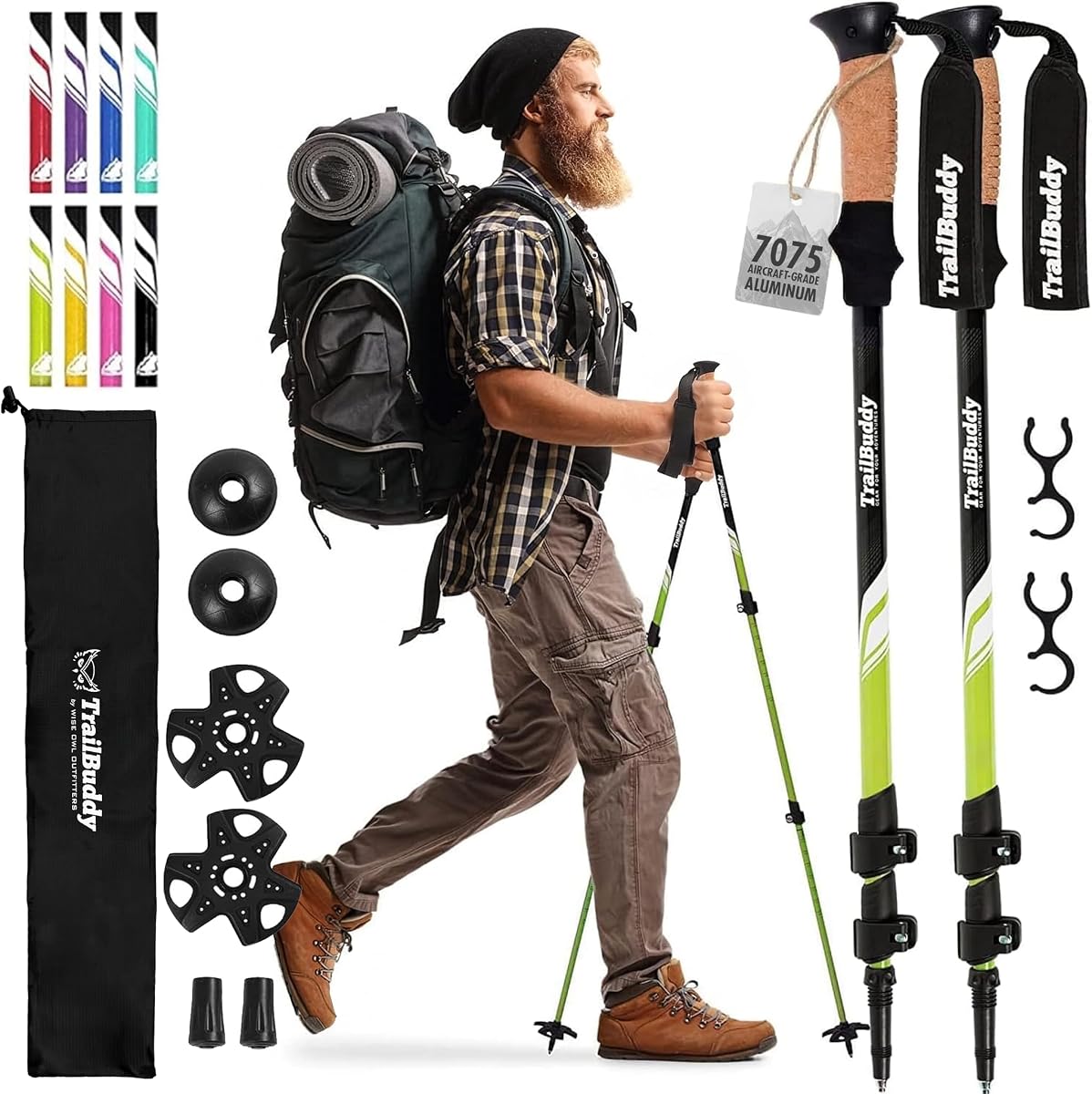
TrailBuddy Trekking Poles
4.7

TrailBuddy Trekking Poles

The default answer under $50. You get 7075 aluminum, cork grips and lever locks for around forty dollars, which is a spec sheet that normally costs more, and 63,741 Amazon ratings averaging 4.7 stars is a deep enough record to be confident the good ones aren't flukes. Volume of reviews is not the same as being the best pole made, and a $150-plus Black Diamond pair will still outlast these. It's just very hard to spend forty dollars better.

Check Price
Highest Rated
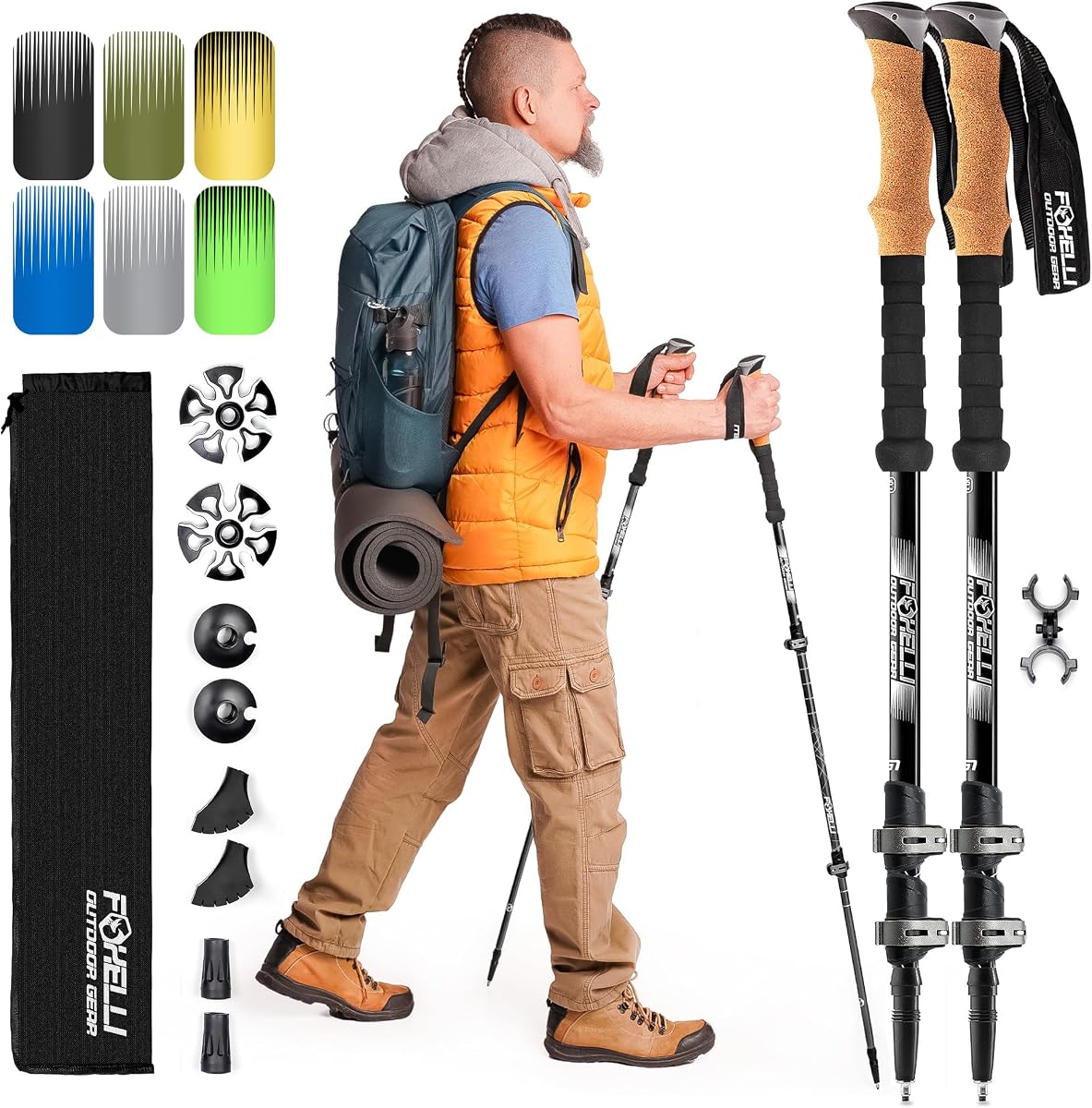
Foxelli Trekking Poles
4.8

Foxelli Trekking Poles

A 4.8-star average across 4,821 ratings is the best score in this guide, and the spec is near-identical to the TrailBuddy set: aluminum shafts, cork grips, quick flip locks, for about two dollars more. If the TrailBuddy color you want is out of stock, buy this instead and don't think about it any harder.

Check Price
Best Lightweight
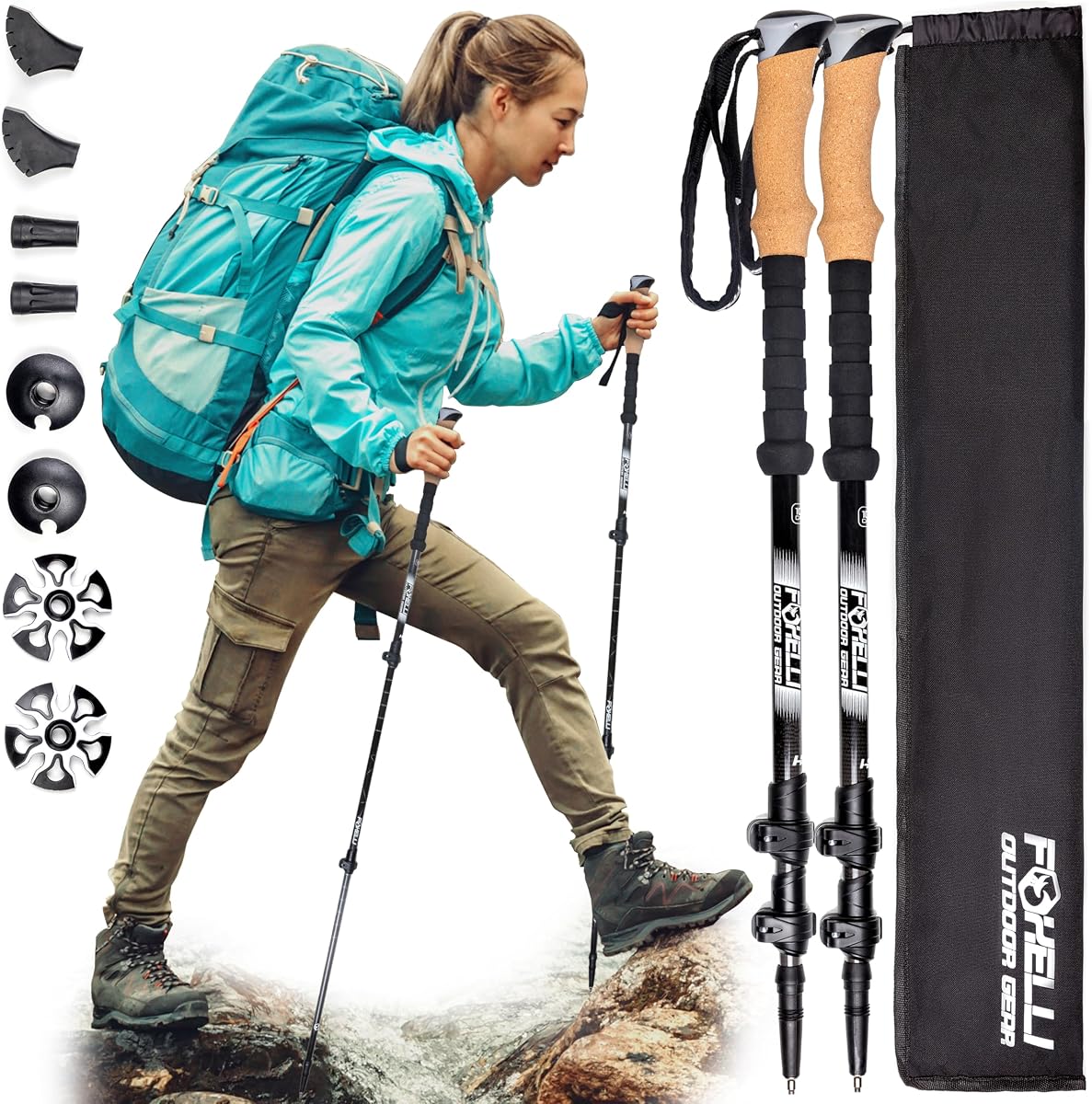
Foxelli Carbon Fiber Trekking Poles
4.7

Foxelli Carbon Fiber Trekking Poles

The lightweight pick, at 7.6 oz per pole and 4.7 stars from 8,427 ratings, which is a serious review base for a carbon pole at sixty dollars. Carbon soaks up the buzz that comes back up the shaft on rocky ground, and that's the part people with sore wrists actually notice.

Check Price
Comparison Table

Every Pick, Side by Side

Best Overall
Best For
A first pair that most people never need to replace
Difficulty
Beginner
Price
$$$
Highest Rated
Best For
The highest buyer rating on the page
Difficulty
Beginner
Price
$$$
Best Lightweight
Best For
Saving weight without gambling on an unknown brand
Difficulty
Intermediate
Price
$$$
Recommended #4
Best For
The cheapest pair worth owning
Difficulty
Beginner
Price
$$$
Recommended #5
Best For
Packing small for travel
Difficulty
Beginner
Price
$$$
Recommended #6
Best For
Buying once from a brand that stocks spare parts
Difficulty
Intermediate
Price
$$$
The Lineup

6 Best Budget Trekking Poles, Compared

Detailed picks with verdicts, strengths, tradeoffs, and the situations where each one makes the most sense.

Best Overall
TrailBuddy Trekking Poles
4.7 (63,741 Amazon ratings)

TrailBuddy Trekking Poles

Quick verdict: The default answer under $50. You get 7075 aluminum, cork grips and lever locks for around forty dollars, which is a spec sheet that normally costs more, and 63,741 Amazon ratings averaging 4.7 stars is a deep enough record to be confident the good ones aren't flukes. Volume of reviews is not the same as being the best pole made, and a $150-plus Black Diamond pair will still outlast these. It's just very hard to spend forty dollars better.

Why It Stands Out

  • 63,741 ratings at 4.7 stars, far and away the biggest evidence base here
  • 7075 aluminum, the stronger alloy, rather than the more common 6061
  • Cork grips and one-handed lever locks at a price where most poles have foam and twist locks
  • Adjusts 24.5 to 54 inches, so one pair covers most of a household

Pros

  • Enormous, consistent review history rather than a handful of ratings
  • Cork grips handle sweat far better than the foam usual at this price
  • Comes with mud baskets, snow baskets, rubber tips and a carry bag

Cons

  • 9.7 oz per pole is middling, and the carbon set here is lighter
  • Sold at a discount so often that the list price is close to meaningless

Best Situations

Day hikesBackpackingBalance supportShared household pair
Difficulty
Beginner
Price Range
$$$
Highest Rated
Foxelli Trekking Poles
4.8 (4,821 Amazon ratings)

Foxelli Trekking Poles

Quick verdict: A 4.8-star average across 4,821 ratings is the best score in this guide, and the spec is near-identical to the TrailBuddy set: aluminum shafts, cork grips, quick flip locks, for about two dollars more. If the TrailBuddy color you want is out of stock, buy this instead and don't think about it any harder.

Why It Stands Out

  • 4.8 stars from 4,821 ratings, the highest average here
  • Cork grips with an extended lower section for choking up on climbs
  • External flip locks, adjustable and serviceable in the field
  • Ships with the full accessory set of baskets and rubber tips

Pros

  • The strongest satisfaction score in this guide
  • Aluminum shafts that bend rather than snap on rocky ground
  • Priced within a few dollars of the budget picks

Cons

  • About a thirteenth of the TrailBuddy set's review base, though 4,821 ratings is still a deep sample
  • Aluminum, so no weight saving over the cheaper aluminum pairs here

Best Situations

Day hikesBackpackingWet weatherSweaty hands
Difficulty
Beginner
Price Range
$$$
Best Lightweight
Foxelli Carbon Fiber Trekking Poles
4.7 (8,427 Amazon ratings)

Foxelli Carbon Fiber Trekking Poles

Quick verdict: The lightweight pick, at 7.6 oz per pole and 4.7 stars from 8,427 ratings, which is a serious review base for a carbon pole at sixty dollars. Carbon soaks up the buzz that comes back up the shaft on rocky ground, and that's the part people with sore wrists actually notice.

Why It Stands Out

  • 7.6 oz per pole, lighter than the aluminum sets here with a stated weight
  • 8,427 ratings at 4.7 stars, unusually deep evidence for a carbon pole this cheap
  • Carbon shafts soak up noticeably more trail vibration than aluminum
  • Cork grips and quick flip locks, the same sensible hardware as the aluminum sets

Pros

  • Genuinely lighter in the hand over a long day
  • Adjusts 24 to 54 inches despite the carbon build
  • Cheaper than most carbon poles from the big outdoor brands

Cons

  • Carbon can split rather than bend if you lever it against rock
  • Half again the price of the aluminum pairs for a few ounces

Best Situations

Long day hikesThru-hikingFast and lightSore wrists
Difficulty
Intermediate
Price Range
$$$
Recommended #4
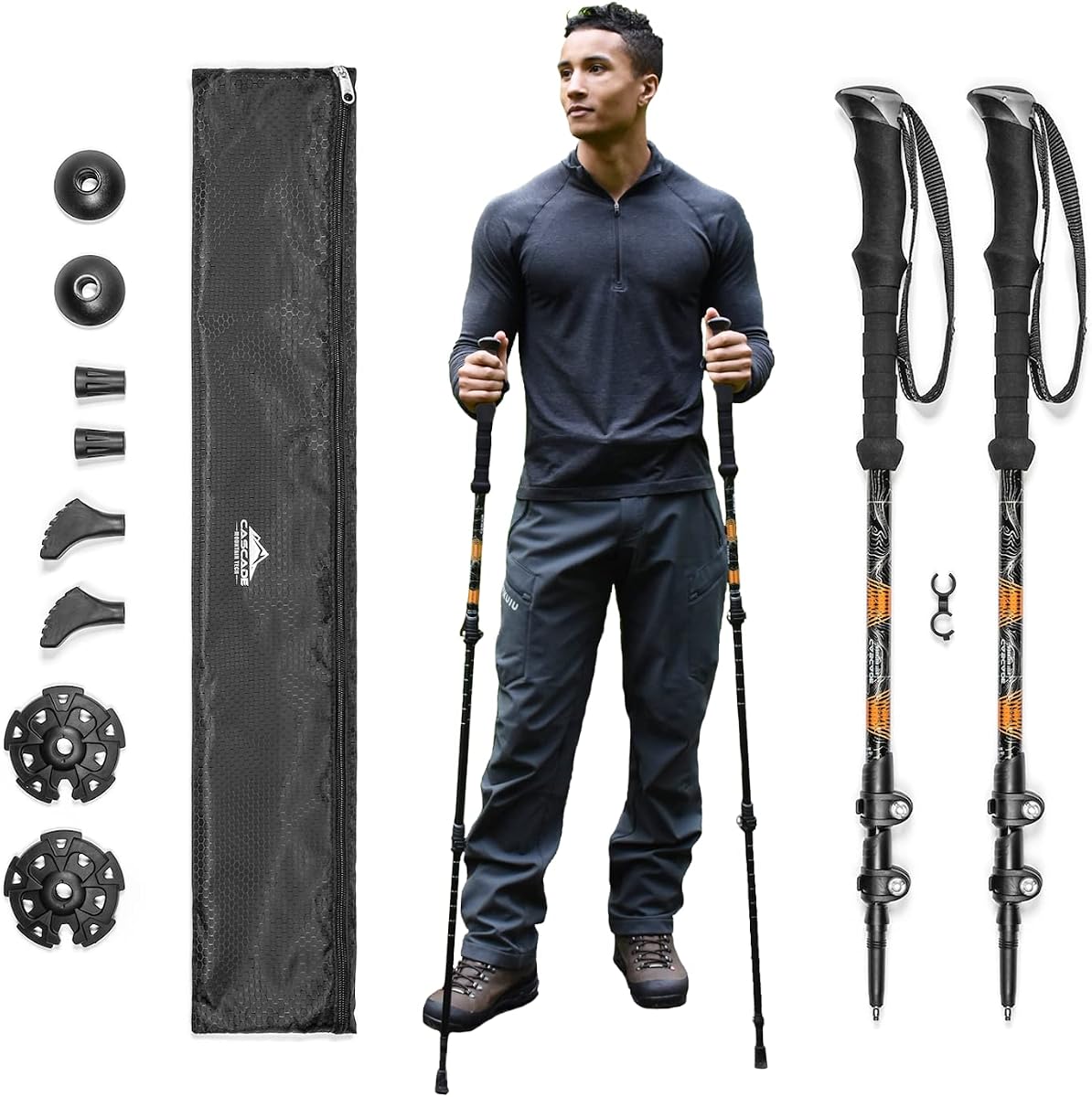
Cascade Mountain Tech Aluminum Trekking Poles
4.6 (5,180 Amazon ratings)

Cascade Mountain Tech Aluminum Trekking Poles

Quick verdict: Thirty dollars for a pair of aluminum poles with quick locks, a full tip kit and 5,180 ratings at 4.6 stars. Nothing here is special, and that's the point. If you're not sure you'll even use poles, this is how you find out without spending real money.

Why It Stands Out

  • $29.99 for the pair, the lowest price in this guide
  • 5,180 ratings at 4.6 stars, so the low price isn't hiding a quality problem
  • 6061 aluminum with an extended EVA down grip
  • Quick lock levers rather than the twist locks usual at this price

Pros

  • Cheap enough that losing or bending one isn't a disaster
  • Extended lower grip is unusually long, which helps on steep pitches
  • Disassembles into three short sections for packing

Cons

  • 10.4 oz per pole, heavier than the carbon set here
  • This listing is the EVA foam grip version, not cork, so hot hands may slip

Best Situations

First-time usersLocal trailsLoaner pairTight budgets
Difficulty
Beginner
Price Range
$$$
Recommended #5
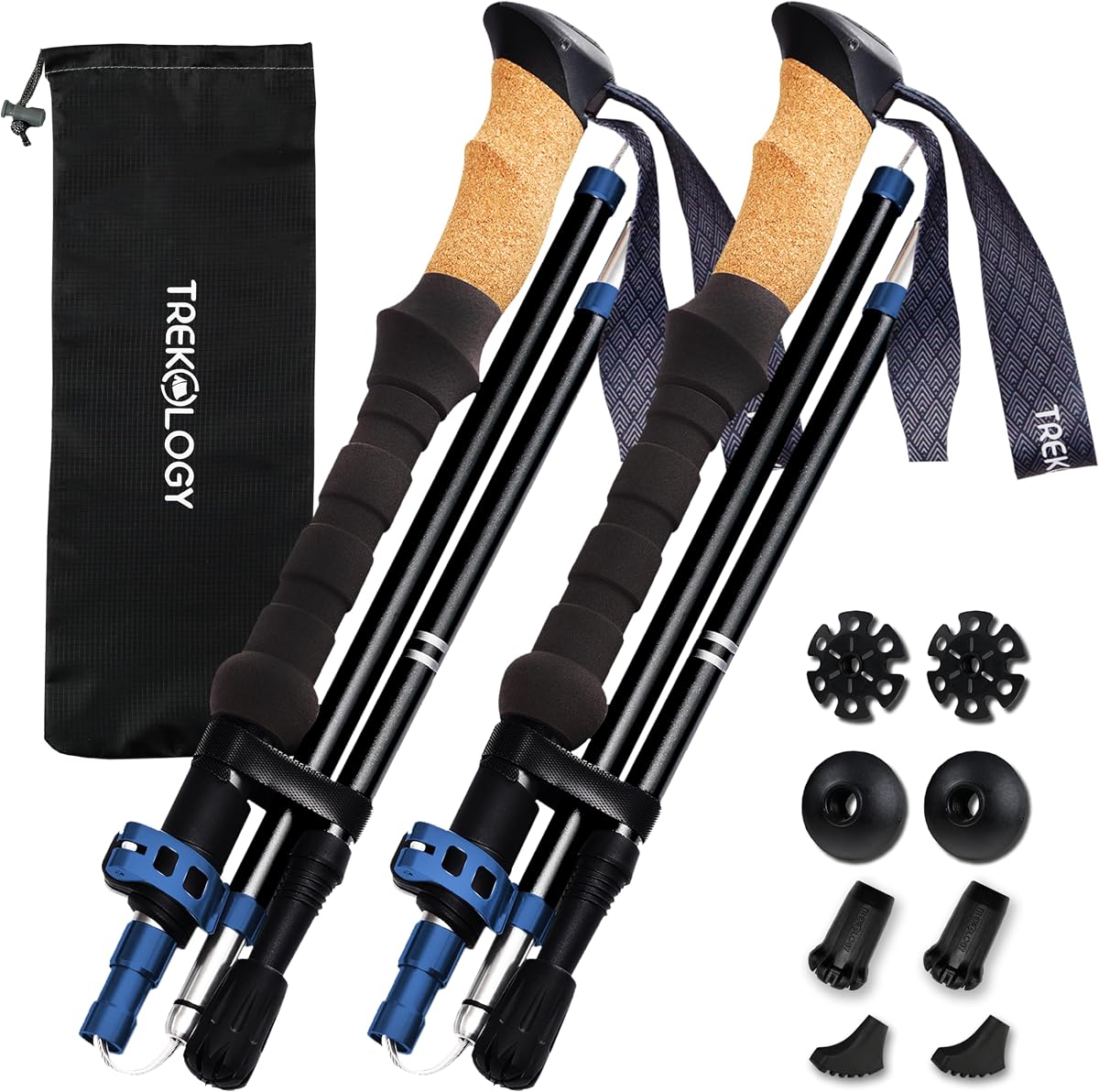
Trekology Trek-Z Cork Grip Trekking Poles
4.4 (7,417 Amazon ratings)

Trekology Trek-Z Cork Grip Trekking Poles

Quick verdict: The folding option. These break into three linked segments and pack to roughly 15 inches instead of the 24-plus a telescoping pole needs, and that difference is what gets them into a suitcase. 7,417 ratings at 4.4 stars, one of the lower averages in this guide but still a solid one.

Why It Stands Out

  • Folds to about 15 inches, far shorter than any telescoping pair here
  • 7,417 ratings, a large evidence base for a folding pole
  • Cork grips rather than the foam usual on budget folding poles
  • Metal flip locks on the adjustable upper section

Pros

  • Genuinely packable, and disappears into checked luggage or a pack lid
  • Fast to deploy once you've done it twice
  • Cork grips at a folding-pole price

Cons

  • 4.4 stars is lower than every pick here except the Black Diamond pair
  • Folding poles adjust across a narrower range and have more parts to wear out

Best Situations

Air travelSmall day packsSnowshoeingOccasional use
Difficulty
Beginner
Price Range
$$$
Recommended #6
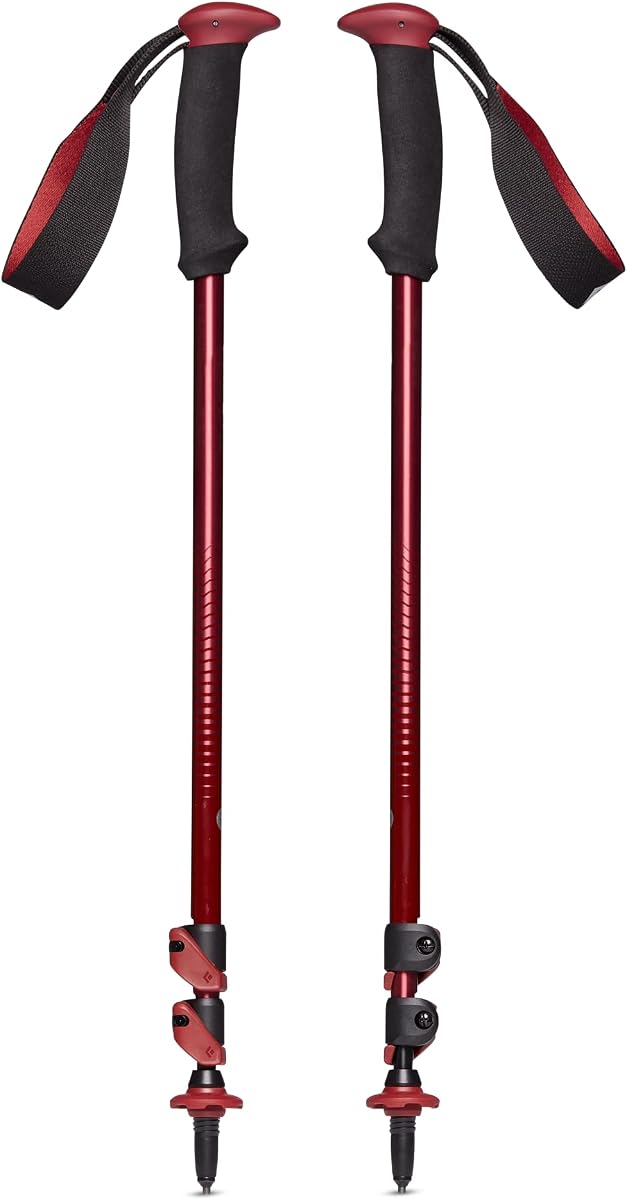
Black Diamond Trail Back Trekking Poles
4.3 (175 Amazon ratings)

Black Diamond Trail Back Trekking Poles

Quick verdict: The only pick here from a dedicated mountain-hardware brand, with Black Diamond's FlickLock clamps and a real parts and repair pipeline behind them. Worth being clear about what this is: the Trail Back is Black Diamond's entry-level pole, not the Alpine Carbon Cork, which sits up in the brand's $150-to-$200 tier. You pay roughly double the TrailBuddy price for the brand's hardware and warranty, and the Amazon evidence is thin: 175 ratings at 4.3 stars, the smallest sample on this page.

Why It Stands Out

  • FlickLock clamps, the design most of the budget lever locks are imitating
  • Aluminum shafts with carbide tips rated for dirt, rock and mixed ground
  • Replacement parts and grips are actually available from the brand
  • Foam grips with adjustable moisture-wicking straps

Pros

  • Built to be serviced rather than replaced when one part wears out
  • Hardware quality is a visible step up from the budget clamps
  • Backed by an outdoor brand's warranty process rather than a marketplace seller's

Cons

  • 175 ratings at 4.3 stars, the thinnest and lowest-rated evidence base here
  • Roughly twice the price of poles with a very similar spec sheet
  • Foam grips rather than cork at this price

Best Situations

Frequent hikingLong-term ownershipRocky terrainWinter use
Difficulty
Intermediate
Price Range
$$$
Buying Guide

What to Check Before You Buy

Lever locks are the one thing to be fussy about

An external lever clamp is the little flip tab you can see on the shaft. You can open and shut it one-handed, you can do it wearing gloves, and you can tell at a glance whether it's closed. When it finally starts to slip, one small screw brings it back. Twist locks hide the mechanism inside the shaft where grit gets into it, and then they either seize solid or slide down under your weight partway through a descent. Every pair in this guide uses lever locks, which is most of the reason they're here.

Trekking pole length: elbow at a right angle on the flat

Stand on level ground, hold the grip, and set the pole so your forearm is parallel to the ground and your elbow sits at about 90 degrees. That's your baseline. Most adults land somewhere between 110 and 130 cm. Then stop treating that number as fixed. Shorten the poles a little for a sustained climb so you aren't reaching up for them, and let them back out for a long descent so you can plant ahead without stooping. Poles that adjust across a wide range are more forgiving if you're between sizes or sharing them.

Aluminum bends, carbon snaps

Carbon shafts save roughly two to four ounces per pole and take a lot of the buzz out of rocky ground. What you give up is the failure mode. Aluminum takes a sideways hit, bends, and usually still walks you out. Carbon takes the same hit and can split. So if you hike rocky trails or fly with your poles in checked luggage, aluminum is the sane default. Carbon earns its money when you're covering fast miles on smoother trail, or if your wrists feel every step.

Cork grips if your hands sweat, foam if they don't

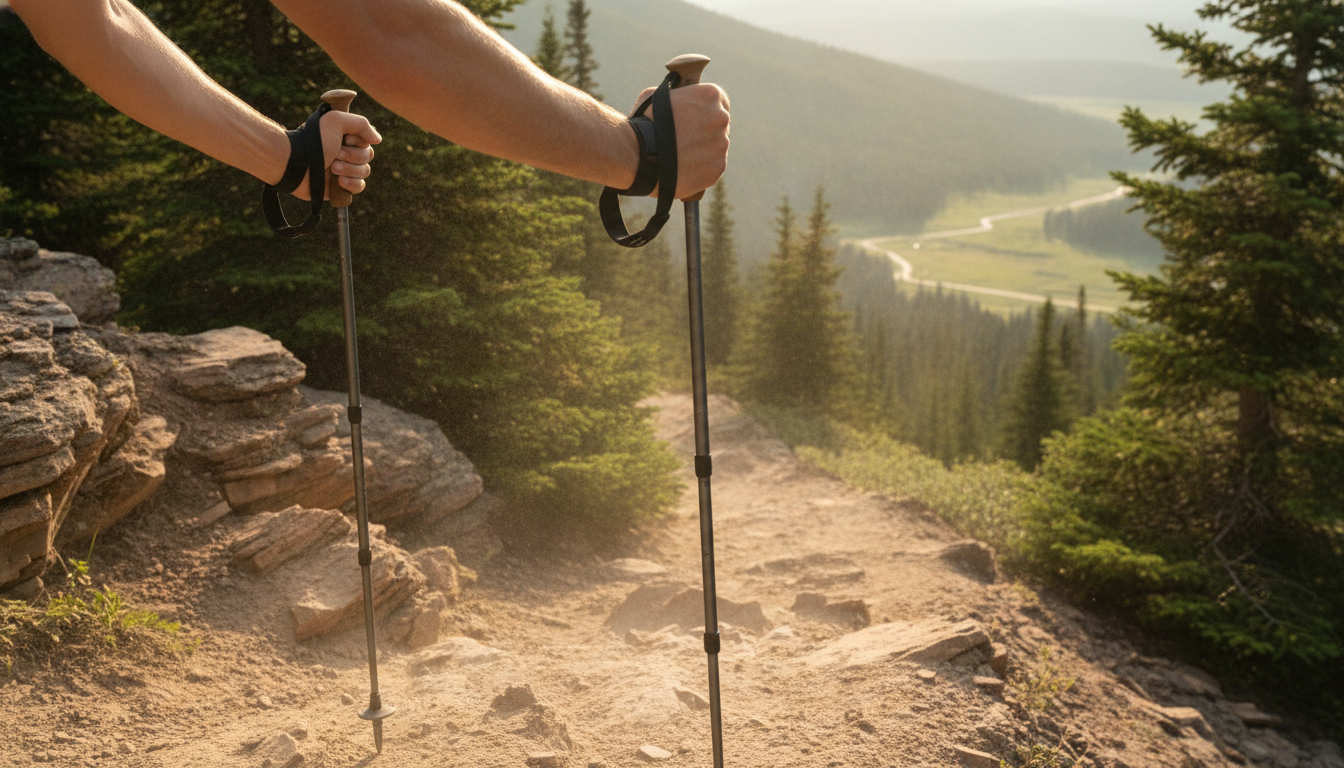
Cork soaks up moisture and molds to your hand over a season, so it stays grippy when your palms are wet. EVA foam feels softer out of the box and costs less, but it can turn slick in heat. Rubber is for cold weather and pavement, and it blisters people in summer. Whatever the material, look for grip that continues a few inches below the handle so you can choke down on a steep pitch without stopping to shorten the pole. And use the straps properly: hand up through the loop, then down onto the grip, so the strap carries your weight instead of your fingers.

Local Trails & Dog Walks
$30-$45

A couple of hours, moderate ground, mostly about balance and knees. An adjustable aluminum pair with lever locks does everything you need, and losing one hurts a lot less at this price.

All-Day Hikes & Backpacking
$40-$60

Long descents under a loaded pack. This is where cork grips and a shaft you trust start paying for themselves, and where almost everyone should be shopping.

Fast, Light & Travel
$60-$85

Carbon shafts or folding Z-poles that pack to about 15 inches, short enough to bury in a checked bag or slide under a pack lid. Lighter in the hand, and out of the way when you don't want them. This is the top of what this page covers; spend past it and you're into the $150-plus poles instead.

Getting Started

Your First Walk With Poles

Poles feel ridiculous for about twenty minutes and then feel obvious. Ten minutes of setup at the trailhead saves you most of the fumbling.

  1. 1

    Set the length before you start walking

    Stand on flat ground with the tip down and adjust until your elbow sits at about 90 degrees with your forearm level. If the pole has markings, note the number so you can get straight back to it. Split the adjustment across both sections rather than running one section out to its limit.

  2. 2

    Check the locks properly

    Close each lever, then plant the pole and lean your weight onto the grip. If the section slides at all, open the lever and tighten the small screw on the clamp a quarter turn, then test again. Do this once at the start rather than discovering it halfway down a wet descent.

  3. 3

    Put your hands through the straps the right way

    Bring your hand up through the loop from below, then down onto the grip so the strap crosses your palm. Pull it snug. Now your fingers can stay relaxed and the strap takes the load, which is what the strap is for.

  4. 4

    Walk normally and let the rhythm sort itself out

    Left pole with right foot, right pole with left foot, exactly as your arms already swing. Don't reach forward or plant hard. On flat ground the poles are barely doing anything, and that's fine.

  5. 5

    Change length for sustained climbs and descents

    Shorten both poles by about 5 to 10 cm for a long climb so you aren't lifting your hands, and lengthen them by a similar amount for a long descent so you can plant ahead without stooping. For short rolling ground, leave them alone and just choke down on the lower grip.

  6. 6

    Swap the tips to suit the ground

    Bare carbide handles dirt, rock and mud. Put the rubber covers on for pavement, boardwalk and slickrock, where bare metal skates around and makes a racket, and swap to the wide baskets for snow or soft sand. Keep the spares in the carry bag so they're actually with you.

Plain English

The Words On The Listing

Lever lock / flick lock
An external clamp on the outside of the shaft that flips open to adjust and shut to hold. You can work it with one hand, in gloves, and tighten it with a small screw when it starts to slip. This is the mechanism you want.
Twist lock
An internal expander that grips the inside of the shaft when you twist the sections against each other. Cheap to make, impossible to inspect, and prone to slipping once dirt gets into it.
Z-pole
A folding pole whose three segments are threaded on an internal cord and snap together end to end, like a tent pole. Packs to about 15 inches.
Carbide tip
The hard tungsten carbide point at the bottom of the pole. It bites into rock and frozen ground and wears down very slowly.
Basket
The small disc just above the tip that stops the pole sinking. Narrow trekking baskets for dirt and mud, wide snow baskets for powder.
Choke-up grip
The strip of foam or cork extending below the main handle, so you can slide your hand down for a short steep section instead of readjusting the pole.
Anti-shock
An internal spring that absorbs some impact on each plant. It adds weight and a slightly vague feel at the tip, and it's easy to live without.
7075 aluminum
A stronger aluminum alloy than the more common 6061. It lets a maker use thinner, lighter walls at the same strength, which is why it gets called out in the listing text.
Avoid These

Mistakes Worth Skipping

  • Buying twist-lock poles to save a few dollars. They're the part that fails, and they fail while you're leaning on them.
  • Setting the poles once and never touching them again. Shortening for climbs and lengthening for descents is most of the benefit.
  • Dropping your hand straight down through the wrist strap, then gripping hard for six hours because the strap isn't supporting anything.
  • Choosing carbon for rocky terrain because it's lighter. Aluminum bends and walks out; carbon can split when you lever it against a rock.
  • Running one section all the way out to its stop instead of splitting the length between both sections, which puts all the stress on one clamp.
  • Planting the poles way out in front and hauling on them. They work best planted near your feet, taking a share of the load rather than pulling you along.
  • Leaving the rubber tip covers at home. Bare carbide skids on wet rock and boardwalk, and plenty of popular trails ask you to cover the tips.
  • Packing them in a carry-on. TSA rules put trekking poles in checked baggage, so security will make you check them or leave them behind.
Explore Individual Gear

Once you know which setup fits your situation, dig into the full guide library for in-depth picks and buying advice:

Full Catalog

Compare All 6 Budget Trekking Poles

Want to browse beyond the ranked picks? Filter and sort the full budget trekking poles listing below.

Best Budget Trekking Poles of 2026 — All Products

6 Products
FAQ

Frequently Asked Questions

Two, for hiking. A single pole leaves you lopsided and loads one side of your body more than the other, which you'll feel in a hip or a shoulder by the end of a long day. Every set in this guide is sold as a pair. One pole is fine if you just want light support on flat ground, or if you need a hand free for a camera or a dog leash.

How We Choose Products

How These Picks Are Chosen

Reader-supported and free of paid placements. Every pick is ranked on published specs and Amazon buyer ratings, not on who pays us.

Spec Research

Each pick is compared on published specs, materials, design, and category fit across the major brands.

Practical Fit

Rankings factor in how well each product matches common hiking, backpacking, and trail running needs, not just popularity.

Amazon Buyer Ratings

Star ratings and review volume from verified Amazon buyers are factored in to reflect real-world satisfaction.

Value

A pick earns its spot by delivering useful performance for the money, whether budget or premium.

POLES SORTED.
WHAT'S LEFT?

Boots and day packs are already up, and water filters and socks are next. New guides go live as I finish them.

Browse All Guides
See Top Picks